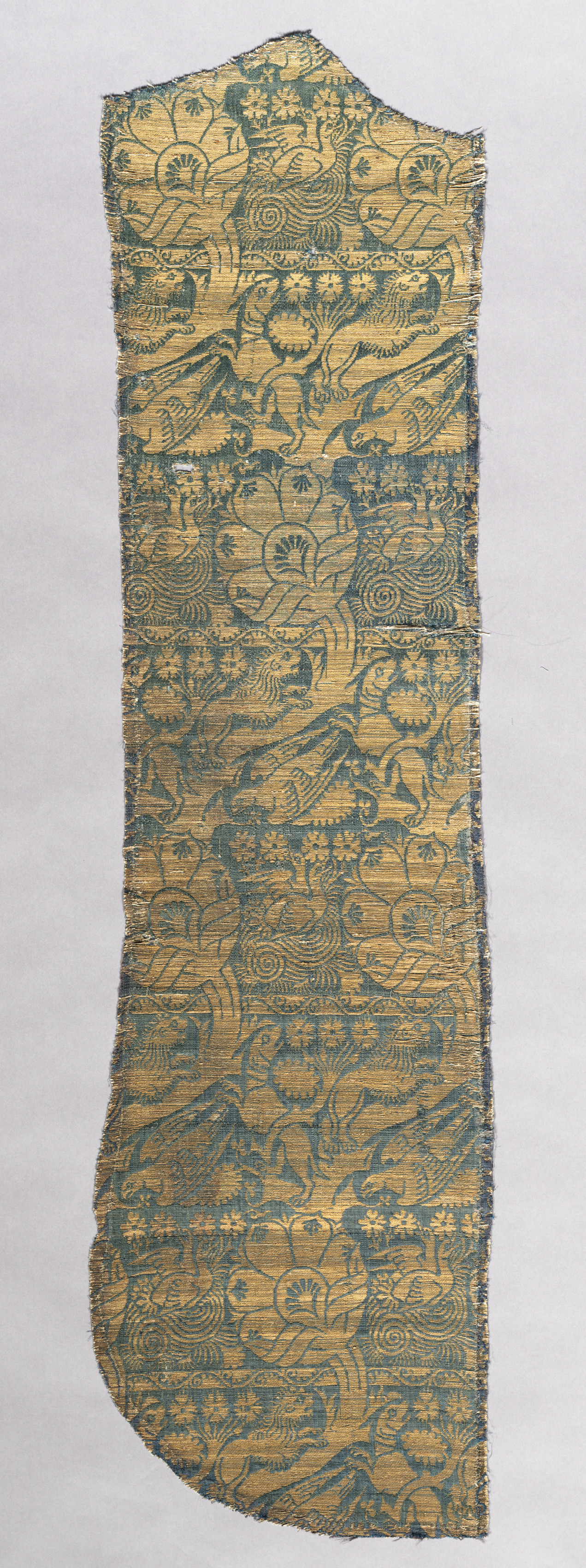
Deconstructing the Zoey Fashion Lab Archive: The Chasuble Fragment with Realistic Animals
As the Chief Fabric Deconstructionist for Zoey Fashion Lab, it is my duty to dissect not merely the physical threads of a textile, but the very narrative it encodes. The subject of this analysis—a sixteenth- to seventeenth-century Italian chasuble fragment featuring realistic animals, executed in silk and gold thread via the complex lampas weave—presents a profound paradox. It is a relic of sacred ritual, yet its visual language is one of worldly observation and naturalistic power. This fragment, resonating with the archival premise that objects are “silent witnesses” to cultural collision and aesthetic fusion, offers a critical foundation for an avant-garde reinterpretation. Our task is to extract its structural DNA and mutate it into a statement that defies both time and tradition.
I. Technical Mastery: The Anatomy of the Lampas Weave
The technical foundation of this fragment is its weave structure. Lampas is a compound weave, a sophisticated technique that was a hallmark of high-status Italian textile production during the Renaissance and early Baroque periods. Unlike simpler weaves, lampas involves multiple warp and weft systems that interlace to create a pattern on a ground fabric. In this fragment, we see a primary structure—likely a satin or twill ground—upon which a secondary, binding warp and a supplementary weft of gold thread (typically a silk core wrapped in gilded silver or gold strip) create the figural design.
The use of silk provides a luminous, fluid base, while the gold thread introduces a reflective, almost sculptural dimension. The realistic animals—perhaps a lion, a deer, or a mythical hybrid rendered with anatomical precision—are not merely printed or embroidered; they are woven into the very fabric. This integration of image and structure is key. The gold thread, often left floating on the reverse to create a rich, three-dimensional effect on the face, demands a specific tension and handling. For the avant-garde designer, this technical complexity is a challenge: how to replicate or subvert this interlocking of material and image in a modern context? We must consider using laser-cut metallic laminates bonded to deconstructed silk organza, or even digital jacquard weaving that can mimic the historical precision while introducing glitch-art distortions.
II. Iconographic Dissection: Realism as a Sacred Tool
The “realistic animals” on this chasuble fragment are not mere decoration. In the context of a liturgical garment, they serve a dual purpose. First, they are symbols rooted in Christian iconography: the lion can represent Christ (the Lion of Judah) or Saint Mark; the deer symbolizes the soul thirsting for God (Psalm 42); the griffin or other hybrids embody the dual nature of Christ. Second, and more critically for our deconstruction, the realism itself is a product of the Renaissance humanist shift. These animals are not stylized Byzantine forms; they are observed from nature, reflecting a growing interest in empirical science and the natural world that was sweeping through Italy.
This is where the “cultural collision” referenced in the Archive Resonance becomes tangible. The chasuble is a vessel for the divine, yet it is decorated with creatures that could have been sketched from a menagerie or a natural history manuscript. The sacred space is invaded by the secular eye. For Zoey Fashion Lab, this tension is a goldmine. The avant-garde designer must ask: What happens when we place hyper-realistic, almost scientific depictions of animals onto a garment that is meant to transcend the physical? We can push this further by using photorealistic digital prints of endangered species onto deconstructed silk, or by embedding micro-sensors that cause the animal motifs to shift or pulse with light, creating a living, breathing iconography that challenges the static nature of historical textiles.
III. The Avant-Garde Imperative: Deconstruction and Recontextualization
The avant-garde style demands rupture, not reverence. Our deconstruction of this chasuble fragment cannot simply be a reproduction. It must be a violent reinterpretation that honors the original’s complexity while shattering its context. Here is the Zoey Fashion Lab methodology for this piece:
- Structural Fragmentation: The lampas weave’s multi-layered system can be physically deconstructed. We will cut the fragment into strips, revealing the floating gold threads on the reverse. These strips will be reassembled into a new silhouette—perhaps a deconstructed jacket or a sculptural collar—where the warp and weft are exposed and tangled, creating a textile that is both a ruin and a blueprint.
- Material Subversion: The silk and gold thread combination will be replaced with recycled metallic fibers and bio-engineered silk grown in a lab. The gold will not be precious metal but a reflective, iridescent polymer that shifts color under different light, mimicking the original’s luster but with a synthetic, futuristic edge. The realistic animals will be reimagined as augmented reality (AR) triggers—woven QR codes or NFC chips embedded in the fabric that, when scanned, project a digital animation of the animal moving across the wearer’s body.
- Silhouette as Sacred Ruin: The chasuble’s original form—a poncho-like vestment—will be inverted. We will create an asymmetric, deconstructed dress that drapes like a torn liturgical garment, with the animal motifs placed off-kilter. One sleeve might be entirely missing, replaced by a cascade of gold-thread fringe that references the original’s weft floats. The hem will be raw, burned, or laser-cut to mimic the fragment’s historical wear.
IV. Conceptual Resonance: The Silent Witness Speaks
The Archive Resonance reminds us that these objects are “silent witnesses” to cultural collision. Our avant-garde reinterpretation must amplify that voice. The chasuble fragment witnessed the Renaissance, the Counter-Reformation, the rise of global trade (as Italian silks incorporated motifs from Persian and Chinese textiles). Our version will witness the Anthropocene, the digital age, and the crisis of authenticity.
We will title the collection “Lampas: The Heretical Animal.” The realistic animals, once symbols of divine order, will become symbols of ecological collapse and genetic mutation. The gold thread, once a sign of wealth and piety, will be a critique of luxury’s environmental cost. The lampas weave’s complexity will be mirrored in the collection’s construction: garments that are modular, reversible, and capable of being disassembled and reassembled by the wearer, challenging the notion of a finished, sacred object.
V. Conclusion: The Fragment as a Blueprint for the Future
This Italian chasuble fragment is not a dead artifact. It is a living blueprint for the avant-garde. Its technical mastery of the lampas weave teaches us about structural integrity and surface decoration. Its iconographic realism forces us to confront the tension between the sacred and the secular. Its historical context as a witness to cultural fusion inspires us to create garments that are not just clothing, but commentaries.
For Zoey Fashion Lab, the deconstruction of this fragment is an act of creative archaeology. We will unearth its threads, interrogate its symbols, and rebuild it into a form that speaks to our time. The result will be a garment that is both a tribute and a transgression—a piece that honors the silent witness of history while shouting into the future. This is the essence of our work: to take the past apart, not to destroy it, but to find the new story it has been waiting to tell.