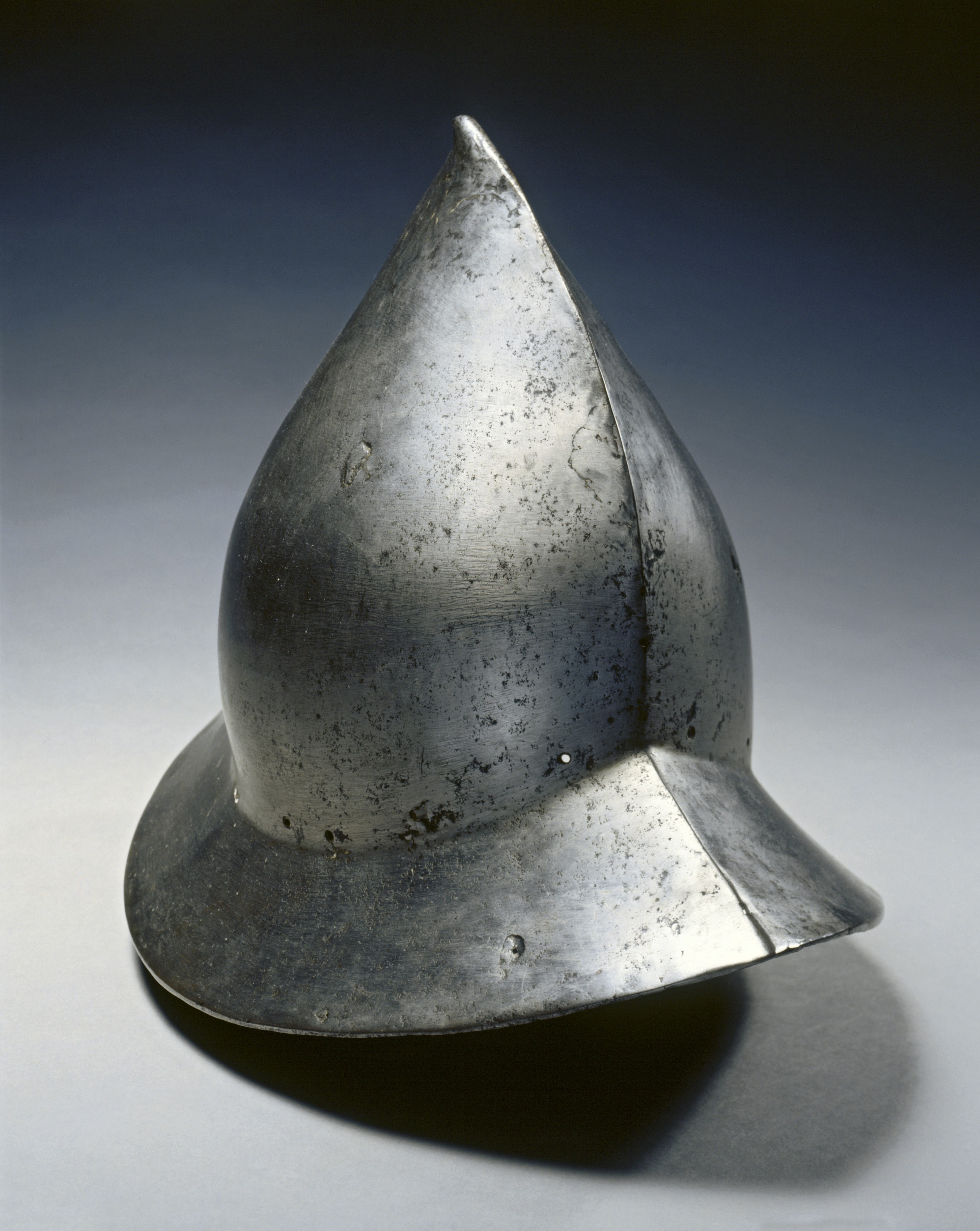
Deconstructing the Cabacete: A Metallurgical and Avant-Garde Analysis for Zoey Fashion Lab
At Zoey Fashion Lab, the role of the Chief Fabric Deconstructionist is to dissect historical artifacts not merely as relics, but as blueprints for future textile and structural innovation. The subject of this analysis is the Cabacete, a Spanish steel helmet from the late 15th century. This piece, a testament to the martial sophistication of the Iberian Peninsula, presents a unique challenge: how to translate its rigid, defensive form into the fluid, expressive language of avant-garde fashion. By treating this Cabacete as a New DNA Strand—a genetic code for design—we can extract its core principles of protection, silhouette, and material tension, and re-engineer them for the runway.
Historical and Technical Context: The Steel Shell as a Second Skin
The Cabacete, a type of infantry helmet, was designed for maximum protection with minimal weight. Its defining features include a rounded, skull-hugging dome, a distinctive brim that flares outward at the sides and back (often called a "tail"), and a visor that could be raised or lowered. The steel used was typically a low-carbon iron alloy, heat-treated to achieve a balance between hardness and malleability. This was not a ceremonial piece; it was a functional, life-saving garment. From a deconstructionist perspective, the Cabacete’s value lies in its structural logic: it distributes impact forces across a continuous, curved surface, while the brim deflects downward strikes. The material is unyielding, yet the form is anthropomorphic—molded to the human skull.
For Zoey Fashion Lab, this presents a foundational principle: armor as architecture. The steel’s weight and rigidity are not flaws but opportunities. In an avant-garde context, we can subvert this by using lightweight, high-tensile materials like carbon fiber, resin-infused Kevlar, or even 3D-printed titanium mesh. The goal is to preserve the Cabacete’s protective silhouette while making it wearable, breathable, and flexible. The "tail" of the brim, for instance, can be reinterpreted as a dramatic, asymmetrical collar or a shoulder cape, using laser-cut leather or molded polyurethane to mimic the steel’s flared geometry.
The New DNA Strand: Deconstructing the Helmet into Textile Elements
The concept of a New DNA Strand implies a biological, evolutionary approach to design. The Cabacete is not a finished object; it is a code. Its DNA consists of three primary strands:
1. The Dome (Primary Silhouette): The helmet’s skull cap is a perfect hemisphere. In fashion, this translates to a structured headpiece or a cowl that encases the head and neck. For an avant-garde collection, we can deconstruct this dome into segmented panels, each articulated with hinges or elastic webbing. This allows the piece to collapse flat for storage or expand into a sculptural, alien-like form. The material could be a hybrid of steel mesh and memory foam, allowing the wearer to shape the helmet’s volume at will. This is not a reproduction; it is a mutation.
2. The Brim (Dynamic Line): The Cabacete’s brim is not uniform. It is shorter at the front and longer at the back, creating a sweeping, aerodynamic line. In fashion, this translates to dramatic, asymmetrical hemlines and sharp, angular shoulders. Imagine a jacket where the right shoulder extends into a rigid, flared wing, while the left remains close to the body. This asymmetry echoes the helmet’s functional design—it protects the neck and shoulders from downward blows. In a deconstructed garment, this brim can become a series of removable, interlocking panels, allowing the wearer to customize their level of protection or exposure. The steel’s patina—a result of oxidation—can be replicated using reactive dyes or metallic coatings that change color with wear.
3. The Visor (Interface and Perception): The visor is a critical element. It is a barrier that both protects and obscures. In fashion, this translates to veils, masks, and transparent overlays. For Zoey Fashion Lab, we can develop a visor made from electrochromic glass or liquid crystal displays, allowing the wearer to control opacity. This creates a dialogue between the wearer and the observer—a theme central to avant-garde design. The visor’s hinge mechanism can be reinterpreted as a series of magnetic or snap-fastened attachments, allowing for quick changes in silhouette. This is not about hiding; it is about controlling the narrative.
Avant-Garde Application: From Battlefield to Runway
The challenge of integrating a 15th-century steel helmet into an avant-garde collection lies in transcending its martial origins. The Cabacete is a symbol of conflict, hierarchy, and protection. In a modern, fashion-forward context, these themes can be reimagined as statements on identity, vulnerability, and power. For instance, a deconstructed Cabacete-inspired bodice could use steel boning and chainmail to create a corset that is both restrictive and liberating. The "helmet" becomes a cage for the torso, emphasizing the tension between confinement and freedom.
Another avant-garde approach is to invert the material hierarchy. Instead of steel, use lightweight, transparent materials like polycarbonate or resin, and then apply a high-gloss, metallic finish. This creates a ghost-like version of the original—an echo of its form without its weight. The brim could be translated into a series of floating, cantilevered panels that hover above the shoulders, attached by thin, invisible wires. This creates a sense of levitation, as if the armor is defying gravity. The New DNA Strand here is the concept of "protective transparency"—a paradox that challenges the viewer’s perception of safety and exposure.
Technical and Material Innovations for Zoey Fashion Lab
To realize this deconstruction, Zoey Fashion Lab must explore advanced fabrication techniques. 3D knitting with conductive yarns can create a flexible, form-fitting base layer that mimics the Cabacete’s dome shape. Laser sintering of metal powders can produce intricate, lattice-like structures that are both strong and lightweight. The "tail" of the brim can be recreated using thermoplastic elastomers that are molded into dynamic, flowing shapes—a direct contrast to the original steel’s rigidity. Additionally, smart textiles with embedded sensors can detect impact or pressure, triggering changes in color or texture. This turns the garment into a responsive, living entity—a true evolution of the original armor.
Conclusion: The Cabacete as a Catalyst for Future Design
The Cabacete is more than a historical artifact; it is a blueprint for structural innovation. By treating it as a New DNA Strand, Zoey Fashion Lab can extract its core principles of protection, silhouette, and material tension, and recombine them into garments that challenge the boundaries of fashion and function. The avant-garde interpretation is not about replicating the past, but about mutating it into something new—a fusion of steel and silk, history and future, armor and adornment. This analysis provides the foundational code; the next step is to weave it into the fabric of tomorrow’s collections.