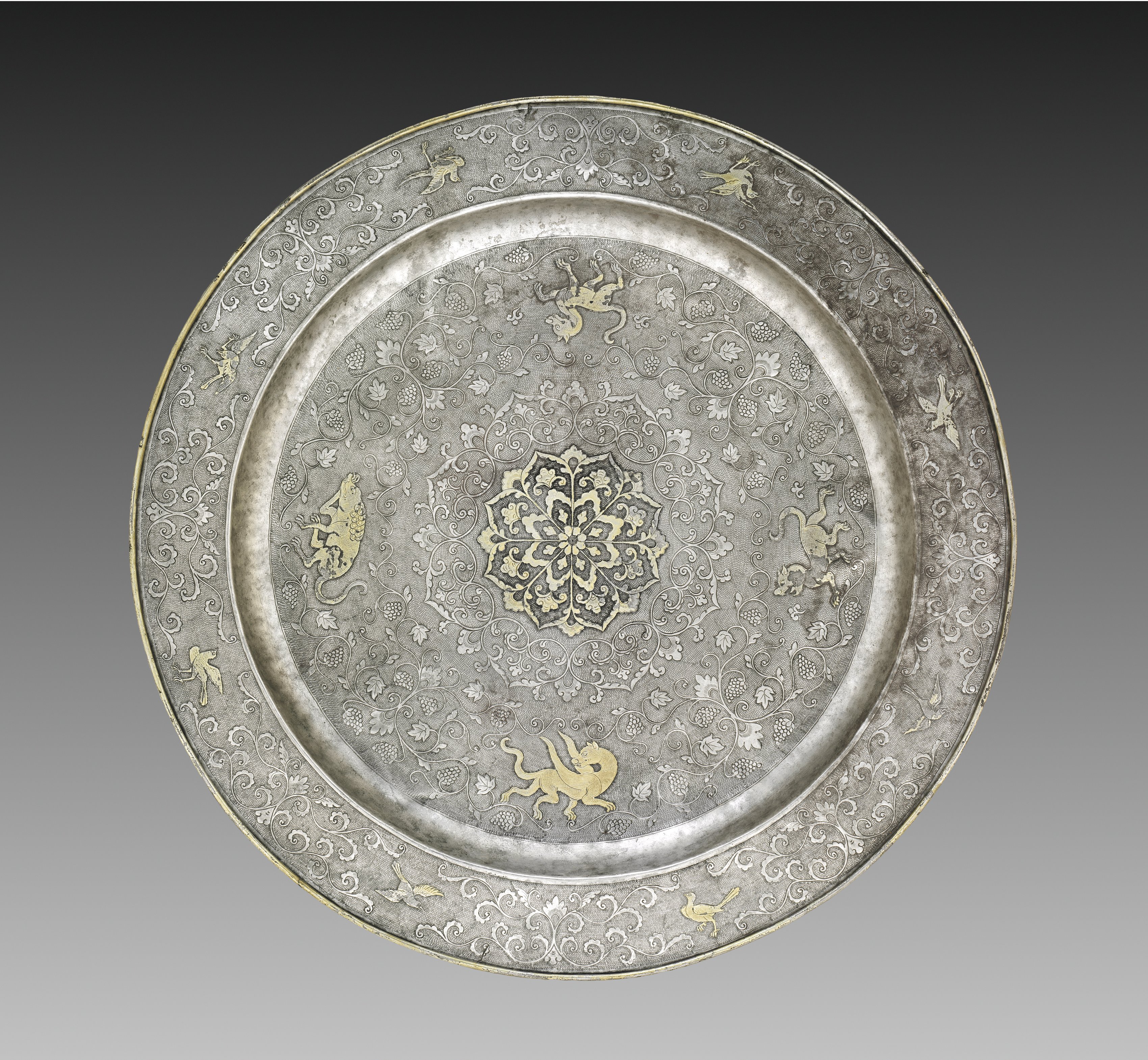
Deconstructing the Tang Dynasty Footed Platter: A New DNA Strand for Avant-Garde Fashion
As the Chief Fabric Deconstructionist for Zoey Fashion Lab, my role is to dissect historical artifacts not merely as relics, but as blueprints for radical, wearable narratives. The subject of this analysis—a Chinese Tang dynasty (618–907) footed platter, crafted from silver with gilt, incised, and chased decoration, depicting mythical beasts amid grapevines—offers a profound and unexpected genetic code for avant-garde fashion. This piece is not a static object; it is a New DNA Strand, a sequence of visual, material, and symbolic data that can be transcribed into garments that challenge, transform, and transcend conventional form. The platter’s synthesis of opulence, mythological complexity, and dynamic naturalism provides the perfect substrate for Zoey Fashion Lab’s disruptive design philosophy.
I. Material Alchemy: From Precious Metal to Textile Architecture
The platter’s primary material—silver with gilt—immediately presents a challenge and an opportunity. Silver is cool, reflective, and structurally rigid, while gilt (gold leaf or gold wash) introduces warmth, luminosity, and a sense of the sacred. In deconstructing this for fashion, we must ask: how do we translate metallic hardness into fabric fluidity? The answer lies in metallic textile engineering. We can replicate the platter’s surface through a hybrid of liquid metal finishes on high-tensile organza, micro-pleated lamé, and laser-cut stainless steel mesh. The gilt effect becomes a gradient—from deep silver at the garment’s core to gold at its extremities, mimicking the platter’s central gilt highlights.
The incised and chased decoration—techniques of carving and hammering from the reverse side to create relief—demands a three-dimensional approach. In fabric, this translates to structural embroidery and thermoplastic molding. We can use a base of double-faced satin, then apply rows of hand-stitched metallic thread to create raised, tactile lines that echo the platter’s chased vines. For the mythical beasts, we employ 3D-printed polymer appliqués coated in silver leaf, then distressed to reveal the underlying gilt. This creates a topographical garment—a landscape of texture that changes as the wearer moves, much like the platter’s surface shifts under light.
II. The Mythical Bestiary: Symbolic Silhouettes and Structural Disruption
The platter’s central motif—mythical beasts amid grapevines—is not mere decoration; it is a visual lexicon of power, transformation, and fertility. In the Tang dynasty, these creatures (often a hybrid of lion, dragon, and phoenix) symbolized imperial authority and cosmic harmony. For Zoey Fashion Lab, we deconstruct this symbolism into disruptive silhouettes. The beasts’ sinuous, intertwined bodies become the foundation for a garment’s armhole and shoulder structure. Imagine a jacket where the sleeve cap is shaped like a beast’s coiled tail, extending into a dramatic, asymmetrical wing that wraps around the torso. The grapevines, with their twisting tendrils and clustered fruit, translate into cable-knit and macramé techniques, creating a lattice of negative space across the back or along a skirt’s hem.
The mythical beasts themselves are reimagined as modular, detachable elements. A beast’s head becomes a sculptural collar or a shoulder pad, crafted from molded leather and silver studs. Its claws and talons are reinterpreted as sharp, angular darts in the fabric, creating tension and release points. The beasts’ eyes, often rendered as circular, staring motifs, inspire circular cutouts or lens-like embellishments that catch light and draw the viewer’s gaze. This is not literal representation; it is a translation of the beast’s energy—its ferocity, its protective nature, its otherworldly grace—into structural elements that empower the wearer.
III. The Grapevine Lattice: Organic Geometry and Kinetic Flow
The grapevines on the platter are not static; they are a dynamic network of growth, entanglement, and fruition. In avant-garde fashion, this organic geometry becomes a lattice of movement. We can deconstruct the vine pattern into a parametric grid for laser-cutting. A base of black silk crepe is overlaid with a laser-cut layer of silver lamé, where the vine pattern is rendered as a series of interconnected, swirling lines. The cutouts reveal the skin or an underlayer of deep purple (the grape color), creating a sense of depth and hidden layers. This technique allows the garment to breathe and move, with the vine pattern expanding and contracting as the wearer gestures.
The grape clusters themselves are reinterpreted as tactile, three-dimensional embellishments. Using a combination of beading, sequins, and resin, we create small, clustered forms that hang from the vine lattice. These clusters are not uniform; some are dense and metallic, others are translucent and colored like amethyst or jade. When the wearer moves, these clusters sway and catch light, mimicking the platter’s interplay of gilt and silver. The vines also inform the garment’s draping and asymmetry. A single vine tendril can become a long, trailing sash that wraps around the waist and falls to the floor, while another vine spirals up the sleeve, creating a sense of organic growth that defies the garment’s structured base.
IV. The Footed Foundation: Elevating the Silhouette
The platter’s footed base—a raised, circular platform—is perhaps the most direct translation into avant-garde fashion. This is not a literal shoe; rather, it is a foundational structure that elevates the entire garment. We can design a structural bodice that mimics the platter’s foot: a circular, rigid base at the hip or waist, made from molded carbon fiber or resin, that flares outward like a bell. This base becomes a platform for the vine and beast motifs to climb upward, creating a garment that is part armor, part sculpture. The footed element also suggests elevation and perspective. In the same way the platter raises the decorative scene for viewing, a garment with a raised, circular collar or a tiered, footed hemline forces the viewer to look up, to engage with the wearer as a living artifact.
The footed platter’s circular, symmetrical form is subverted in our design. We create a deconstructed circle—a skirt that is circular in plan but open on one side, revealing a contrasting underlayer. The footed base becomes a kinetic element; a hoop skirt or a series of concentric, flexible rings that allow the garment to sway and undulate. This is a direct reference to the platter’s function as a serving dish, but reimagined as a performative, wearable object that invites movement and interaction.
V. The Avant-Garde Synthesis: A Wearable Artifact
The final analysis is not about replication, but about synthesis. The Tang dynasty footed platter is a masterpiece of craftsmanship, but its true value for Zoey Fashion Lab lies in its conceptual density. We extract its DNA—the metallic alchemy, the symbolic bestiary, the organic lattice, and the foundational foot—and splice it with contemporary materials and techniques. The result is a garment that is both ancient and futuristic, a wearable artifact that challenges the boundary between object and subject, between history and the avant-garde.
This garment will be a conversation starter, a piece that demands to be read. It will feature a silver-gilt finish achieved through a combination of metallic foil and hand-painted resin, a lattice of laser-cut vines that reveal a purple underlayer, and detachable beast-shaped armor at the shoulders. The footed base will be a flexible, circular frame that elevates the silhouette, while the grape clusters will be rendered as hanging, kinetic embellishments. This is not fashion for the faint of heart; it is a deconstruction of a dynasty, a re-coding of a cultural artifact into a new, expressive language. At Zoey Fashion Lab, we do not simply design clothes—we excavate, deconstruct, and reanimate the past, forging a new DNA strand that connects the Tang dynasty to the future of fashion.