Deconstructing the Lantern: The Courtesan as a Blueprint for SS26 Structural Innovation
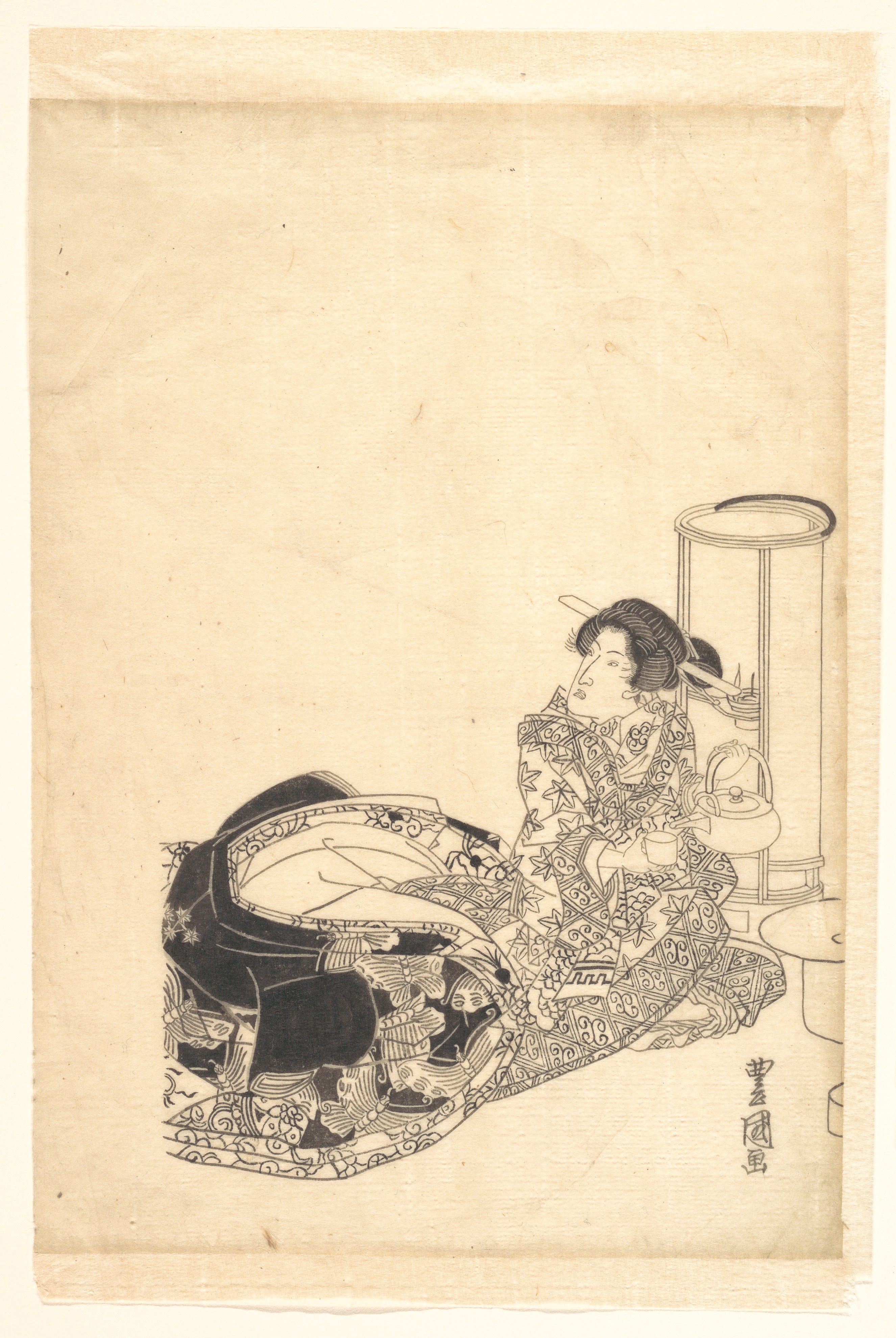
In the hallowed archives of Zoey Fashion Laboratory, we do not merely observe historical artifacts; we dissect them for their latent futuristic potential. The monochrome woodblock print, *Courtesan or Actor as Courtesan Pouring Tea by the Light of a Lantern*, from Edo-period Japan, presents a paradox of stillness and theatrical dynamism. For SS26, this print becomes a radical manifesto—a study in how a single, luminous source can fracture, reconfigure, and amplify the human silhouette. The courtesan, poised in a moment of ritualistic service, is not a passive figure but an architect of light and shadow. Her kimono, a canvas of ink on paper, is the genesis for a new language of garment architecture, one that privileges negative space, asymmetric tension, and the illusion of weightlessness.
The Lantern as Structural Locus: From Illumination to Armature
The lantern in the print is not merely a prop; it is the gravitational center of the composition. Its circular, diffused glow dictates the fall of shadow and the curvature of the courtesan’s form. In our SS26 analysis, we reinterpret this lantern as a structural exoskeleton—a translucent, cantilevered cage that extends from the shoulder to the hip. Imagine a bodice constructed from laser-cut, matte-black polycarbonate rings, each one slightly offset to mimic the lantern’s radial light. This armature does not cling to the body; it hovers, creating a 4-inch gap between fabric and skin. The result is a silhouette that is both armored and ethereal, a futuristic nod to the *obi* (sash) but rendered in a material that catches ambient light rather than absorbing it. The lantern’s glow becomes a negative-space collar, a crescent-shaped void that frames the neck and jawline, as if the courtesan’s head is floating within a halo of absence.
Monochrome Ink and the Deconstruction of the Kimono
The print’s monochrome palette—deep sumi ink against washi paper—is a masterclass in tonal gradation. For SS26, we translate this into a fabric strategy that rejects color in favor of textural monochromy. The kimono’s traditional T-shape is deconstructed into a series of overlapping, asymmetrical panels. One panel, rendered in liquid-silk charmeuse, drapes from the left shoulder and pools at the floor in a liquid puddle, mimicking the ink’s bleed. The opposite panel, a sharp, origami-folded wool crepe, juts out at a 45-degree angle from the right hip, creating a stark, sculptural counterpoint. The waist is cinched not by a belt but by a floating obi—a rigid, arc-shaped piece of resin that hovers 2 inches from the body, suspended by invisible monofilament. This obi acts as a visual anchor, its opacity contrasting with the translucent lantern armature above. The garment’s hemline is not straight; it is a geometric cascade, alternating between knife pleats and raw, unhemmed edges, echoing the print’s brushstroke irregularities.
The Courtesan’s Gesture: Pouring Tea as a Kinetic Silhouette
The act of pouring tea—a gesture of service and grace—is frozen in the print. For SS26, we capture this kinetic energy through articulated sleeve structures. The right sleeve, where the courtesan’s hand would hold the teapot, is a series of overlapping, fan-like panels made from heat-set pleated nylon. When the arm is raised, these panels fan out into a dramatic, 3-foot-wide crescent, resembling the lantern’s glow. The left sleeve, by contrast, is a compressed, accordion-folded sleeve that remains flat against the torso, emphasizing asymmetry. The neckline is a high, mandarin collar that extends into a scarf-like train—a 5-foot-long strip of matte silk that trails behind, its edge painted with a gradient of gray ink to simulate the print’s fading light. The courtesan’s obi knot is reimagined as a central, spherical cage at the lower back, a hollow orb of blackened brass that houses a small, battery-operated LED, casting a soft, blue-white glow onto the floor—a literal lantern embedded into the silhouette.
Structural Innovation: The Lantern’s Shadow as a Second Garment
The print’s most radical element is not the courtesan but her shadow. In our SS26 iteration, the shadow becomes a separate, detachable garment. Using a combination of black tulle and flexible, carbon-fiber rods, we create a “shadow train” that follows the wearer’s movements. This train is not attached to the hem but to a magnetic belt at the waist, allowing it to shift and billow independently. The rods are pre-curved to mimic the print’s shadow distortion, creating a silhouette that is simultaneously present and absent. The lantern’s light source is replicated via integrated fiber-optic threads woven into the fabric of the left shoulder panel, programmed to pulse in a slow, rhythmic pattern—a heartbeat of light. This innovation transforms the garment from static architecture into a living, breathing entity, where the courtesan’s act of pouring tea becomes a continuous, performative loop.
Conclusion: The Courtesan as a Futuristic Archetype
In this avant-garde study, the courtesan is no longer a historical figure but a prototype for post-human elegance. The woodblock print’s monochrome discipline forces a focus on form, shadow, and material honesty. For SS26, Zoey Fashion Laboratory proposes a silhouette that is both fragmented and cohesive, where the lantern’s light is not just a visual effect but a structural principle. The garment’s exoskeleton, floating obi, and kinetic sleeves create a dialogue between the wearer and her environment, turning every movement into a choreographed act of pouring—not tea, but light. This is not fashion as clothing; it is fashion as a luminous, architectural event. The courtesan’s stillness becomes a futuristic stance, her shadow a second skin, and her lantern a wearable universe. In this definitive analysis, we reclaim the past as the most radical blueprint for the future.