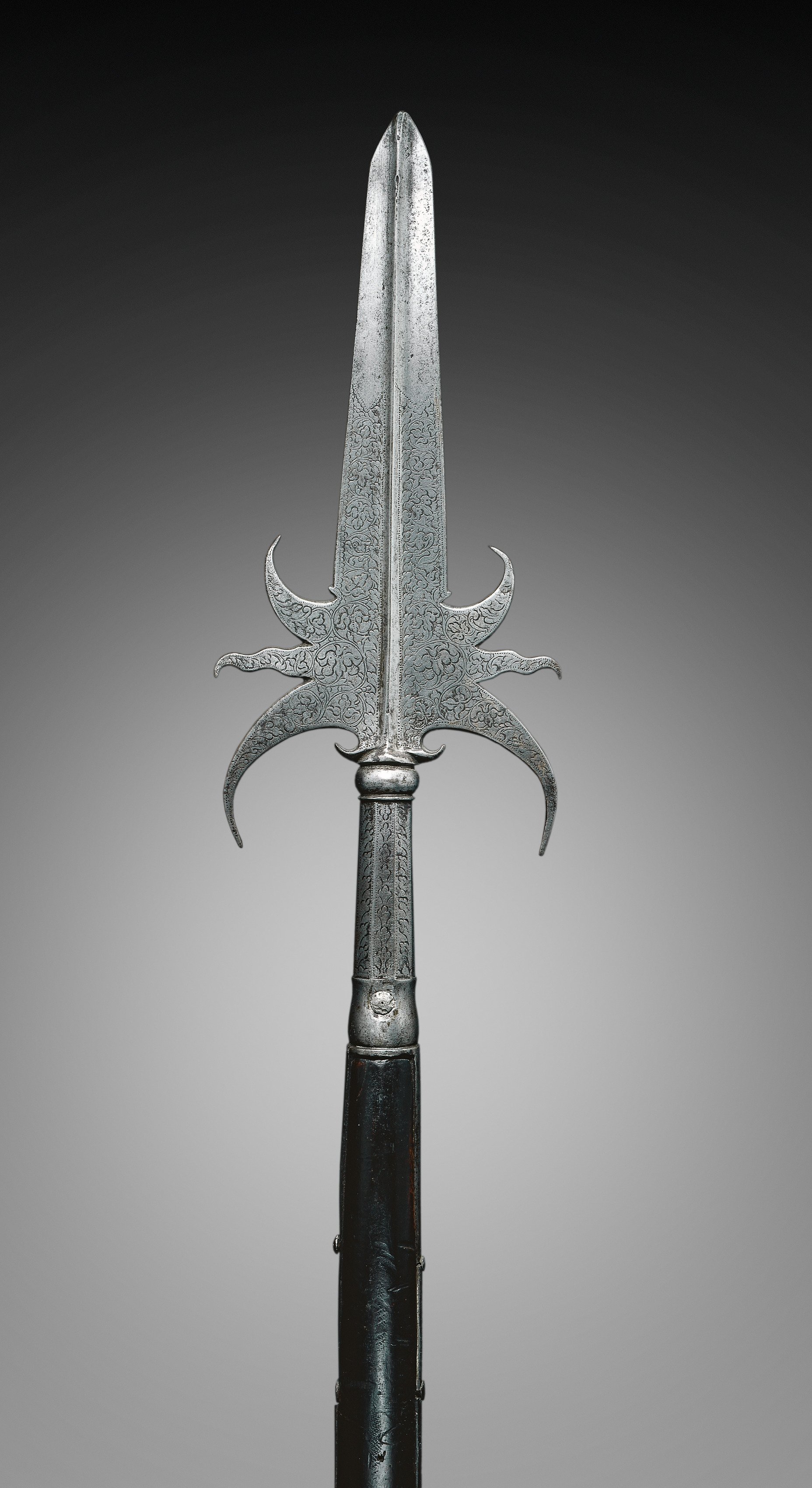
Partisan Reimagined: A Deconstruction of 17th Century French Polearm into Avant-Garde Fashion DNA
At Zoey Fashion Lab, the role of the Chief Fabric Deconstructionist is to unearth the latent narrative embedded within historical artifacts and translate their structural, material, and symbolic essence into contemporary fashion language. The subject of this analysis—a 17th-century French Partisan—presents a uniquely compelling case. This weapon, a ceremonial and functional polearm, is not merely a relic of martial history; it is a blueprint for a new aesthetic syntax. By deconstructing its technical components—steel head and round wood haft—and viewing them through the lens of a New DNA Strand, we can forge an avant-garde collection that redefines power, protection, and silhouette.
Historical and Symbolic Context: The Partisan as a Gesture of Authority
The Partisan, originating in France during the 17th century, was a weapon of distinction. Unlike the common pike, its broad, often ornate blade was carried by infantry officers and palace guards, serving as a symbol of rank and ceremonial authority. Its design was a balance of lethal utility and aristocratic display. The steel head, frequently etched or gilded, was a declaration of status, while the long wooden haft maintained a physical distance between the bearer and the threat—a metaphor for controlled power. For Zoey Fashion Lab, this duality is pivotal. The Partisan is not about aggression but about structured presence. It is a tool of command that dictates space, a concept ripe for translation into garments that shape and define the wearer’s environment.
Technical Deconstruction: Steel and Wood as Material Narratives
The Partisan’s two primary materials—forged steel and turned wood—offer a stark, elemental contrast. Steel represents hardness, reflectivity, and permanence. In the 17th century, its production was a labor of fire and hammer, resulting in a surface that could be both mirror-like and menacing. The round wood haft, typically ash or oak, provided a warm, organic counterpoint. Its grain was a record of growth, its weight a grounding force. Together, they form a dialectic of rigidity and flexibility.
In our deconstruction, we extract these properties not as literal materials but as conceptual fibers. Steel becomes a metaphor for armature and illumination. We envision fabrics with metallic threads that catch light like a polished blade, or structural boning that mimics the blade’s rigidity. The wood haft translates into cylindrical volume and tactile warmth. Think of sculpted sleeves that echo the haft’s roundness, or woven textures that replicate the grain of aged oak. This is not costume; it is the translation of structural logic into textile behavior.
The New DNA Strand: Integrating Partisan Geometry into Avant-Garde Silhouette
The New DNA Strand is our methodology for genetic-level design integration. We do not simply apply Partisan motifs as prints or embroideries. Instead, we extract its core geometric and functional principles and weave them into the very pattern cutting and construction of the garment. The Partisan’s blade, for instance, is a long, tapered triangle with a central ridge—a shape that suggests both penetration and deflection. This silhouette can be mapped onto a coat’s lapel, a skirt’s train, or a cape’s hem, creating lines that cut through space with precision.
Blade-Inspired Structures: Asymmetry and Edge
The Partisan blade’s asymmetry—often with a single sharp edge and a reinforced back—informs a new approach to garment construction. We propose asymmetrical closures and single-sided draping. A jacket might feature a right-sided, blade-like panel that extends beyond the body, while the left side remains fitted. This creates a visual imbalance that commands attention, much like the weapon’s purposeful design. The central ridge of the blade translates into a seamed spine running down the back of a gown or coat, creating a dramatic, architectural line that elongates the torso and suggests a rigid, unyielding core.
Haft-Inspired Volumes: Cylindrical and Grounded
The round wood haft informs our approach to sleeve and limb encasement. Instead of traditional armholes, we explore circular, tunnel-like sleeves that are attached at the shoulder and hang as independent cylinders, allowing the arm to move freely within. These sleeves can be constructed from stiffened, double-faced fabrics that hold their shape, mimicking the haft’s solidity. Alternatively, the haft’s length inspires extended, floor-sweeping silhouettes that anchor the garment to the ground, creating a sense of rooted authority. A full-length skirt or coat that trails behind the wearer becomes a physical declaration of territory—a modern Partisan’s reach.
Material Innovation: Translating Steel and Wood into Textile Language
To realize this vision, we must develop new fabrications that embody the Partisan’s material logic without literal replication. For the steel element, we look to liquid metal finishes achieved through foil stamping, metallic coating, or the use of micro-filament stainless steel threads woven into a base cloth. These fabrics will shift from matte to mirror-like under light, creating a dynamic, armor-like surface. For the wood haft, we explore compressed felt, molded leather, or sculpted neoprene that can be shaped into tubular forms. These materials offer the warmth and tactility of wood while allowing for structural rigidity. A third, hybrid material—a carbon fiber-infused textile—could bridge the two, offering the hardness of steel and the grain-like texture of wood.
Color Palette and Surface Treatment
The Partisan’s original palette was limited: the blue-grey of steel, the brown of oiled wood, and the occasional gold or silver of ceremonial inlay. Our avant-garde interpretation expands this into a monochromatic spectrum of greys, silvers, and bone whites, punctuated by sharp accents of oxidized copper or verdigris green—a nod to aged metal. Surface treatments will include laser-cut perforations that mimic the decorative piercings on historic Partisan blades, and embossed patterns that replicate wood grain. These are not decorative additions but integral to the garment’s structural logic, creating ventilation and visual rhythm.
Conclusion: The Partisan as a Blueprint for Wearable Authority
The 17th-century French Partisan, when deconstructed through Zoey Fashion Lab’s methodology, yields a rich vocabulary for avant-garde design. Its steel and wood are not materials but principles of form and function. Its asymmetry, volume, and grounding presence become tools for redefining how a garment interacts with the wearer and the space around them. By integrating these elements as a New DNA Strand, we create collections that are not nostalgic but prophetic—garments that arm the wearer with a silent, commanding elegance. The Partisan’s legacy is not in its blade but in its blueprint for a new kind of fashion: one that is structural, symbolic, and unapologetically authoritative.