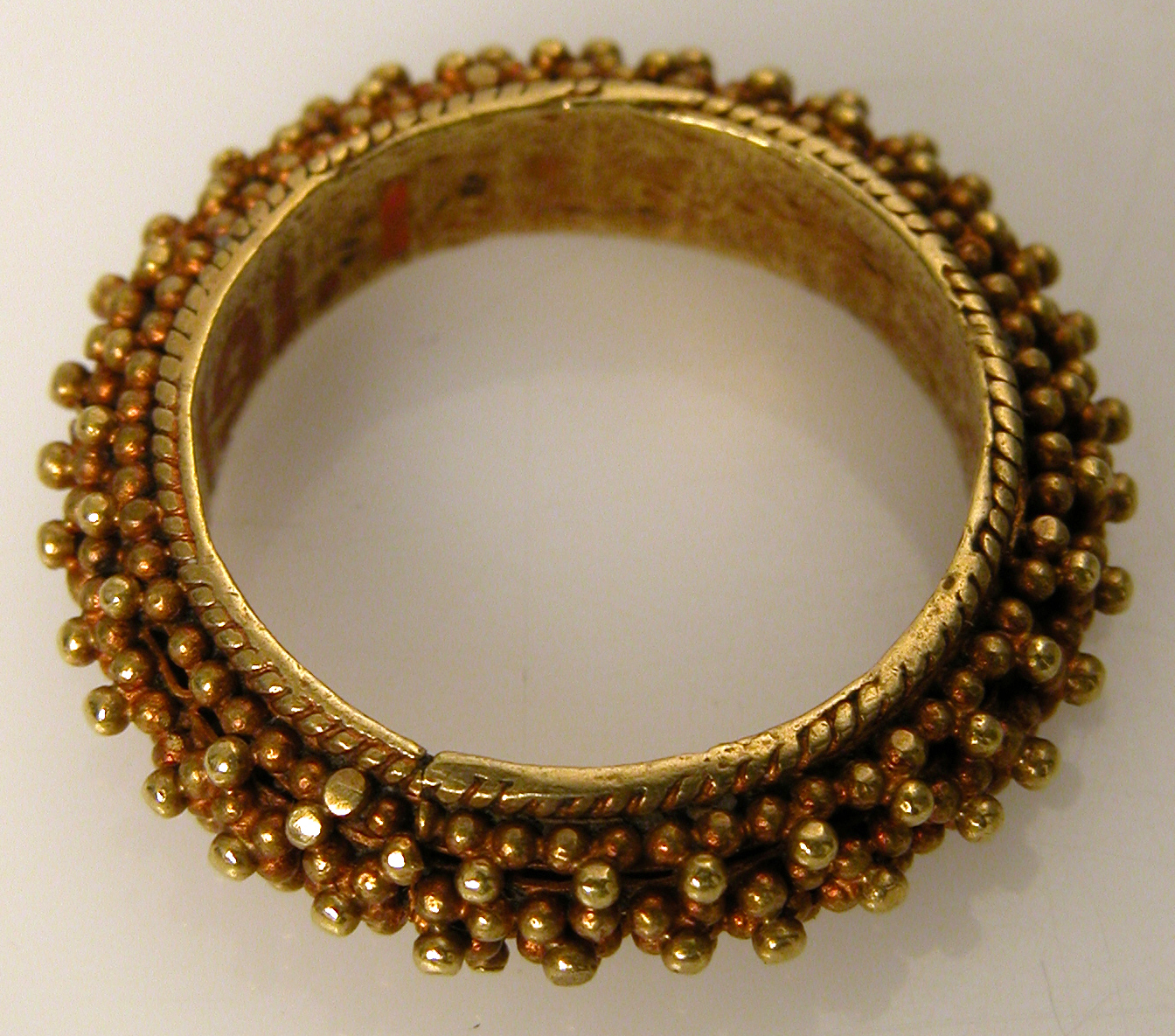
Deconstructing the Byzantine Finger Ring: A Proto-Futurist Blueprint for SS26
The Byzantine finger ring, rendered in solid gold, is not merely an artifact of imperial adornment; it is a compressed architectural manifesto. Within its circular confines lies a paradox of permanence and transience—a golden loop that simultaneously anchors the flesh and gestures toward the celestial. For Zoey Fashion Laboratory’s SS26 collection, this relic serves as a radical departure point, where the historical weight of Byzantium is fractured through a lens of deconstructive aesthetics and futuristic silhouette engineering. The ring’s materiality—pure gold—becomes a narrative of tension: a metal synonymous with eternity, yet molded into a form that encircles the ephemeral human digit. This analysis decodes the ring’s structural DNA, correlating it with the archive node’s dialectic of mirrored splendor and stone-bound mortality, to propose a new lexicon of wearable sculpture.
The Gold Standard: From Imperial Ornament to Structural Armature
Gold, in the Byzantine context, was never passive. It was a theological and political medium, reflecting divine light while asserting earthly power. In the SS26 avant-garde context, this material is reimagined as a structural exoskeleton—not an embellishment, but a load-bearing element that dictates the silhouette’s architecture. The finger ring’s circular geometry is extrapolated into oversized, cantilevered rings that extend beyond the hand, forming rigid, semi-orbital cages around the forearm. These are not jewelry; they are articulated prosthetics that challenge the boundary between body and adornment. The gold is treated with a matte, brushed finish to subvert its historical luster, creating a surface that absorbs rather than reflects light—a deliberate nod to the “cold stone sarcophagus” from the archive node. This matte gold is then juxtaposed with polished, mirror-like inlays, echoing the “smooth silver mirror” facet of the source text. The result is a garment architecture where the ring’s original symbolism of unity is deconstructed into a series of fractured, orbiting segments that hover around the body, never fully closing the circle.
Silhouette as Syntax: The Split-Leaf Motif and Temporal Collapse
The archive node’s description of “gold-inlaid split-leaf patterns on a smooth silver mirror” versus “relief-carved life narrative on a cold stone sarcophagus” provides the core dialectic for SS26 silhouette innovation. The finger ring’s intricate filigree—often featuring palmettes and split-leaf designs—is reinterpreted as asymmetrical draping and negative-space cutouts. The “split-leaf” becomes a literal, structural cut: garments are bisected along diagonal axes, with one half rendered in liquid, mirror-like silver lamé, and the other in heavy, stone-textured black neoprene. This split is not decorative; it is a temporal hinge. The mirror side references the Byzantine obsession with divine reflection and opulence, while the stone side evokes the funerary, the archival, the mortal. The finger ring’s gold is translated into rigid, 3D-printed articulated joints that connect these two halves, allowing the wearer to modulate the silhouette—from a closed, symmetrical form to an open, deconstructed drape. The ring’s circularity is thus broken, becoming a linear, almost calligraphic trace across the body’s topography.
Deconstructive Logic: The Ring as a Node of Tensile Forces
In the Byzantine ring, the band’s tensile strength is hidden beneath ornament. For SS26, this tension is externalized. The gold is extruded into ultra-thin, spring-tempered wires that form a network of suspended architectural lines, reminiscent of a geodesic dome collapsed onto a human scale. These wires connect to laser-cut, gold-plated anchor points embedded in the garment’s seams, creating a dynamic system of pull and release. The finger ring’s original function—to hold—is inverted; now, the body holds the ring’s geometry. The wearer becomes the armature for a mobile, kinetic sculpture. The split-leaf motif is re-engineered as modular, interlocking panels that can be detached and reconfigured, echoing the ring’s potential for transformation (from a simple band to a complex signet). This modularity is a direct critique of the static nature of historical artifacts, proposing a fashion that is processual—always in a state of becoming, never finalized.
The Archive Node’s Mirror-Sarcophagus Dialectic: Fabric as Memory Surface
The archive node’s juxtaposition of the “smooth silver mirror” and the “cold stone sarcophagus” is the collection’s philosophical engine. The finger ring, in its gold materiality, sits between these two poles. For SS26, this is translated into a fabric technology: a dual-surface textile that is mirror-polished on one side and textured, almost petrified, on the other. This fabric is used for transformable garments that can be worn inside-out, shifting the wearer’s identity from a reflection of opulence to an embodiment of mortality. The ring’s gold is applied as conductive thread that traces the split-leaf patterns across these surfaces, creating a circuit that can be activated by touch—a subtle, futuristic nod to the ring’s historical role as a seal, a marker of presence. The silhouette is thus a memory surface, where the ring’s circular narrative is written and rewritten through the act of wearing.
Structural Innovation: The Ring as a Zero-Point of Garment Architecture
The most radical proposition of this analysis is the ring as a zero-point of garment architecture. Traditional couture begins with the body, draping outward. Here, the ring is the origin—a micro-architecture that generates the macro-silhouette. For SS26, this manifests as cantilevered shoulders and asymmetrical hemlines that originate from a single, oversized gold ring positioned at the collarbone or hip. The ring acts as a structural fulcrum, from which all other fabric panels are suspended or tensioned. This is a direct inversion of the Byzantine ring’s logic: instead of the ring encircling the finger, the garment encircles the ring. The split-leaf motif becomes a repeating fractal pattern that scales from micro-embroidery to macro-drape, creating a visual echo that collapses the distinction between ornament and structure. The gold is not applied; it is the load-bearing skeleton of the piece.
Conclusion: The Ring as a Portal to SS26’s Temporal Architecture
The Byzantine finger ring, in its golden materiality and circular syntax, is not a relic to be replicated but a temporal portal for Zoey Fashion Laboratory’s SS26 collection. By deconstructing its form—splitting its circle, externalizing its tension, and juxtaposing its materiality with the archive node’s mirror-sarcophagus dialectic—we arrive at a silhouette that is simultaneously ancient and futuristic. The ring’s gold becomes a scaffold for kinetic, modular, and dual-natured garments that challenge the static nature of both historical artifacts and contemporary fashion. The wearer is no longer adorned; they are architecturally inhabited by a structure that oscillates between reflection and burial, opulence and mortality. This is the definitive avant-garde couture for SS26: a fashion that does not simply dress the body but redefines its relationship to time, material, and meaning.