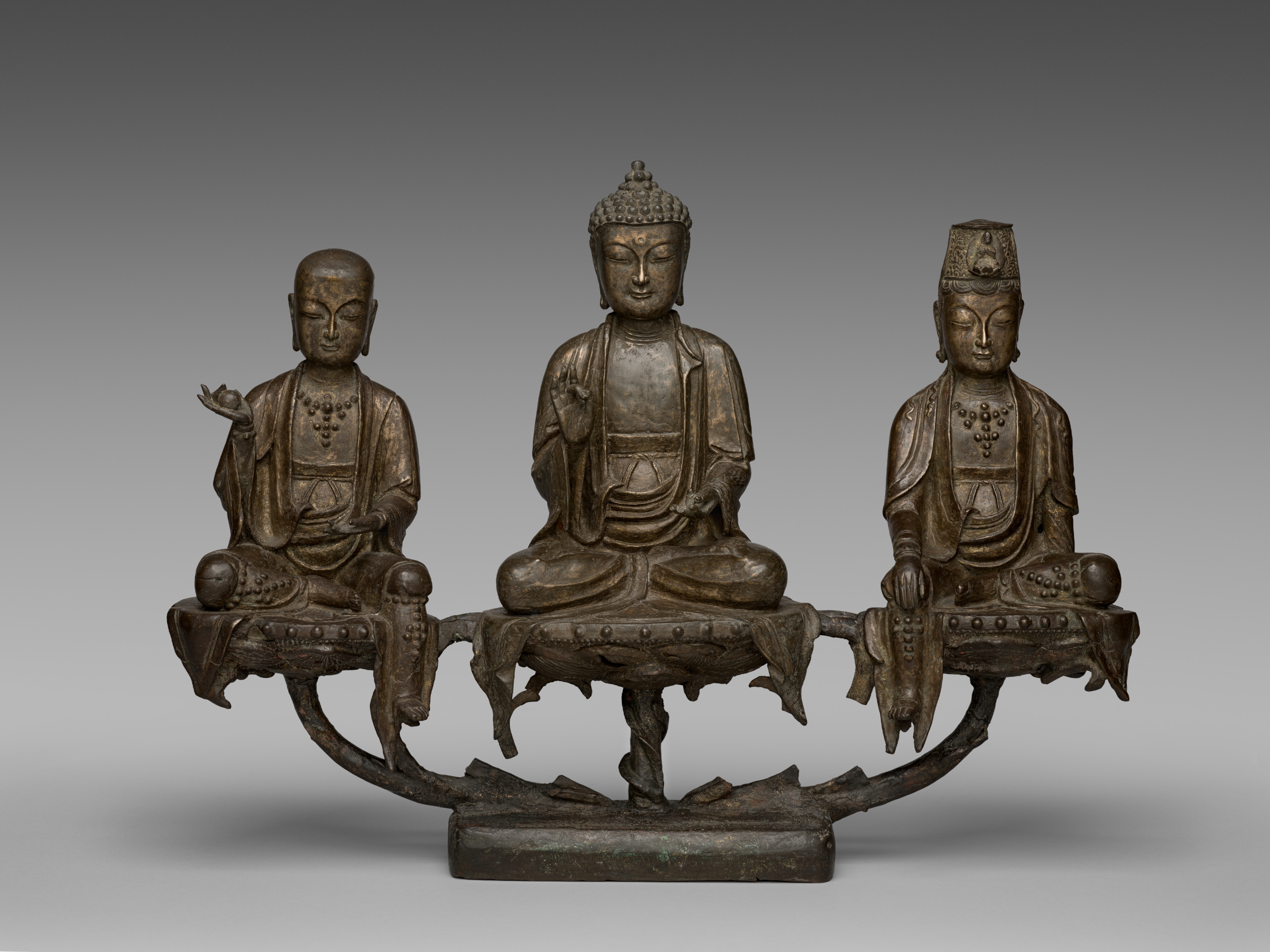
Deconstructing the Divine: The Amitabha Triad as an Avant-Garde Textile Narrative
At Zoey Fashion Lab, the act of deconstruction is not merely about taking apart; it is about unearthing the latent narratives, the unspoken dialogues between material, form, and cultural memory. When we encounter the Amitabha Triad—a Korean Joseon dynasty bronze sculpture with traces of gilding—we are not looking at a static religious artifact. We are looking at a complex, layered textile waiting to be unraveled. The bronze is our fabric; the gilding, our thread; the triad’s iconography, our pattern. This analysis re-interprets the Triad through the lens of Archive Resonance, specifically the dialectic of the “mirror” and the “stone coffin,” to propose a new avant-garde collection that speaks to both transcendence and mortality.
Materiality as a Fabric of Time
The first layer of our deconstruction addresses the material itself. Bronze, in the context of Joseon dynasty craft, is a material of permanence and ritual. It is not a soft, pliable textile, but a hard, cast metal. For the avant-garde designer, this paradox is the starting point. We must ask: How does the weight of bronze translate into the drape of a garment? How does the patina of centuries—the corrosion, the loss of gilding—become a surface texture?
The answer lies in the “stone coffin” reference. The Triad, like the coffin, is a container of a sacred story. Its bronze surface is a relief—a narrative carved in negative space. In our collection, this translates to garments that are not simply sewn but cast. We envision structured, sculptural silhouettes using molded leather and resin-impregnated fabrics that mimic the rigidity of cast metal. The “traces of gilding” become a key design element. Instead of uniform gold, we employ strategic, abraded metallic foils applied to the fabric’s surface, then partially removed. This creates a visual language of erosion and memory—a gold leaf that is present only as a ghost of its former self, echoing the Triad’s own history of wear and ritual use.
The Triad’s Iconography: A Pattern of Transcendence
The Amitabha Triad—the central Buddha flanked by two bodhisattvas—is a composition of hierarchy and flow. The central figure is static, meditative, a pillar of absolute presence. The flanking figures are dynamic, their bodies often in a slight contrapposto, their hands gesturing in mudras. This is not a static image; it is a choreography of energy.
For our avant-garde interpretation, this becomes a pattern of asymmetrical layering. The central Buddha’s stillness is translated into a core garment—a severe, floor-length column dress or a tailored, high-necked jacket in a deep, oxidized bronze tone. This piece is the “stone coffin” of the outfit: the stable, narrative-bearing foundation. The bodhisattvas’ dynamism is then overlaid as detachable, floating panels—like the “mirror” in the Archive Resonance. These panels, cut from a sheer, iridescent silk organza, are printed with a digital pattern derived from the Triad’s flame-like mandorla and the lotus pedestals. The pattern is not literal; it is a fractured, deconstructed mandala, where the lines of the lotus petals become sharp, geometric pleats, and the flames become jagged, laser-cut edges.
Archive Resonance: The Mirror and the Coffin
The central conceptual tension in this analysis is the juxtaposition provided by the Archive Resonance reference: a “mirror with split-leaf” pattern versus a “stone coffin with relief narrative.” This is the avant-garde’s playground. The mirror represents surface, reflection, and the illusion of permanence. The coffin represents depth, burial, and the truth of decay. The Amitabha Triad sits in the middle, promising transcendence from the latter through the former.
In our collection, this is realized through a technique of double-faced textiles. One side of the fabric is a smooth, reflective surface—achieved through liquid metallic finishes or mirror-polished vinyl. This side is printed with the “split-leaf” pattern: a dense, intricate, almost chaotic overlay of palm-like fronds, reminiscent of the Joseon dynasty’s love for natural motifs. This is the mirror side, the public face of transcendence, the promise of a gilded paradise. The reverse side is the coffin side. It is left raw, unfinished, perhaps with a relief-printed texture that mimics the rough, carved stone of a sarcophagus. On this side, we emboss the silhouette of the Triad—not as a clear image, but as a faint, almost archaeological impression, as if the figures are emerging from the stone itself.
Avant-Garde Silhouettes: The Unstable Garment
The final product is not a garment; it is a wearable artifact. Silhouettes are unstable and modular. A long, asymmetric skirt might be constructed from panels that can be flipped, revealing the mirror side or the coffin side depending on the wearer’s movement. A bodice might be built like a bronze cuirass, with articulated metal plates (in lightweight aluminum, anodized to a bronze patina) connected by gilded chainmail. The chainmail itself is deconstructed: some links are left empty, some are filled with tiny, dark beads that mimic the “traces of gilding” loss.
The headpieces are crucial. They are not crowns but negative-space halos. Using a wire structure, we create the outline of the Triad’s mandorla, but it is empty, a void. This references the “stone coffin” as an empty vessel, while the wearer’s head becomes the living, breathing mirror of the divine. The color palette is deliberately muted and metallic: deep, oxidized greens and blacks (bronze patina), pale, dusty gold (traces of gilding), and a single, shocking accent of lacquer red—a color found in the robes of Korean Buddhist monks, a vibrant, living thread in the narrative of death and rebirth.
Conclusion: The Garment as a Sacred Object
By deconstructing the Amitabha Triad through the lens of Archive Resonance, Zoey Fashion Lab does not produce a costume or a historical reproduction. We produce a critical garment—one that forces the wearer and the viewer to confront the duality of existence. The bronze is not just metal; it is a frozen moment of devotion. The gilding is not just decoration; it is a fading whisper of the infinite. The mirror and the coffin are not opposites; they are the two sides of the same fabric of time. This collection is a meditation on how the sacred is always, already, a textile of memory, woven from the threads of ritual, decay, and the relentless human desire to reflect the light of the divine, even as we are buried in the shadows of history.