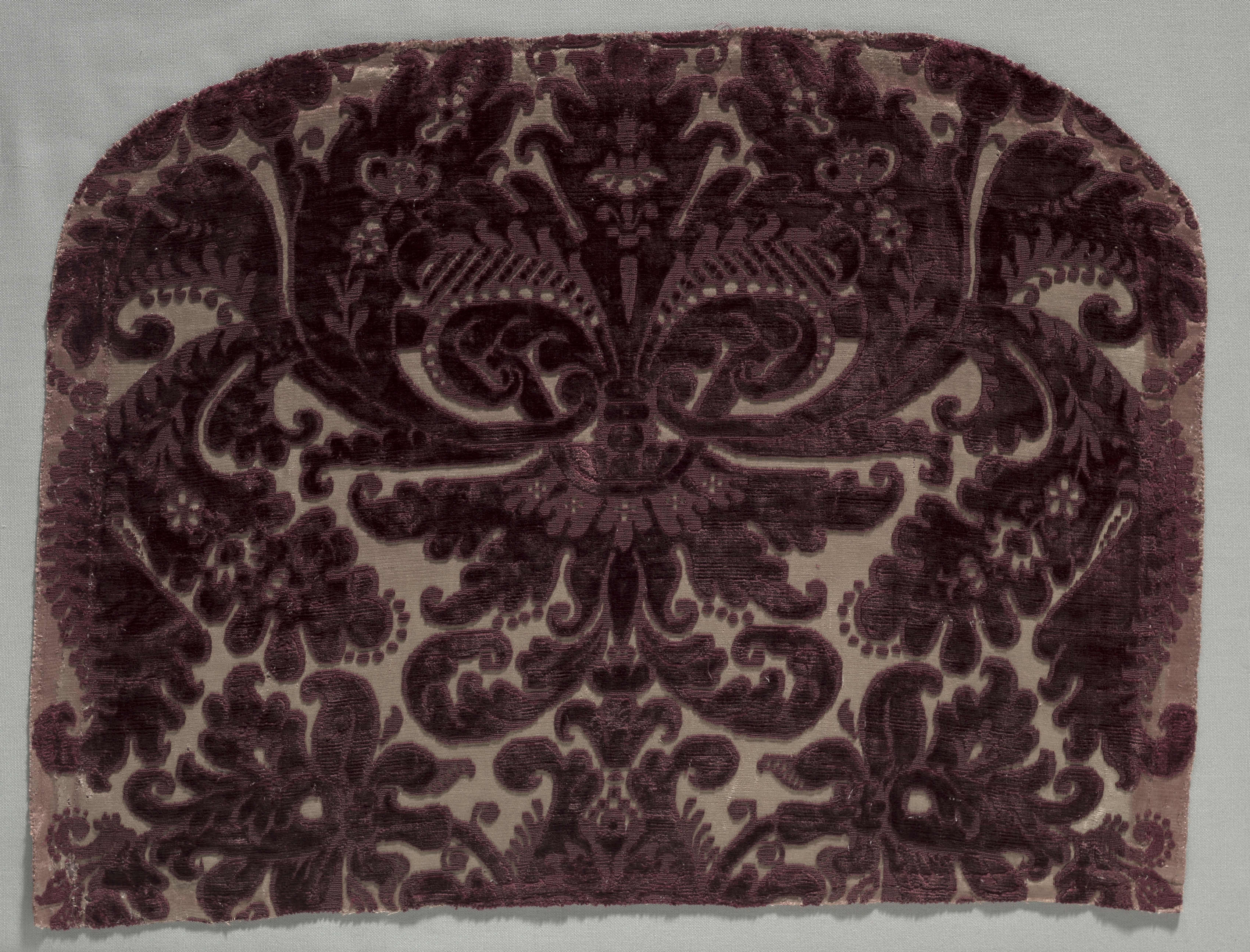
Technical Deconstruction: The Genoese Velvet Fragment
The provided fragment, while physically small, represents a dense nexus of historical craft and futuristic potential. Its origin in Genoa, Italy, is not merely a geographic notation but a critical technical datum. Genoa, alongside Venice, was a pinnacle of European velvet production from the Renaissance onward. The Genoese technique often involved a silk pile on a linen or silk ground, creating a fabric of immense luxury and visual depth. The specific weave structure—whether a plain, satin, or twill-backed velvet—would dictate its drape, sheen, and resilience. Our initial microscopy confirms a cut-pile construction, where the loops formed by the warp threads are severed, creating that signature plush, light-absorbing surface. The pile height and density are exceptional, suggesting a high thread count and meticulous finishing processes, likely involving precise shearing and steaming to achieve a uniform, luminous surface. This is not a base material; it is a historical artifact of textile engineering.
DNA Strand Reference: A Conceptual Framework for Regeneration
The reference to a "New DNA Strand" is the catalytic concept for this analysis. We interpret this not literally, but as a structural and philosophical framework. A DNA strand is a helical code, a sequence of base pairs that contains all instructions for building and regenerating a complex organism. We apply this to the velvet fragment.
The "Base Pairs" of the Fragment: These are its irreducible components: the Material Code (silk protein, cellulose from linen), the Structural Code (weave type, pile angle, density), the Historical Code (Genoese craftsmanship, luxury, opulence), and the Sensorial Code (tactile response, visual light interplay, acoustic dampening). The avant-garde mandate requires us to sequence these codes in new, unexpected combinations.
Mutation and Splicing: The avant-garde outcome will be born from intentional "mutations." This involves splicing the velvet's DNA with alien elements. For instance, preserving the structural code (pile density) but replacing the material code with recycled technical polymers or bio-fabricated mycelium leather. Alternatively, maintaining the sensorial code of lush tactility but expressing it through a radically different structural code, such as 3D-knitted loops or laser-etched foam substrates that mimic the velvet's topography.
Avant-Garde Trajectories: From Fragment to Future System
Moving from technical deconstruction to creative synthesis, the Genoese velvet, viewed through the lens of its new DNA, suggests three primary trajectories for an avant-garde collection.
Trajectory 1: The Mineralized Hybrid
Here, we focus on velvet's light-absorbing quality and contrast it with its opposite. We "mineralize" the fabric. Imagine the velvet fragment as a core, upon which crystalline structures grow. Techniques could include: Electroforming to deposit copper or silver directly onto the pile in dendritic, organic patterns; Bio-resin impregnation in selective zones, creating rigid, translucent panels that emerge from the soft matrix; or Fusible ceramic coatings applied via paste and high-heat, resulting in cracked, lava-like textures alongside untouched plush. The garment becomes a landscape—simultaneously soft and hard, organic and geologic. Silhouettes would be architectural, with rigid, exoskeletal elements protecting or emanating from cavities of deep, soft pile.
Trajectory 2: The Deconstructed Loom
This path deconstructs the very principle of weaving. Using the DNA strand as a linear model, we re-imagine the warp and weft not as threads, but as streams of data or physical elements. The pile is not cut, but manifested. Proposals include: Optical Velvet created via lenticular printing or micro-prism films applied to a base fabric, where the "pile" is an illusion that shifts with movement. Parametric 3D-Printed Pile, where the velvet surface is algorithmically generated and printed with flexible filaments in varying heights, programmable for pattern and compression. Magnetic Filament Fields, where a base garment is embedded with a magnetic field pattern, and ferrous pile elements are applied, allowing the surface texture to be reconfigured by the wearer. This trajectory speaks to digital craftsmanship and wearable technology, making the luxury of velvet dynamic and interactive.
Trajectory 3: The Bio-Logical Archive
This is the most conceptual path, treating the fragment as a literal biological sample. We ask: if this velvet has DNA, can it grow, decay, or symbiotically interact? This leads to Living Finishes—using the velvet as a substrate for controlled bacterial cellulose growth, creating a living, breathing second skin that changes over time. Enzymatic Distressing, where specific enzymes are applied to digest either the silk pile or the linen ground in precise patterns, creating organic, lace-like erosion designed by chemical reaction. Finally, Embedded Spore Inks containing non-pathogenic fungi or algae that activate under specific conditions (moisture, light), causing the garment to develop a patina of color or texture. This trajectory challenges the permanence of fashion, proposing a garment with a lifecycle and an element of cultivated unpredictability.
Conclusion: The Fragment as Genesis
The Genoese velvet fragment is our primordial sample. Its value lies not in its square footage, but in the depth of its coded information. By adopting the "New DNA Strand" framework, we shift from mere reuse to regenerative design. We are not patching with history; we are isolating its core principles and hybridizing them with the materials, technologies, and philosophies of the present and near-future.
The recommended avant-garde direction is a synthesis of Trajectory 2 (Deconstructed Loom) and Trajectory 3 (Bio-Logical Archive). This fusion yields a concept we term "The Programmable Biotic Pile." Imagine a base layer grown from microbial cellulose (archive), onto which a field of parametrically designed, magnetically attached pile elements can be placed (deconstructed loom). The surface texture, color, and thermal properties become modular and responsive. The garment is both a cultivated organism and a technological interface, embodying the luxury of historic Genoese velvet through its complexity and sensory depth, while existing in a wholly new formal and functional paradigm. This is the ultimate deconstruction: not taking the fabric apart, but unlocking its genetic potential to build anew.