Technical Deconstruction: The Architectural Blueprint of Opulence
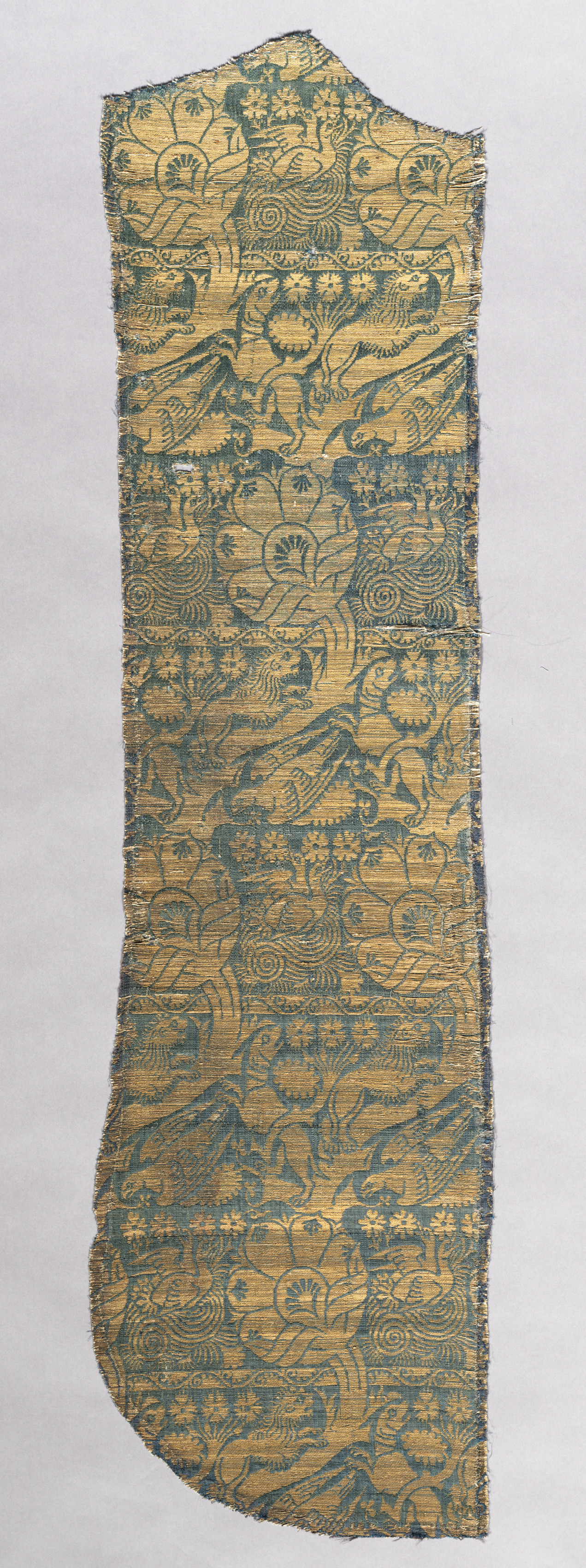
The provided fragment is not merely silk and gold; it is a lampas weave, a pinnacle of medieval and Renaissance textile engineering. This technique is fundamental to our analysis. Lampas involves the interlacing of two sets of warps (foundation and binding) with two or more sets of wefts, creating a compound structure that allows for complex, contrasting patterns with a pronounced relief effect. In this instance, the ground is likely a fine silk tabby, providing a supple, luxurious base. Over this, a secondary set of silk wefts, potentially in a satin or twill binding, constructs the elaborate figurative design. The gold thread, now tarnished but once radiant, is not simply couched on but integrated as a third weft, often wrapped around a silk core (file), woven to form the shimmering background or specific highlights within the animals' forms.
Material Semiotics: Silk as Skin, Gold as Aura
The material choices are a direct language of power and sanctity. Italian silk, particularly from centers like Lucca or Venice, represented the apex of European technology and trade in the medieval period. Its use here signals immense wealth and a connection to global networks (the Silk Road). The gold thread amplifies this, transforming the textile from a decorated surface into a light-emitting object, designed to catch candlelight in a dim chapel, making the depicted creatures seem alive and supernatural. For Zoey Lab, this is a masterclass in material hierarchy: the base material (silk) carries the narrative image, while the precious additive (gold) creates an environmental effect, an aura. In deconstruction, we might separate these layers literally: imagine the gold pattern extracted as a sheer, metallic overlay, or the silk animal motifs printed onto technical mesh, isolating their symbolic weight from their opulent context.
Narrative Deconstruction: The "Realistic Animals" Codex
The description "realistic animals" is intriguing for a presumably medieval chasuble. This realism is likely relative—a move away from pure heraldic symbolism toward observed naturalism, perhaps in the style of the International Gothic. These creatures (eagles, hounds, lions, or possibly mythical hybrids like griffins) are not just decoration; they are a symbolic lexicon. Each animal carries a specific theological or patronal meaning: the lion of St. Mark, the eagle of St. John, the lamb of God, the pelican of piety. They form a silent sermon woven into the garment.
From Sacred Code to Genetic Code: The DNA Strand Reference
The directive "Reference: New DNA Strand" is our pivotal avant-garde lens. It instructs us to view this woven narrative not as a static iconography but as a generative, organic code. The repeating pattern of animals can be seen as a sequence—a base pair sequence in the genetic makeup of the garment's purpose. Deconstruction here means sequencing this code and splicing it. We could isolate a single "realistic animal" motif—the curve of a hound's spine, the feather pattern of an eagle's wing—and use it as a repeating印花 (print) or jacquard motif across an entire garment, divorcing it from its sacred narrative and celebrating its pure formal beauty. Alternatively, we could fragment the animals, pixelating their forms into abstract patterns that only hint at their origin, much as DNA contains the instructions for a whole but is itself an abstract sequence.
Avant-Garde Synthesis: The Zoey Lab Recombinant Garment
Pulling these threads together—the technical, the material, the narrative—under the avant-garde mandate leads us to a proposal for a contemporary piece.
Proposed Garment: The "Lampas Genome" Coat
Structure: We reject the original chasuble's closed, ceremonial form. Instead, we create a tailored, architectural coat. Its silhouette is sharp and modern, but its construction pays homage to the lampas principle: it is built from multiple, distinct layers that interact to form a whole. An outer shell of technical, matte silk-organza (representing the ground weave) is laser-cut with a precise, geometric pattern derived from the negative spaces around the animals.
Surface Intervention: Beneath this shell, a separate layer—a dynamic, flowing lining—carries the "DNA." Using advanced digital printing, we take the most "realistic" detail from an animal (the texture of fur, the barbules of a feather) and replicate it in a monochromatic, graphic pattern that resembles a DNA gel electrophoresis or a strand of code. This pattern is not static; it is scaled and distorted across the garment's panels.
Material Translation: The gold thread is translated for a modern context. We do not use literal gold, but its concept of light interaction. This is achieved through strategic use of heat-bonded metallic foil in fragmented, irregular patches on the outer shell, or through the integration of fine, conductive threads (a modern "gold thread") that allow for subtle, embedded lighting at seams, causing the coat to emit a soft glow in certain conditions—a direct, avant-garde dialogue with the original's luminous intent.
Philosophical Conclusion: Deconstruction as Reverence
For Zoey Fashion Lab, this analysis demonstrates that deconstruction is not destruction. It is a method of deep listening. By disassembling the chasuble fragment—its lampas architecture, its material sermon, its animal codex—we have not discarded its value but have sequenced its creative genome. The resulting avant-garde proposal honors the fragment's complexity by refusing mere replication. Instead, it recombines the core principles (compound structure, symbolic materiality, encoded narrative) into a new form that speaks to contemporary technology, personal expression, and a continued fascination with the interface of the organic, the symbolic, and the crafted. The original garment aimed to inspire awe in a divine context; our deconstructed "Lampas Genome" coat seeks awe through the revelation of the profound intelligence embedded in historical craft, making it newly visible and vitally relevant.