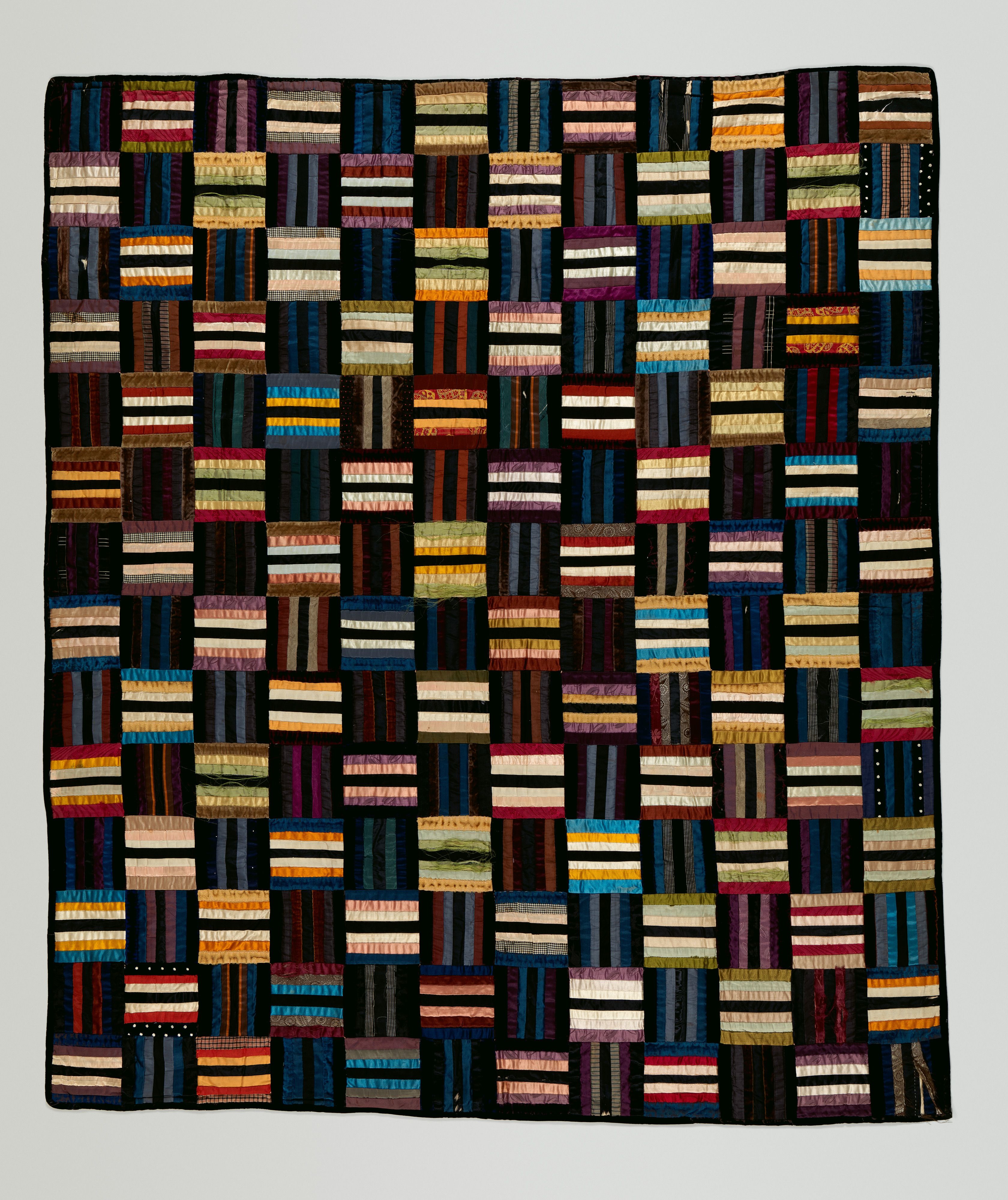
Deconstructing the Domestic: The Roman Stripe Quilt as Avant-Garde Armature for SS26
The quotidian object, stripped of its utility and re-contextualized within the crucible of high fashion, becomes a radical proposition. For Zoey Fashion Laboratory’s SS26 collection, the humble American quilt—specifically a Roman Stripes pattern rendered in silk, silk velvet, and cotton—is not merely a textile reference but a structural manifesto. This analysis deconstructs the quilt’s inherent geometry, tactility, and cultural weight to propose a future silhouette that is both architecturally severe and sensuously draped. The Roman Stripes pattern, with its rhythmic verticality and chromatic tension, serves as the primary generative code for a new typology of garment architecture.
From Domestic Artifact to Futuristic Silhouette
The traditional Roman Stripes quilt, with its alternating bands of color and pattern, is an exercise in controlled repetition. In the hands of the avant-garde, this repetition becomes a rhythmic pulse—a visual metronome that dictates the garment’s silhouette. The quilt’s historical function as a layered, protective covering is inverted for SS26: it is no longer a surface to be lain upon, but a structural membrane to be worn. The futuristic silhouette emerges from the quilt’s inherent dimensionality. We propose a series of modular, sculptural forms where the quilt’s panels are not sewn flat but are engineered as independent, articulated volumes. Think of a double-layered, asymmetrical tunic where the front panel is a rigid, quilted carapace of silk velvet (its pile catching light to create a living, shifting texture) while the back panel is a fluid, deconstructed fall of silk habotai. The Roman stripe becomes a directional force, guiding the eye vertically upward, elongating the form into a cybernetic silhouette that is both armored and ethereal.
Material Alchemy: Silk, Velvet, and Cotton as Structural Agents
The material triad of silk, silk velvet, and cotton is not a decorative choice but a strategic one. Each fiber possesses distinct structural properties that are exploited to create tension, release, and volume. The silk velvet is the primary agent of opacity and weight. Its dense pile, when quilted in a Roman Stripe pattern, creates a rigid, almost architectural relief. This is the material for the garment’s “hard” zones—the shoulders, the hips, the collar. The silk, in its purest, unquilted form, is the material of fluidity and transparency. It is used for the “soft” zones—the inner linings, the trailing panels, the veiled layers that reveal the body in motion. The cotton, historically the quilt’s backbone, is re-engineered as a structural batting. However, instead of being hidden, it is exposed and treated as a visible, textural element. Raw edges of cotton batting are left unhemmed, fraying into a soft, organic fringe that contrasts with the sleekness of the silk. This is a deliberate deconstructive aesthetic, where the garment’s internal architecture is laid bare, challenging the viewer to see the process of making as part of the final form.
Structural Innovation: The Quilt as Modular Armature
The core innovation for SS26 lies in the re-imagining of the quilt’s stitching lines. In traditional quilting, the stitches are functional—they hold the layers together. Here, they become structural seams that define the garment’s volume. We propose a technique of “negative-space quilting,” where the Roman Stripe pattern is not filled with batting but is left hollow, creating a series of tubular, air-filled channels. These channels act as pneumatic ribs, allowing the garment to hold its shape without internal boning. A coat, for example, is constructed from a series of these tubular stripes, each one a self-supporting column of silk velvet. The stripes are not sewn together but joined with invisible magnetic snaps, allowing the wearer to reconfigure the silhouette in real-time—a truly futuristic, modular garment. The cotton batting is used sparingly, only in the panels that require a softer, more compressive fit, such as the waist or the inner sleeve. This creates a dialectic between the rigid, pneumatic outer shell and the soft, yielding interior.
Chromatics and the Roman Stripes Code
The Roman Stripes pattern is a code of visual rhythm. For SS26, we decode this rhythm into a chromatic language that is both nostalgic and futuristic. The traditional palette of deep indigo, ochre, and vermillion is retained but re-saturated to an almost neon intensity. The silk velvet stripes are dyed in a gradient of these colors, shifting from dark to light as they move from the garment’s core to its periphery. The silk stripes are left in their natural, off-white state, creating a stark contrast that emphasizes the pattern’s verticality. The cotton batting, when exposed, is bleached to a ghostly white, serving as a neutral ground that absorbs the surrounding color. This chromatic strategy is not decorative but functional: it creates a visual map of the garment’s structural logic. The brightest stripes correspond to the most rigid, load-bearing zones; the palest stripes indicate areas of movement and drape.
Conclusion: The Quilt as a Portal to the Future
The American Roman Stripes quilt, in this avant-garde analysis, is no longer a relic of domestic craft. It is a blueprint for a new sartorial order. By deconstructing its layers, re-engineering its materials, and re-imagining its stitching as structural architecture, Zoey Fashion Laboratory proposes a futuristic silhouette that is both a tribute to tradition and a radical departure from it. The garment becomes a living, breathing structure—a second skin that is simultaneously protective and expressive, rigid and fluid. This is not simply fashion; it is structural innovation as a form of cultural commentary, where the quilt’s history is honored by being destroyed and rebuilt as a vision of the future. The SS26 collection will be a testament to the power of the everyday object, re-contextualized as a vehicle for avant-garde expression.