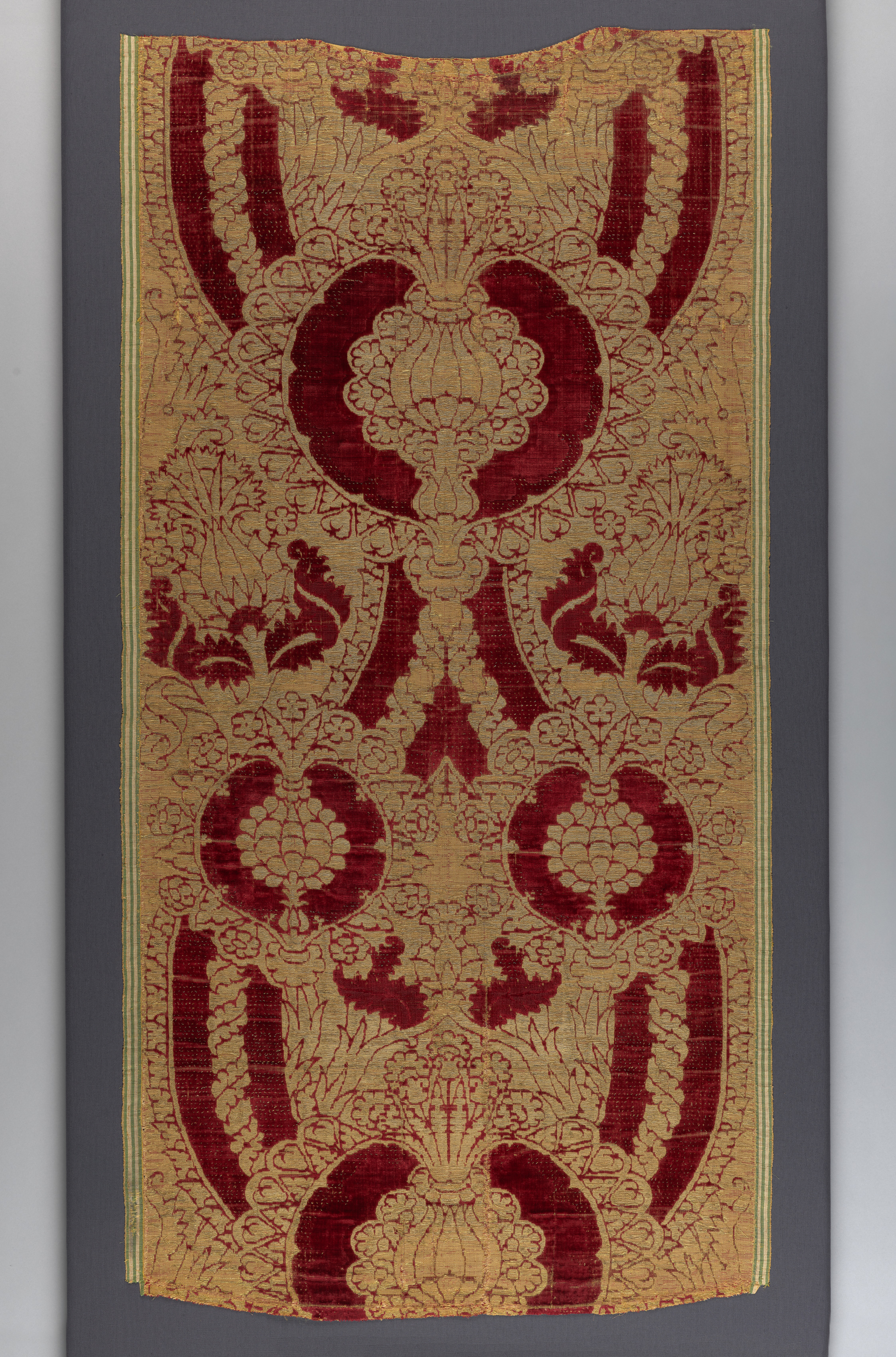
Deconstructing the Past: Silk Velvet with Gold in Pomegranate Pattern
At Zoey Fashion Lab, our mission is to unravel the structural and aesthetic DNA of historical textiles, translating their core principles into avant-garde expressions. The subject of this analysis—a 15th-century Italian silk velvet with gold, featuring a pomegranate pattern—presents a remarkable case study. Originating possibly in Florence, this fabric is not merely a relic; it is a sophisticated engineering of luxury, texture, and symbolism. By dissecting its technical components, we can extract a new design language, a “New DNA Strand,” that informs our disruptive, future-facing collections.
Technical Architecture: The Three-Dimensional Fabric
The technical specifications of this velvet are extraordinary. It employs a complex weave structure combining cut pile in two heights, uncut pile loops, and gold-thread loops. This is not a flat surface; it is a sculptural terrain. The two heights of cut pile create a chiaroscuro effect—a play of light and shadow that defines the pomegranate motif. The higher pile catches light, appearing luminous, while the shorter pile recedes into darkness, adding depth. The uncut pile loops introduce a tactile roughness, a deliberate disruption to the smooth velvet, while the gold-thread loops act as metallic accents, catching ambient light and creating a shimmering, almost liquid quality.
From a deconstructionist perspective, this fabric challenges the binary of “texture” versus “pattern.” Here, texture is pattern. The pomegranate is not printed or embroidered onto a ground; it is carved from the pile itself. The gold threads are not merely decorative; they are structural, woven into the fabric’s warp and weft, creating a tension between the soft, organic silk and the rigid, metallic gold. This interplay of materials—soft/hard, matte/shiny, smooth/rough—is the core of its avant-garde potential.
Symbolic Deconstruction: The Pomegranate as a Motif of Transformation
The pomegranate pattern in Renaissance Italy was a symbol of fertility, abundance, and eternal life. It was also a motif of power, often used in ecclesiastical and aristocratic garments. For Zoey Fashion Lab, we reinterpret this symbolism through a contemporary lens. The pomegranate is no longer a static emblem; it becomes a metaphor for cellular division, genetic mutation, and organic growth. The seeds within the fruit represent potential, multiplicity, and the fragmentation of identity. In our avant-garde designs, the pomegranate pattern will be deconstructed into its constituent parts—individual seeds, stems, and leaves—reassembled as abstract, asymmetrical forms that suggest a living, evolving organism.
The gold thread, historically a signifier of wealth and divinity, is recontextualized as a conductor of energy. In our designs, gold will be used not as a surface embellishment but as a structural element—a metallic thread that runs through the fabric like a nervous system, connecting disparate parts of a garment. This creates a visual and tactile dialogue between the organic (silk) and the inorganic (metal), echoing the tension between nature and technology that defines our era.
Deconstructing the Weave: From Historical Craft to Avant-Garde Technique
To translate this 15th-century fabric into a modern design language, we must first deconstruct its weave. The two heights of cut pile can be reimagined as variable density zones within a garment. For example, a jacket might have high-pile panels on the shoulders (catching light, creating volume) and low-pile panels on the sides (receding, creating a slimming effect). The uncut pile loops become tactile disruptions—strategically placed at seams, cuffs, or collars to invite touch and create a sense of unfinished, raw luxury. The gold-thread loops are transformed into metallic micro-architectures—tiny loops that can be pulled, stretched, or left loose to create a three-dimensional, almost sculptural surface.
Our design process will involve reverse-engineering the velvet using modern techniques. We will use laser-cutting to create precise variations in pile height, mimicking the two-height cut pile. We will incorporate uncut pile loops through a combination of hand-weaving and digital knitting, allowing for controlled irregularities. The gold-thread loops will be replaced with conductive metallic fibers that can be integrated with LED micro-lights, creating a garment that literally glows from within. This is not mere homage; it is a technological evolution of the original craft.
Avant-Garde Application: The New DNA Strand Collection
Under the “New DNA Strand” concept, this deconstructed velvet will inform a capsule collection of seven pieces, each representing a different aspect of the fabric’s genetic code. The first piece, “The Pomegranate Seed,” is a top with a single, oversized pomegranate motif on the left shoulder, constructed with high-pile cut velvet and gold-thread loops that form a spiral pattern. The second piece, “The Velvet Terrain,” is a floor-length coat with variable pile heights, creating a topographical map of the pomegranate pattern. The third piece, “The Gold Conductor,” is a bodysuit with metallic threads running along the spine and arms, connecting to tiny LED nodes that pulse with the wearer’s heartbeat. The fourth piece, “The Uncut Loop,” is a skirt with deliberately unfinished edges, where uncut pile loops hang loose, creating a fringe-like effect. The fifth piece, “The Shadow Pile,” is a dress with low-pile velvet panels that appear almost black, contrasting with high-pile panels that shimmer. The sixth piece, “The Genetic Fragment,” is a deconstructed jacket where the pomegranate pattern is broken into geometric shards, reassembled in a chaotic, asymmetrical arrangement. The seventh piece, “The Metamorphosis,” is a cape that can be worn in multiple configurations, with gold-thread loops that can be pulled to change the shape and silhouette.
Conclusion: Weaving the Past into the Future
The 15th-century Italian silk velvet with gold in pomegranate pattern is not a museum piece; it is a blueprint for innovation. By deconstructing its technical and symbolic DNA, Zoey Fashion Lab can create garments that are both historically grounded and radically futuristic. The interplay of cut and uncut pile, the tension between silk and gold, the organic symbolism of the pomegranate—all these elements are raw materials for an avant-garde vocabulary. In our hands, this ancient fabric becomes a living, evolving entity, a New DNA Strand that connects the past to the future, the tactile to the technological, the symbolic to the structural. This is the essence of deconstruction: not to destroy, but to reveal the hidden potential within every thread.