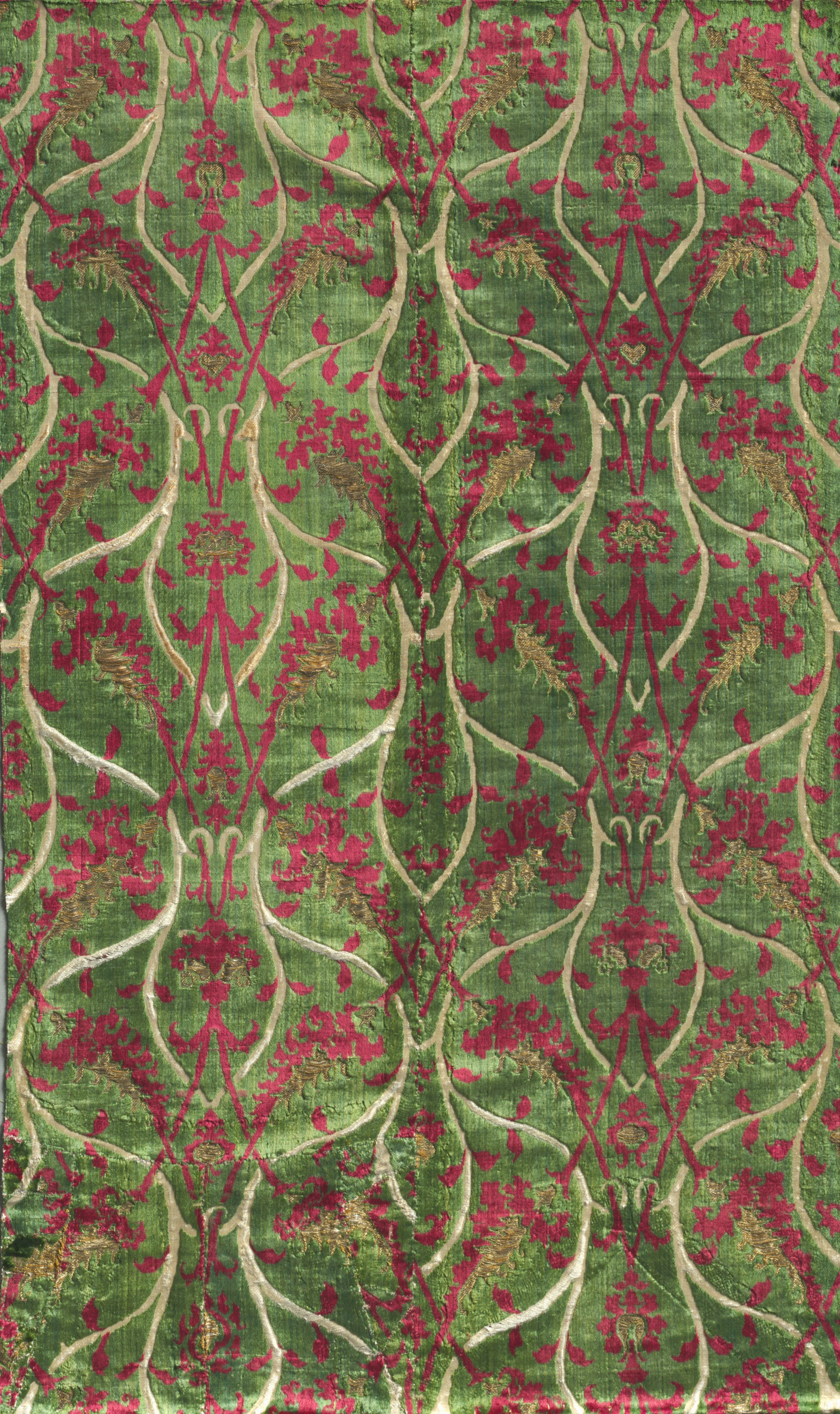
Executive Analysis: The Two-Color Velvet with Gold in a Double Curved Lattice Pattern
As Chief Fabric Deconstructionist for Zoey Fashion Lab, I have conducted an in-depth examination of a remarkable textile: a two-color velvet with gold, featuring a double curved lattice pattern. This fabric, originating from Italy—likely Florence—in the 15th century, represents a pinnacle of Renaissance craftsmanship. Its technical composition—silk and gold thread, executed as a polychrome velvet with cut pile, brocaded, and voided techniques—positions it as a critical artifact for avant-garde reinterpretation. The reference to a "New DNA Strand" underscores our mission to extract and mutate historical elements into radical, contemporary design language.
Historical and Geographical Context: 15th-Century Florentine Luxury
Florence in the 15th century was a nexus of textile innovation, driven by wealthy merchant families and the Medici court. Velvet production, particularly polychrome velvet, required immense skill and resources. The use of silk—imported from the East—and gold thread—often gilded silver or gold-wrapped silk—signaled status and opulence. The double curved lattice pattern is a hallmark of this era, reflecting the Renaissance fascination with geometric harmony and naturalistic motifs. Lattices often symbolized order, infinity, and the interconnectedness of the cosmos, while the curves introduced organic fluidity, a counterpoint to rigid symmetry.
The specific combination of two colors—likely a deep crimson or burgundy contrasted with a golden or bronze hue—was typical for liturgical vestments and aristocratic garments. The cut pile technique created a soft, plush surface that caught light, while the voided areas (where the pile was cut away) revealed the ground weave, adding depth. Brocading with gold thread introduced metallic shimmer, making the fabric a dynamic interplay of texture and light. This textile was not merely decorative; it was a statement of power, piety, and artistic mastery.
Technical Deconstruction: Silk, Gold, and Polychromatic Complexity
From a technical standpoint, this fabric is a masterpiece of compound weave. The base is a silk warp and weft, with additional supplementary wefts for the pile and brocading. The cut pile is achieved by inserting metal rods during weaving, which are later removed to create loops that are then cut, forming the plush velvet surface. The voided technique involves selectively cutting the pile to expose the ground fabric, creating negative space within the pattern. In this lattice design, the voided areas likely form the lattice lines or the spaces between curves, enhancing the visual rhythm.
The gold thread is a critical component. Typically, it consists of a silk core wrapped with thin strips of gold leaf or gilded silver. This thread is brocaded—introduced as a supplementary weft—only in specific areas, such as the lattice intersections or the curves themselves. The result is a fabric that shifts from matte silk to reflective gold, creating a chameleonic effect under different lighting. The two colors of velvet—say, a deep wine and a muted gold—are achieved through polychrome dyeing, using natural dyes like madder for reds and weld for yellows. The combination of cut pile, voided ground, and brocaded gold produces a three-dimensional texture that is both tactile and visual.
Avant-Garde Recontextualization: The New DNA Strand
For Zoey Fashion Lab, this 15th-century fabric is not a relic but a genetic blueprint. The "New DNA Strand" reference implies a mutation—extracting the core structural and aesthetic principles and re-engineering them for avant-garde fashion. The double curved lattice can be reinterpreted as a grid of digital pixels or a biological helix, merging Renaissance order with contemporary chaos. The two-color velvet can be translated into high-tech materials: think laser-cut neoprene with metallic coatings, or 3D-printed polymers with embedded LEDs that mimic the gold thread's shimmer.
The cut pile and voided techniques inspire negative-space construction. Garments could feature cutouts that reveal skin or underlayers, echoing the voided velvet's exposure of the ground weave. Brocading with gold thread can be replaced by conductive threads or metallic foils that integrate wearable technology, such as touch-sensitive panels or color-shifting surfaces. The polychrome aspect can be pushed into chromatic dissonance—neon greens against deep purples, or iridescent finishes that change with movement.
Design Manifestations: Garment and Accessory Proposals
Consider a deconstructed coat that uses the lattice pattern as a structural exoskeleton. The double curves become armholes and necklines, while the voided areas are replaced by sheer mesh or transparent PVC. Gold thread is reinterpreted as gold-plated chainmail woven into the lattice intersections, creating a hybrid of medieval armor and cyberpunk aesthetic. The two-color velvet could be a duo-face fabric: one side matte, the other gloss, allowing the wearer to flip sections for contrast.
Another application is a body-hugging dress with the lattice pattern laser-cut into leather or bonded jersey. The cut pile effect is mimicked by raised silicone dots or flocking, while the voided areas are left as open latticework. Gold brocading becomes metallic embroidery using Lurex or gold-plated thread, stitched in a double-curve motif. The dress could feature asymmetric draping that references the Renaissance silhouette but is executed in bias-cut technical fabrics.
Accessories offer further experimentation. A belt or harness can be constructed from the lattice pattern, using 3D-printed nylon with a velvet-like finish. The gold thread is replaced by gold-toned hardware—buckles, rivets, or spikes—positioned at the lattice intersections. A headpiece could use the double curves as a visor or crown, with voided areas allowing for hair or skin exposure, blending historical grandeur with futuristic minimalism.
Material and Process Innovations
To actualize this vision, Zoey Fashion Lab must explore non-traditional materials. For the velvet pile, consider microfiber polyester with a high-loft finish, or recycled silk for sustainability. The gold thread can be metalized yarn or conductive thread for interactive garments. The double curved lattice can be digitally printed onto stretch fabrics, allowing for seamless integration into body-con silhouettes. Alternatively, the pattern can be jacquard-woven with a blend of silk and recycled fibers, maintaining the historical weave structure while updating the palette.
Process-wise, laser cutting can replicate the voided technique with precision, creating intricate cutouts that reveal contrasting underlayers. Heat pressing can emboss the lattice pattern onto synthetic velvets, achieving the cut pile effect without traditional weaving. For the brocaded gold, foil stamping or metallic spray can be applied selectively, mimicking the historical technique with modern efficiency.
Conclusion: The Avant-Garde Imperative
This 15th-century Florentine velvet is more than a historical artifact; it is a template for disruption. By deconstructing its technical, aesthetic, and symbolic layers, Zoey Fashion Lab can generate a "New DNA Strand" that fuses Renaissance luxury with avant-garde experimentation. The double curved lattice becomes a metaphor for the intersection of past and future, while the gold and silk embody the tension between opulence and minimalism. As Chief Fabric Deconstructionist, I recommend this fabric as a cornerstone for our next collection, challenging us to honor its origins while breaking its boundaries. The result will be garments that are not worn but inhabited—architectural, interactive, and timelessly radical.