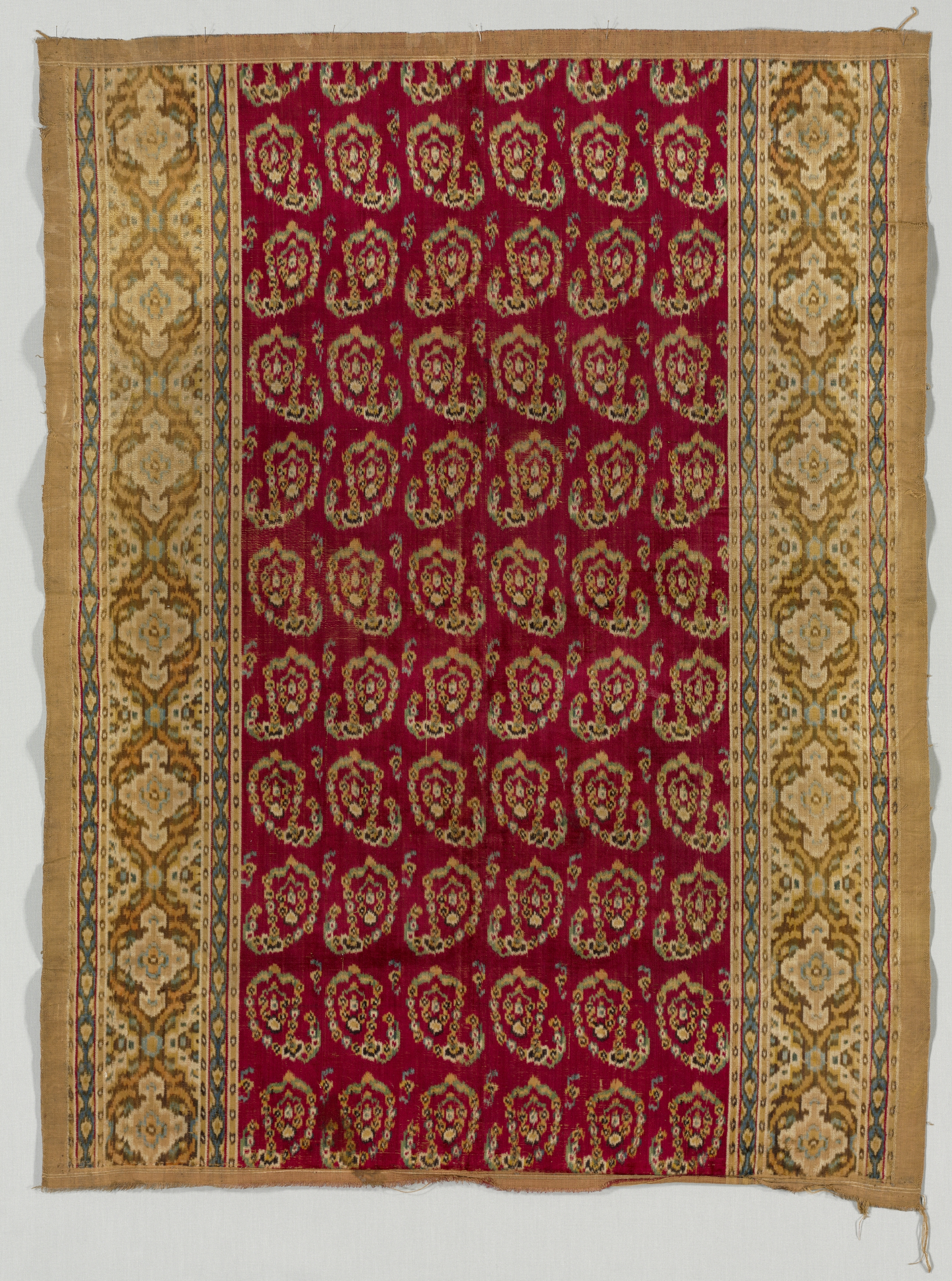
Deconstructing the Kashan Velvet: A New DNA Strand for Zoey Fashion Lab
At Zoey Fashion Lab, we do not merely observe textiles; we interrogate them. We dissect their history, their construction, and their cultural resonance to extract the raw genetic material for new, avant-garde forms. The subject of this analysis—a 19th-century Iranian velvet panel from Kashan—represents a profound anomaly within the traditional textile canon. Its technical mastery and ornamental density are not endpoints but starting points. For the Lab, this velvet is not a relic; it is a new DNA strand, a blueprint for deconstructing opulence and re-splicing it into a radical, contemporary aesthetic.
Technical Genesis: The Architecture of Opulence
The Kashan velvet is a product of extraordinary technical sophistication. Its structure is a cut-pile velvet, woven on a drawloom with a silk foundation and a pile of silk or sometimes a blend of silk and cotton. The defining characteristic is the depth and density of the pile, achieved through the insertion of metal rods that are later cut to create a plush, three-dimensional surface. This is not a flat, printed image; it is a sculpted topography. The motifs—often featuring cypress trees, peacocks, or intricate floral arabesques—are not merely dyed but are built through the interplay of raised pile and voided, or uncut, ground.
The color palette is equally deliberate. Deep, saturated ruby reds, midnight blues, and emerald greens dominate, often with the introduction of gold or silver metallic threads (Lahaf) to create a shimmering, reflective surface. The gold is not a mere accent; it is a structural element, woven into the ground to catch light and create a dynamic, almost holographic effect. The weave density is exceptionally high, often exceeding 100 warp threads per inch, giving the fabric a weight and a drape that is both luxurious and architecturally rigid. It is a fabric that demands to be seen in motion, its surface shifting with every angle of light.
For Zoey Fashion Lab, this technical profile is a deconstruction manual. The cut-pile technique, with its ability to create both positive and negative space, suggests a method for building volume and texture in avant-garde silhouettes. The metallic threads are not decorative; they are a source of digital-age interference, a noise in the visual field that can be amplified or fragmented. The high-density weave offers a structural integrity that can be manipulated—slashed, burned, or chemically dissolved—to create new forms.
Cultural Context: The Weight of History
To understand the Kashan velvet is to understand its origin. Kashan, a city in central Iran, was a major center of silk production and velvet weaving from the 16th century onward. The 19th-century panels were often created for the Qajar court, serving as wall hangings, tent linings, or ceremonial garments. The motifs are deeply symbolic: the cypress tree represents resilience and eternity; the peacock symbolizes immortality and divine beauty; the floral arabesques evoke the gardens of paradise. The velvet itself was a marker of status, wealth, and spiritual aspiration.
This cultural weight is not something to be ignored or superficially referenced. For the Lab, it is a counterpoint to be subverted. The traditional symbolism—the fixed meanings of eternity and paradise—must be destabilized. The velvet’s history as a symbol of imperial power and religious transcendence becomes a raw material for critique. We do not reproduce the peacock; we extract its pattern and re-encode it as a glitch, a fractured repetition that speaks to the instability of identity in the digital age. The cypress tree is not a symbol of resilience but a line to be broken, a vector of decay.
Avant-Garde Application: The New DNA Strand
The Kashan velvet, as a new DNA strand, offers a set of genetic instructions for Zoey Fashion Lab. These instructions are not about replication but about mutation. The following are key areas of deconstruction and re-synthesis:
1. Surface and Structure: The cut-pile technique is a model for creating tactile, sculptural surfaces. The Lab will experiment with laser-cutting and chemical etching to selectively remove pile, creating patterns that are not woven but burned. This introduces a sense of decay and impermanence, a direct counter to the velvet’s original intention of eternal beauty. The metallic threads will be isolated and used as conductive fibers, embedded with LEDs or sensors to create garments that respond to light or touch.
2. Color and Light: The deep, saturated colors of the Kashan velvet are a starting point for a chromatic deconstruction. The Lab will extract the color values and remap them onto a digital palette, then apply them to materials like neoprene, latex, or recycled plastic. The gold threads become a source of reflective interference, used in holographic panels or iridescent coatings that shift color based on the viewer’s angle. The goal is not to replicate the richness of the original but to create a disorienting, hyper-saturated effect that challenges the eye.
3. Motif and Pattern: The arabesques and floral motifs are not to be faithfully reproduced. Instead, they are fragmented and recombined using generative algorithms. The Lab will input the original pattern into a neural network, then output a series of glitched, distorted variations. These new patterns will be applied to the fabric using digital printing or embroidery with metallic thread, creating a dialogue between the handcrafted and the computational. The peacock’s tail becomes a data visualization, its feathers representing lines of code or sound frequencies.
4. Silhouette and Form: The velvet’s architectural weight informs the construction of avant-garde silhouettes. The Lab will use the fabric’s rigidity to create exaggerated, non-bodily forms—shoulders that jut out like architectural brackets, sleeves that are sculpted into geometric shapes, hemlines that are asymmetrical and jagged. The velvet is not draped; it is folded, pleated, and bonded to create a second skin that is both armor and artifact. The metallic threads are used as structural supports, like ribs in a corset, but visible and exposed.
Conclusion: The Fabric as a Living Code
The 19th-century Kashan velvet is not a finished object. It is a living code, a set of instructions that are open to interpretation and mutation. For Zoey Fashion Lab, it is a new DNA strand that allows us to reimagine the relationship between history and the future, between handcraft and technology, between opulence and decay. The velvet’s technical mastery is a challenge to be surpassed, its cultural weight a burden to be transformed. The final garments will not be nostalgic; they will be prophetic, speaking of a world where tradition is not preserved but deconstructed, where beauty is not eternal but ephemeral, and where the fabric itself is a site of radical, ongoing creation.