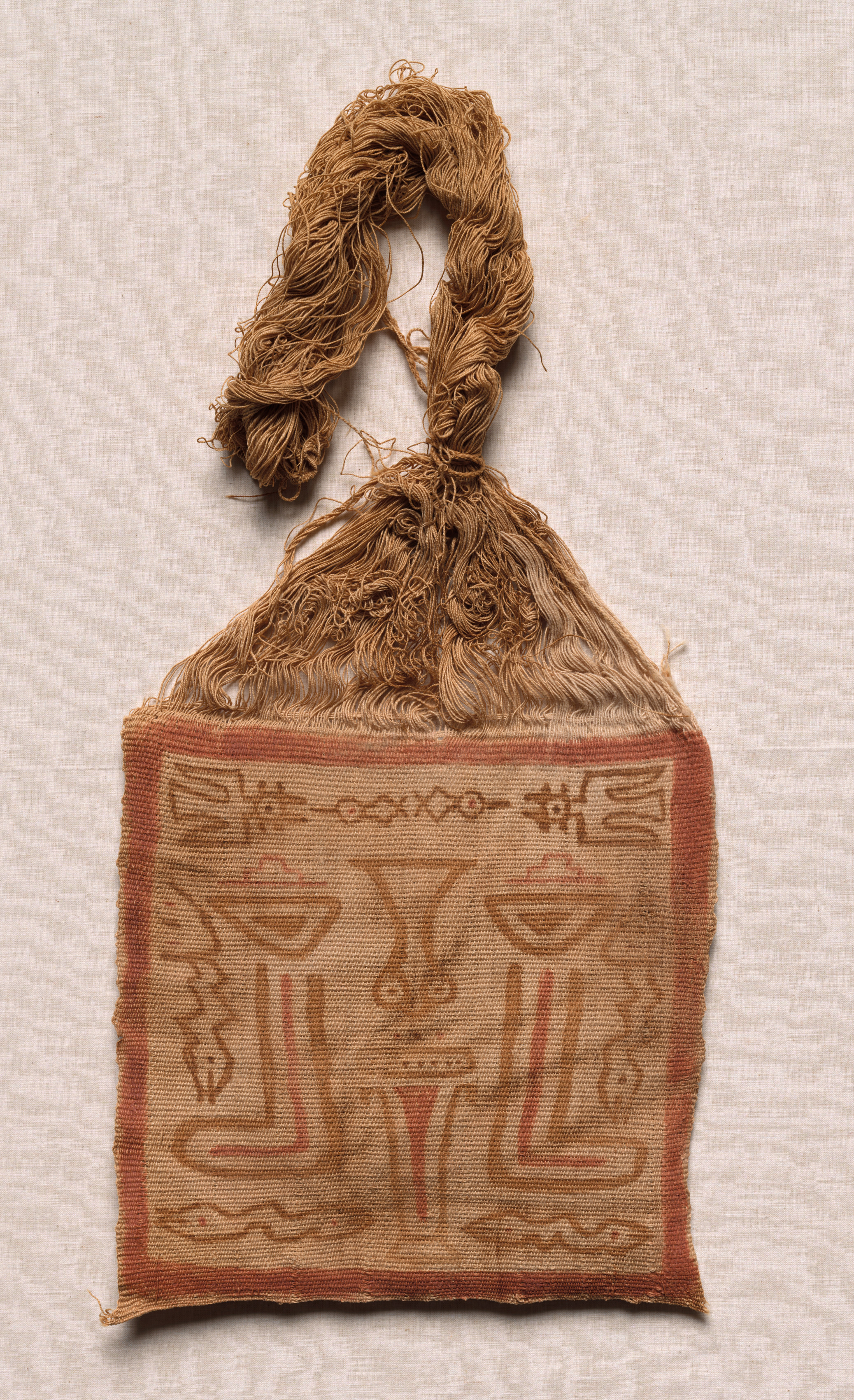
Deconstructing the Paracas Mummy Bundle Mask: An Avant-Garde Analysis for Zoey Fashion Lab
At Zoey Fashion Lab, our mission is to excavate the latent narratives embedded within historical textiles, transforming them into provocations for contemporary design. The subject of this analysis—a Mummy Bundle "Mask" from the Paracas culture of Peru’s South Coast (700 BCE–1 CE)—offers a profound case study. Constructed from cotton and pigment in a plain weave, this artifact from the Ocucaje site in the Ica Valley is not merely a funerary object; it is a radical statement on the transformation of the human form through textile architecture. For the avant-garde sensibility, this mask represents a pre-Columbian prototype of deconstruction, where the boundaries between body, fabric, and identity are deliberately blurred.
Technical Foundation: The Radical Simplicity of Plain Weave
The mask’s technical base—cotton and pigment in a plain weave—is deceptively simple. Plain weave, the most fundamental interlacing of warp and weft, is often dismissed as a baseline structure. However, in the context of this Paracas artifact, its simplicity is a deliberate choice that amplifies the subsequent interventions. The cotton fibers, native to the region, provide a neutral, absorbent canvas. The plain weave’s even grid creates a stable yet permeable surface, one that invites manipulation.
From an avant-garde perspective, this is a rejection of ostentatious technical complexity in favor of raw materiality. The mask does not rely on intricate brocading, tapestry, or supplementary wefts to achieve its impact. Instead, it uses the absence of structural embellishment to foreground the application of pigment and the act of shaping. This is a proto-minimalist gesture, a precursor to the 20th-century avant-garde’s fascination with the “truth to materials.” The mask’s power lies not in its technical difficulty but in the tension between the uniformity of the weave and the irregular, expressive application of color.
Pigment and Surface: The Aesthetics of Ritualized Decay
The pigments applied to this mask are not merely decorative; they are agents of transformation. Paracas artists utilized natural mineral and plant-based dyes, often in vivid reds, yellows, blacks, and blues. On this mask, the pigment is likely applied in patterns that reference feline, avian, or serpentine motifs—iconography tied to shamanic flight and the journey of the deceased into the afterlife.
For the avant-garde designer, the key insight is the performative nature of the pigment’s application. The paint does not adhere perfectly to the plain weave; it cracks, fades, and bleeds into the cotton fibers. This is not a flaw but a feature—a record of ritual use, burial, and time. The mask becomes a palimpsest, where the original design is partially obscured by the physical history of its existence. This aligns with the avant-garde interest in process art and the aesthetics of decay. The mask challenges the notion of a pristine, finished object, instead celebrating the beauty of erosion, of boundaries dissolving between the object and its environment.
Form and Function: The Mask as a Deconstructed Body
Functionally, this mask was part of a mummy bundle—a complex textile-wrapped package containing the deceased. The mask was placed over the face or head of the mummy, serving as a surrogate face for the journey into the next world. This is a crucial conceptual leap: the mask is not a portrait of the individual but a generic, idealized, or supernatural visage that replaces the decaying flesh.
From a deconstructionist viewpoint, this act is a radical dismantling of the self. The individual’s identity is not preserved but replaced by a textile construct. The mask is an interface between the organic body and the inorganic textile, a point of transition. The plain weave cotton becomes a second skin, one that is more durable, more symbolic, and more potent than the original. This prefigures the avant-garde fascination with exoskeletons, prosthetics, and the cyborg—the idea that the body can be augmented, abstracted, or even replaced by fabric.
Cultural Resonance: The Archive as a Collision of Temporalities
The reference to “Archive Resonance” in the brief—specifically the mention of 16th–17th-century cultural collisions—provides a critical lens. While this mask predates the Spanish conquest by over a millennium, its journey into a museum or private collection places it within a network of colonial and post-colonial translations. The mask was once a functional object within a living cosmology; now it is an artifact, a specimen, a source of aesthetic inspiration for a global fashion lab.
For the avant-garde practitioner, this displacement is not a loss but a generative rupture. The mask’s meaning is no longer fixed; it becomes a floating signifier, open to reinterpretation. The collision of the Paracas worldview with contemporary fashion creates a third space—a hybrid where the ancient and the futuristic coexist. The mask’s geometric patterns, its use of negative space, and its emphasis on the face as a canvas can be read as a proto-abstraction, a visual language that resonates with modern and postmodern art.
Avant-Garde Design Implications: From Mask to Garment
How does this analysis inform Zoey Fashion Lab’s design practice? The Paracas mask offers several direct provocations:
1. Surface as Narrative: The mask teaches us that a garment’s surface is not a neutral plane but a field of historical and ritual action. Designers should consider how pigment, wear, and manipulation can create a record of process. This could translate into garments that are intentionally distressed, dyed in irregular layers, or constructed from fabrics that age and change over time.
2. The Face as a Site of Intervention: The mask’s replacement of the biological face with a textile one suggests a deconstruction of the human silhouette. Avant-garde fashion can explore hoods, veils, and face-covering structures that abstract the wearer’s identity, creating a new, textile-based persona. This is not about hiding but about redefining the boundaries of the self.
3. Plain Weave as a Radical Choice: In an industry obsessed with technical innovation, the mask’s use of plain weave is a reminder that simplicity can be the most powerful statement. The focus should shift from complex weaves to the intervention on the surface—painting, quilting, cutting, or layering. The plain weave becomes a blank slate for deconstruction.
4. The Body as a Bundle: The mummy bundle itself is a total textile environment. The mask is just one element of a larger wrapping. This concept can inspire designs that envelop the body entirely, creating a second skin that is both protective and transformative. The garment becomes a cocoon, a container for the wearer’s journey.
Conclusion: The Mask as a Proto-Avant-Garde Object
The Paracas Mummy Bundle Mask is far more than an archaeological curiosity. It is a radical artifact of textile-based identity transformation. Its plain weave structure, its ritualized pigment application, and its function as a surrogate face all prefigure the deconstructionist and avant-garde impulses of later centuries. For Zoey Fashion Lab, this mask serves as a blueprint for a fashion that is not about ornamentation but about existential redefinition. It challenges us to see fabric not as a covering but as a technology of the self, a medium for rewriting the human form. In the collision of the Paracas archive with the avant-garde present, we find a resonance that is both ancient and urgently contemporary.