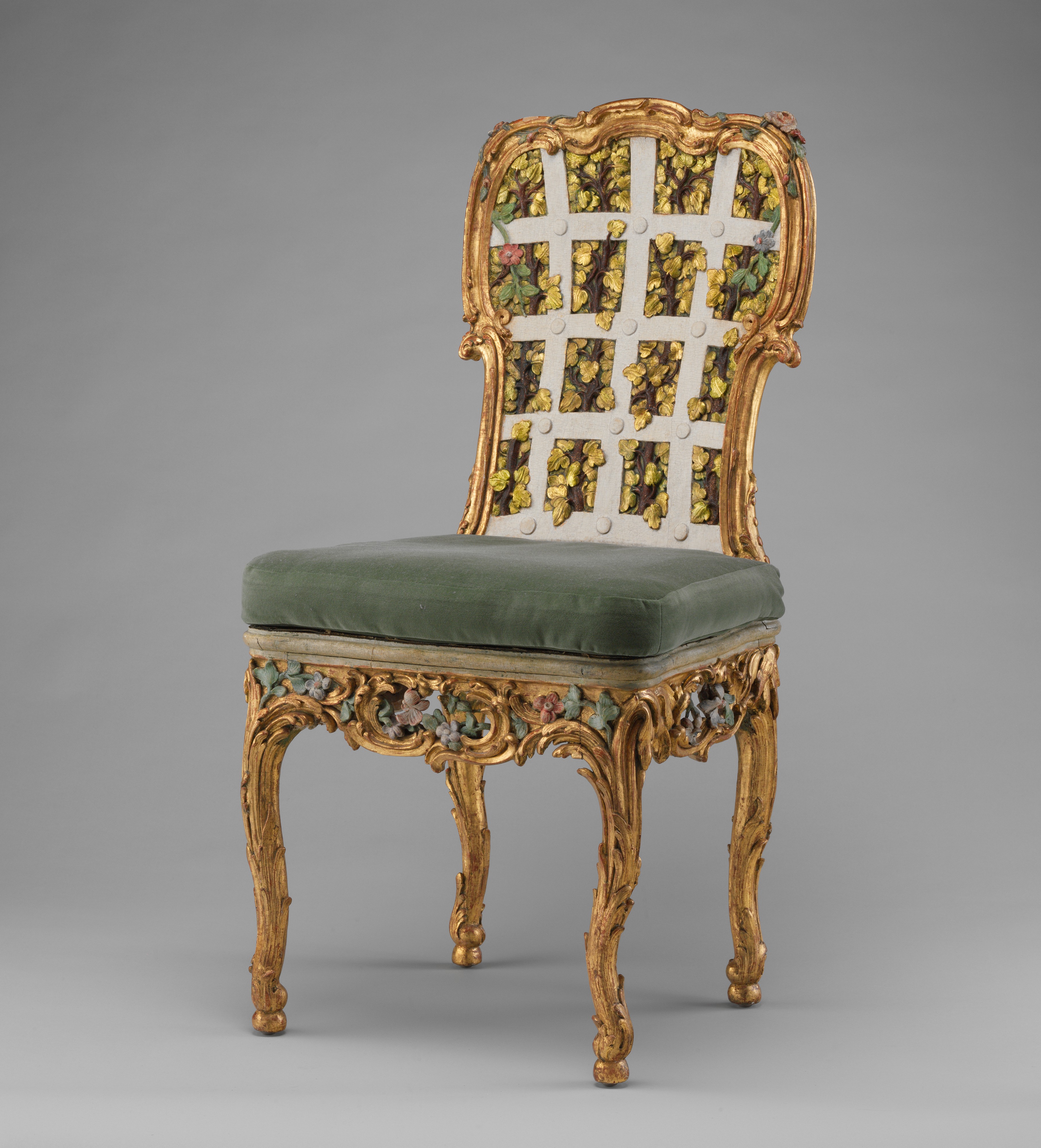
Deconstructing the Throne: The Side Chair as Avant-Garde Couture Prototype
The mandate for Zoey Fashion Laboratory’s SS26 collection is not found in the expected archives of textile history or natural forms, but in the silent, structural polemic of a single object: a side chair from the Global Frontier. This artifact, with its carved, painted, and gilded limewood frame and its non-original silk velvet squab, presents not as furniture, but as a deconstructed anthropomorphic architecture. Our analysis dissects this chair not for its function, but for its profound implications on the human silhouette, proposing a couture language where support and constraint, ornament and structure, are radically renegotiated. The chair becomes our first client, its form dictating a sartorial revolution built on the principles of rigid carapace, deliberate discomfort, and the poetic tension between body and imposed form.
Structural Innovation: The Exoskeletal Framework
The chair’s primary provocation lies in its carved limewood—a material both rigid and capable of intricate manipulation. This translates directly to SS26’s core innovation: the exoskeletal dress-form. We move beyond fabric draped on a body to architecting a wearable framework that exists independently of the wearer’s precise morphology. Inspired by the chair’s stiles, crest rail, and stretchers, garments will be built from lightweight, sculptural composites—resins infused with carbon fiber or molded polymers finished with gilded lacquer—that create a literal silhouette around the body. Imagine a bodice that is not sewn but assembled, with interlocking panels that echo the chair’s joinery, creating a hollow space between shell and skin. This is not clothing as a second skin, but as a portable, personal architecture. The silk velvet pillow, a later addition, is critically instructive; it signifies the point of contact, the necessary concession to the organic body. In our designs, these moments manifest as isolated, luxurious intrusions—a shock of plush, mutable velvet inserted into a rigid pectoral cavity or at the small of the back, highlighting the body’s presence only where it meets the structure’s confines.
Futuristic Silhouette: The Geometry of Enthronement
The side chair dictates a specific posture: upright, contained, formal. SS26 extrapolates this into a silhouette of amplified geometry and deliberate restriction. The squared crest rail inspires severe, horizontal shoulder extensions that frame the head like a modern halo. The splayed back legs inform a silhouette that widens sharply towards the hem, not through volume of fabric, but through angular, cantilevered appendages built out from the hips or calves, creating a stable, grounded base. This creates a silhouette that is static, powerful, and inherently futuristic—a silhouette meant for presentation, not for motion. Walking becomes a deliberate, ritualized performance. The wearer does not merely occupy space; they define it with their architectural periphery. This challenges the fluid, body-con trends of recent seasons, proposing instead a return to grandeur through abstract form, where the human figure becomes the central pillar in a wearable monument.
Material Dialectics: Gilded Carapace vs. Volatile Softness
The materiality of the chair presents a masterclass in contrast. The hard, gilded limewood versus the soft, absorptive velvet is a dialectic we will exploit to its extreme. The "gilded carapace" will be realized through advanced surface treatments: photo-reactive lacquers that shift hue under specific lighting, mimicking aged gilt, and precision-carved foam sealed to a porcelain-like finish, suggesting wood but weighing nothing. This represents the immutable, public facade. Opposing this, we introduce volatile, organic textiles: silk velvets that are chemically treated to decay or morph in contact with air or light, hydro-chromic linens that reveal patterns with moisture (perspiration), and inflated silicone bladders that serve as dynamic, body-responsive "pillows." This juxtaposition creates a narrative of permanence versus ephemera, the historic artifact versus the living organism. A gown may feature a rigid, gilded torso from which erupts a sleeve of unstable, blooming velvet, visually consuming the arm.
The SS26 Proposition: Standalone Avant-Garde Study
Contextualized as a standalone study, this collection rejects narrative frivolity. Each piece is a wearable thesis on the relationship between support and suppression, ornament and integrity. The four-chair set suggests a series, a variation on a form; thus, SS26 will comprise four distinct "families" of looks, each extrapolating a different element of the chair—the curvature of a splat, the tension of a stretcher, the redundancy of a duplicate object. The non-original pillow is key; it acknowledges adaptation and the imperfect history of objects. For Zoey, this translates to modularity and personalization. Certain rigid elements will be detachable, allowing the wearer to decide their own points of contact and comfort, to author their own relationship to the structure they don.
Ultimately, the Global Frontier side chair offers Zoey Fashion Laboratory a blueprint for a couture that is intellectually rigorous and sculpturally severe. SS26 will be a collection where garments are furniture for the body, proposing a future where dress is less about seasonal expression and more about permanent, radical re-architecture of the human form. We are not designing clothes to be sat in; we are designing clothes that, in themselves, constitute a throne.