Deconstructing the Carpet: Yamut Main as Architectural Textile for SS26
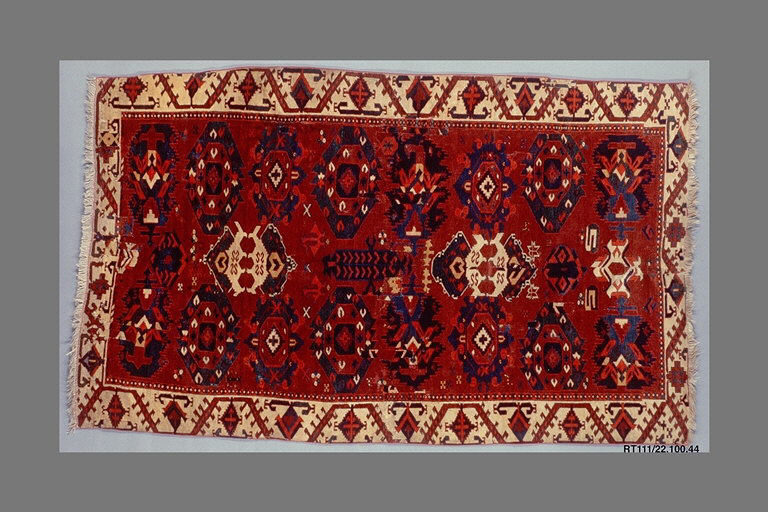
The Yamut Main Carpet, a relic of nomadic ingenuity from the Global Frontier, is often relegated to the realm of decorative arts—a warm, textured floor covering. For the avant-garde laboratory of Zoey Fashion Laboratory, however, this artifact is not a rug; it is a tectonic blueprint. In our SS26 study, we dismantle the Yamut Main’s structural DNA, extracting its symmetrically knotted pile, woolen warp and weft, and nomadic geometry to forge a new lexicon of futuristic silhouettes. This analysis transcends mere inspiration; it is a surgical extraction of structural innovation from a primal source.
The Symmetrical Knot as a Modular System
The core of the Yamut Main’s identity lies in its symmetrically knotted pile—a technique where two warp threads are twisted around a weft, creating a dense, resilient surface. In our deconstruction, this knot is not a decorative flourish but a modular building unit. For SS26, we propose a garment architecture where each knot becomes a three-dimensional node. Imagine a gilet constructed from hundreds of these knots, each one a tiny, rigid dome that can pivot on a central axis. The result is a dynamic, responsive surface that shifts with the wearer’s movement, creating a living silhouette that is both armor and fluid textile. This is not tailoring; it is tensile engineering on a micro-scale.
Furthermore, the knot’s symmetry offers a structural paradox. While traditional couture relies on seams and darts to shape fabric, the Yamut knot allows for self-supporting forms. We propose a coat where the pile is woven at varying densities—dense at the shoulders to create a rigid, architectural shoulder line, and sparse at the hem to allow for a cascading, almost liquid fall. This gradient of knot density is a break from conventional draping, introducing a new method of mass distribution that anticipates the body’s kinetic demands. The garment becomes a wearable scaffold, not a second skin.
Warp and Weft: The Axes of Futuristic Silhouette
The Yamut Main’s warp (vertical threads) and weft (horizontal threads) are not merely structural elements; they are directional forces. In a traditional carpet, the warp provides tensile strength, while the weft locks the pile in place. For SS26, we invert this hierarchy. The warp becomes the silhouette’s skeleton, running vertically along the spine and limbs. By weaving the warp with a high-tension wool, we create compression zones that cinch the waist or flare the hips without a single dart or seam. This is structural tailoring derived from the loom itself.
Conversely, the weft is reimagined as a horizontal expansion system. In our prototype, the weft is woven with a looser tension, allowing it to billow and contract in response to the wearer’s breath or stride. This creates a dynamic, inflatable silhouette—a dress that appears rigid when static but unfurls into a dramatic, undulating form during movement. The interplay between warp (stability) and weft (fluidity) generates a binary system of garment architecture, where the body becomes the active agent that triggers the transformation. This is not a passive garment; it is a kinetic sculpture.
Wool as a Futuristic Material: Beyond Softness
Wool, in the context of the Yamut Main, is often perceived as a soft, insulating fiber. For our avant-garde study, we reclassify wool as a high-performance structural material. The natural crimp of wool fibers provides inherent elasticity and memory, allowing it to hold form under tension without permanent deformation. We propose a wool-based shell for a jacket that is thermally bonded to a biodegradable resin, creating a rigid, self-supporting exoskeleton that mimics the structural integrity of carbon fiber but with the tactile warmth of a nomadic textile. This is biomimetic architecture at the molecular level.
Moreover, the pile height of the Yamut Main becomes a tool for gradient opacity and texture. By varying the pile length from 2mm to 15mm, we can create zones of translucency and opacity. A short pile in the bodice yields a dense, opaque surface, while a long pile at the sleeves produces a fuzzy, light-scattering effect that blurs the garment’s edges. This textural gradient allows for a futuristic camouflage, where the garment’s silhouette shifts between sharp definition and ethereal dissolution. The wool is no longer just material; it is a medium for optical manipulation.
Nomadic Geometry: The Blueprint for SS26 Silhouettes
The geometric motifs of the Yamut Main—often octagons, stars, and stylized flora—are not mere decorations. They are spatial diagrams for garment construction. In our SS26 collection, we extract the octagonal grid as a tessellation pattern for a modular dress. Each octagonal panel is woven separately with its own pile density and then joined via a magnetic or snap-fit system inspired by the knot’s symmetry. The wearer can reconfigure the dress into a miniskirt, a cape, or a full-length gown, depending on the occasion. This transformative modularity is a direct response to the nomadic lifestyle, where versatility is survival.
Finally, the border patterns of the Yamut Main—often featuring a repeating, stepped design—are reinterpreted as structural seams that define the garment’s silhouette. These seams are not hidden; they are exoskeletal ridges that create a futuristic armor-like profile. By weaving these borders with a higher knot density, we create rigid structural ribs that shape the garment’s volume, much like the ribs of a ship’s hull. The result is a silhouette that is both organic and mechanical, a hybrid of nomadic craft and cybernetic design.
Conclusion: The Carpet as Couture Prototype
The Yamut Main Carpet, in our avant-garde analysis, is not a historical artifact but a living system of structural innovation. Its symmetrically knotted pile, directional warp and weft, woolen fiber, and geometric logic provide a complete toolkit for futuristic silhouette construction. For SS26, Zoey Fashion Laboratory proposes a new paradigm: textile as architecture, knot as module, and carpet as couture. We are not merely designing garments; we are weaving the future from the threads of the past. The Global Frontier is not a distant land; it is the next frontier of fashion, where every knot holds the potential for a new form.