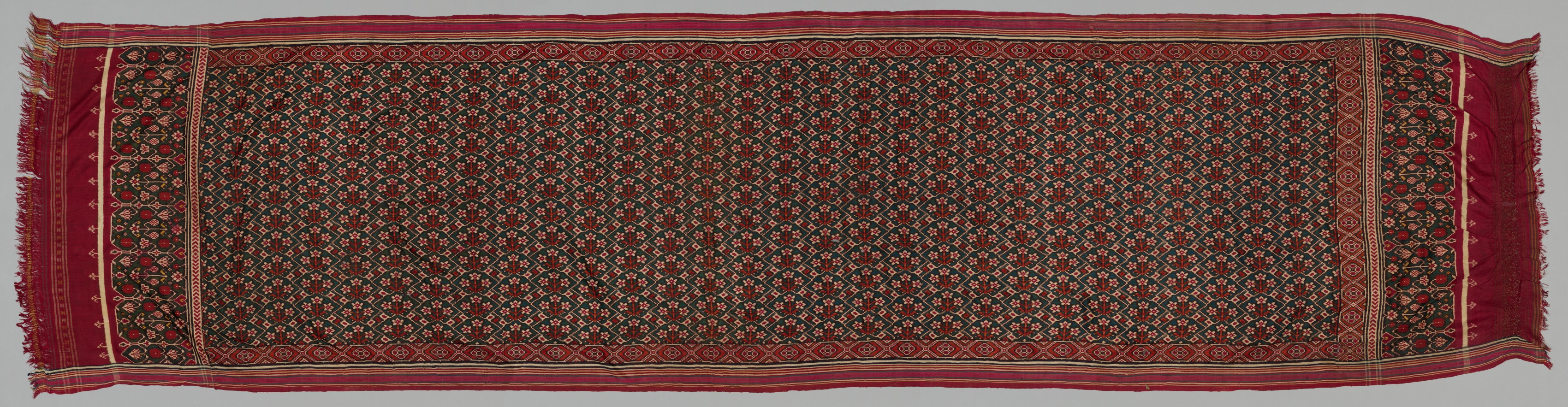
Deconstructing the Silk Patolu Sari: A 19th-Century DNA Strand for Avant-Garde Expression
As Chief Fabric Deconstructionist for Zoey Fashion Lab, my role is to dissect historical textiles not merely as artifacts, but as living systems of data—a genetic code waiting to be recombined. The subject of this analysis, a 19th-century Silk Patolu Sari from Gujarat, India, presents a uniquely potent case. Its technical foundation—a tabby weave executed in double ikat—is not a simple decorative technique; it is a sophisticated, pre-industrial form of digital precision. When viewed through the lens of our lab’s “New DNA Strand” paradigm, this sari becomes a blueprint for avant-garde innovation, demanding a radical reinterpretation of its structure, color, and cultural resonance.
Technical Autopsy: The Double Ikat as a Pre-Digital Matrix
To understand the Patolu, one must first appreciate the sheer computational complexity of its construction. Double ikat is a resist-dyeing process where both the warp and weft threads are individually dyed to a precise pattern before being woven. In the case of the Patolu, this is executed on a silk tabby (plain weave) ground. The tabby weave, the simplest of interlacings, provides a neutral, stable canvas. The genius lies not in the weave structure, but in the pre-planned, pixel-like mapping of color across the yarns.
This is where the “New DNA Strand” concept becomes literal. Each warp and weft thread functions as a single strand of genetic information. The dye resist patterns (the knots, the dips, the precise measurements) are the codons—the instructions for creating a specific visual protein. The finished sari is the fully expressed organism. For the avant-garde designer, this is not a nostalgic relic. It is a masterclass in modular, algorithmic design, executed centuries before the computer. The precision required to align the dyed warp and weft to create a coherent, often geometric or figurative, pattern is staggering. A single misalignment of a thread—a single “mutation” in the DNA—would distort the entire image.
Color and Pattern: A Chromosomal Archive of Place and Power
The 19th-century Patolu is typically characterized by a deep, resonant palette: rich reds from madder, indigo blues, deep blacks from iron, and occasional accents of yellow or green. These colors are not arbitrary; they are a chromosomal archive of the region’s ecology, trade routes, and ritual significance. The red, often dominant, is associated with fertility, marriage, and auspiciousness. The geometric patterns—often featuring diamonds, squares, and stylized floral or animal motifs—are not mere decoration. They are a visual language, a system of signs that communicated the wearer’s community, status, and life stage.
For Zoey Fashion Lab, this color and pattern system is a data set to be deconstructed and re-synthesized. The traditional red is not a fixed value; it is a historical pigment concentration that can be extracted, analyzed, and recombined with modern, synthetic or bio-engineered dyes. The geometric motifs—the diamonds, the borders—are not sacred forms. They are base-level geometric primitives that can be algorithmically scaled, rotated, distorted, or fragmented. The avant-garde approach is to treat the Patolu’s pattern as a source code, not a finished image. We can isolate the “diamond” motif, run it through a generative adversarial network (GAN) to produce infinite variations, and then weave those new patterns using a digital jacquard loom, preserving the double-ikat’s logic of pre-dyed precision but with infinitely variable complexity.
The Avant-Garde Recombination: From Sari to Structural System
The traditional Patolu sari is a garment of defined form: a long, unstitched drape. The avant-garde imperative is to liberate the textile from its historical silhouette. The sari’s construction—its warp and weft, its borders, its field—can be reimagined as a modular system. The double ikat’s inherent tension between the dyed warp and weft creates a fabric that is both rigid in its pattern and fluid in its drape. This is a critical design property.
Consider the following deconstructionist applications:
1. The Deconstructed Silhouette: Instead of a single, continuous sari, the Patolu’s pattern can be broken into discrete panels. A jacket could be constructed from the sari’s border, its geometric precision forming a structured, architectural shoulder. The field, with its repeating diamonds, could become a fluid, asymmetrical skirt or a layered cape. The act of cutting and re-sewing the ikat pattern is a deliberate act of genetic splicing, creating new visual relationships between the original codons.
2. The Hybrid Material: The silk itself is a protein fiber. Our lab could extract the silk fibroin and re-spin it with other bio-polymers—perhaps a conductive fiber for wearable technology or a biodegradable cellulose. The double-ikat pattern could then be re-encoded using a different material language: the resist-dyeing process could be replaced with a digital printing technique that mimics the pixelated precision of ikat, or the pattern could be translated into a laser-cut, perforated leather or a 3D-printed polymer lattice. The logic of the double ikat—the pre-planned, two-axis color mapping—is the DNA; the material is the expression system.
3. The Interactive Garment: The Patolu’s pattern is static. An avant-garde evolution would make it dynamic. Imagine a garment where the double-ikat pattern is re-created using thermochromic or photochromic dyes. The “warp” and “weft” of color would shift in response to body heat or ambient light, creating a living, breathing textile. The historical pattern becomes a baseline genetic code that can mutate in real-time, a garment that is never the same twice.
Cultural and Conceptual DNA: The Weight of History
It is impossible to deconstruct the Patolu without acknowledging its cultural gravity. This sari was often a family heirloom, a marker of identity, and a ritual object. To recombine its DNA is not an act of destruction, but of critical translation. The avant-garde designer must approach this material with respect for its origin, but with the freedom to ask: What is the core principle here? The answer is not “a traditional Indian garment.” The core principle is a system of pre-planned, two-axis color mapping on a plain weave, executed with extraordinary precision and imbued with cultural meaning.
Our task at Zoey Fashion Lab is to extract that principle—that “New DNA Strand”—and re-express it in a form that speaks to the 21st century. We are not replicating the Patolu. We are evolving it. The resulting garment might not look like a sari, but it will carry the genetic memory of the Patolu’s logic: the tension between the predetermined and the fluid, the pixel and the thread, the cultural archive and the avant-garde future. This is the deconstructionist’s ultimate goal: to find the timeless algorithm within the historical artifact, and to write it anew.