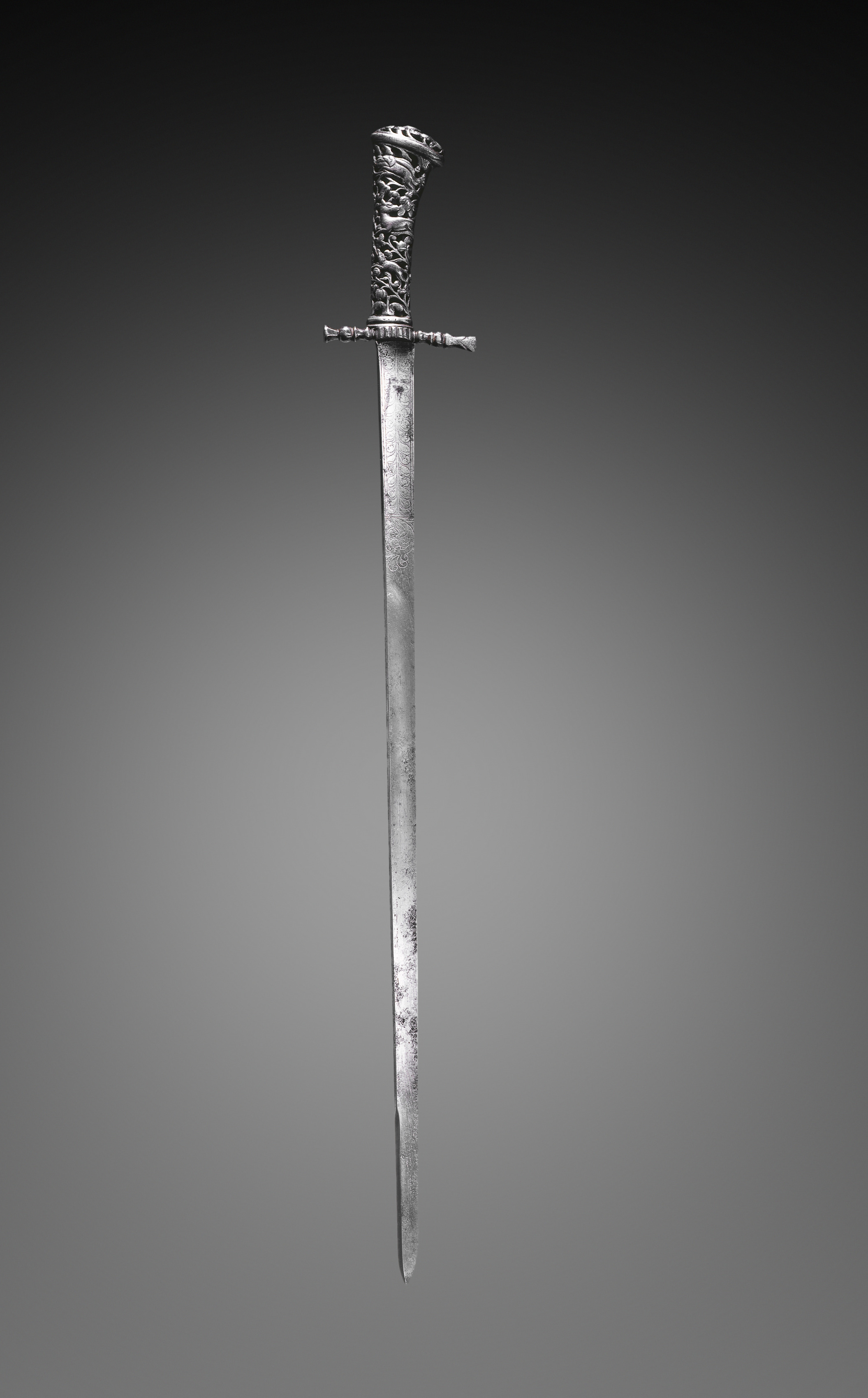
Deconstructing the Hunting Sword: An Avant-Garde Fabric Analysis for Zoey Fashion Lab
At Zoey Fashion Lab, the act of deconstruction is not merely an undoing; it is a radical re-reading of material history. The subject of this analysis—a Dutch Hunting Sword from the 17th or 18th century—presents a unique challenge. Its technical components: a steel blade, a pierced and chiseled cast-iron hilt, and engraved markings, are not fabrics in the traditional sense. Yet, as the Chief Fabric Deconstructionist, I view this artifact through the lens of textile logic. The sword’s structure, its surface treatments, and its functional ergonomics can be translated into a new, avant-garde fabric language. The reference to a “New DNA Strand” is critical here. We are not replicating the sword; we are extracting its genetic code—its tension, perforation, weight, and reflection—to weave a wholly novel material expression.
Phase One: The Steel Blade – Translating Rigidity into Drape
The blade is the sword’s primary narrative. Forged steel represents a continuum of hardness, polish, and linear force. In fabric terms, this translates to a material that must possess structural memory and a high degree of tensile strength, yet must ultimately drape against the human form. The “New DNA Strand” here is the concept of compressed linearity.
Fabric Proposition: “Tempered Organza”
We propose a base fabric of high-density silk organza, treated with a thermosetting resin that mimics the blade’s rigidity. However, the deconstruction lies in the negative space. The blade’s engraved markings—the faint, deliberate scratches of its maker—are reinterpreted as laser-cut micro-perforations that follow the grain of the fabric. These perforations are not random; they form a pattern of stress lines, allowing the fabric to bend and crease in predetermined ways, much like a blade’s flex. The steel’s reflective quality is achieved through a metallic foil lamination applied only to the raised, un-perforated strips of the organza, creating a play of matte shadow and polished light. This fabric would not be soft; it would be a wearable, articulated structure—a second skin of tempered light.
Phase Two: The Cast-Iron Hilt – Deconstructing Weight and Ornament
The hilt, with its pierced and chiseled cast-iron construction, is the most conceptually rich element for Zoey Fashion Lab. Cast iron is dense, brittle, and ornate. Its pierced nature suggests latticework, ventilation, and a deliberate interplay of solidity and void. The chiseling introduces a handcrafted, almost organic texture to an industrial material. This is the antithesis of the sleek blade.
Fabric Proposition: “Corroded Lace Matrix”
Our deconstruction begins with the hilt’s weight. We cannot use iron, so we must simulate its visual and tactile density through layering. The “New DNA Strand” is negative relief. We will construct a fabric from multiple layers of heavy, unbleached linen and coarse hemp, bonded with a biodegradable polymer. The top layer will be a laser-cut lattice inspired by the hilt’s pierced patterns—geometric, yet irregular, mimicking the chisel marks. The fabric’s surface will be treated with a rust-pigment dye and a sanded, napped finish to replicate the rough, pitted texture of cast iron. The critical deconstructive move is to invert the hilt’s function. Where the hilt is a solid grip, our fabric will be a flexible, breathable cage. The lattice will be underlaid with a sheer, conductive metallic mesh that catches light in the voids, creating a sense of depth and internal structure. The weight will be real but distributed, creating a garment that feels anchored and monumental, yet moves with a slow, deliberate gravity.
Phase Three: The Engraved Blade – Encoding Narrative into Surface
The blade’s engravings are not merely decorative; they are a form of material writing. They record ownership, provenance, and a symbolic language of power. In our avant-garde fabric, this becomes a system of embedded information. The “New DNA Strand” here is tactile calligraphy.
Fabric Proposition: “Embossed Memory Vinyl”
We will develop a fabric using a flexible, matte-finish PVC or polyurethane base. The engravings are translated into a relief pattern using a high-pressure embossing technique, creating a surface that is both visual and tactile—a text that can be read by the fingers. The pattern will be a hybrid of the original blade’s floral or heraldic motifs, fused with abstract, fragmented forms that suggest a mutating genetic code. To maintain the avant-garde ethos, the embossing will be asymmetrical and non-repeating, creating the illusion of a surface that is perpetually shifting, like a living organism. The color will be a deep, gunmetal grey, with micro-flecks of silver embedded in the recesses of the engraving, catching light only at specific angles. This fabric becomes a second skin of memory, a wearable archive of the sword’s history, now mutated into a new, unstable form.
Phase Four: Synthesizing the New DNA Strand – The Final Fabric
The ultimate fabric for Zoey Fashion Lab is not a single material but a composite system that merges all three deconstructed elements. The “New DNA Strand” is a hybrid of rigidity, weight, and inscription. The final fabric proposal is a three-dimensional textile that operates as a garment and an object simultaneously.
The Final Proposition: “The Armored Second Skin”
This fabric is constructed in three primary layers, each corresponding to a sword component:
- Layer One (The Blade): A base of the tempered organza with micro-perforations, providing structure and a reflective, linear drape. This layer is the skeleton.
- Layer Two (The Hilt): A middle layer of the corroded lace matrix, bonded to the organza at specific stress points. This layer provides weight, texture, and the illusion of cast mass. The lattice pattern is aligned with the perforations of the first layer to create a complex, three-dimensional shadow play.
- Layer Three (The Engraving): A top layer of the embossed memory vinyl, applied in floating panels that are not fully attached to the layers beneath. These panels can shift and move independently, creating a rustling, metallic sound and a constantly changing surface topography. The engraved patterns are mapped to the wearer’s biomechanics, with deeper reliefs over joints and shallower ones over the torso, mimicking the sword’s balance.
Ergonomics and Movement: The fabric is designed to be self-supporting in key areas (shoulders, hips) while remaining fluid in others (arms, waist). The weight of the middle layer is counterbalanced by the rigid structure of the first, creating a garment that feels simultaneously heavy and buoyant. The perforations and lattice allow for breathability, while the metallic elements create a microclimate of reflective heat.
Conclusion: The Dutch Hunting Sword is no longer a weapon. In the hands of Zoey Fashion Lab, it is a generative matrix. The steel becomes a system of tension. The cast iron becomes a language of voids. The engraving becomes a tactile code. The resulting fabric is a living artifact—a wearable deconstruction of history, power, and materiality, engineered for the avant-garde body of the future. This is not fashion; this is material archaeology.