Deconstructing the Divine: An Avant-Garde Analysis of a 15th-Century Italian Tempera Panel
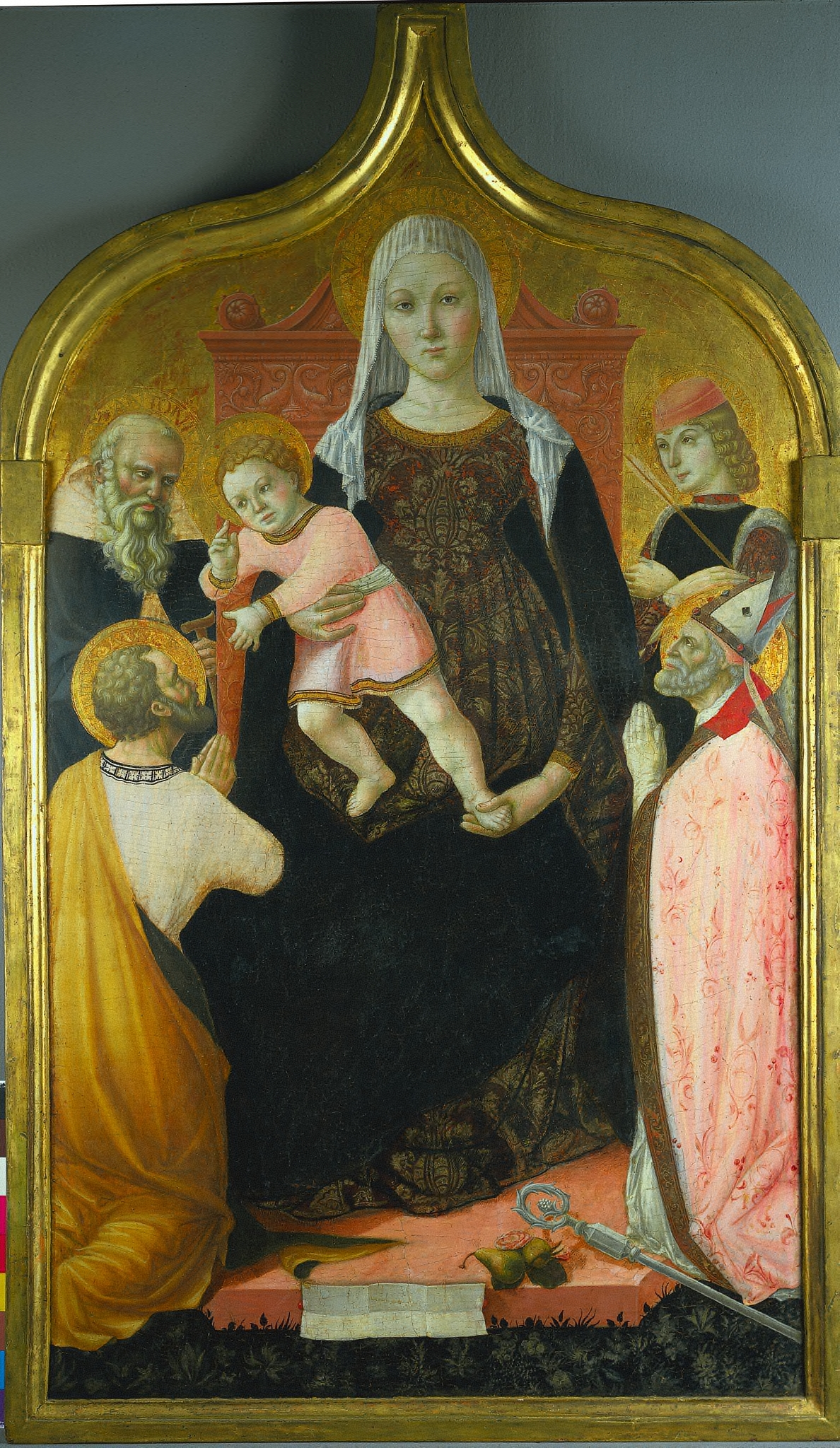
At Zoey Fashion Lab, our mission is to deconstruct the fabric of history, reweaving its threads into avant-garde narratives that challenge the very essence of fashion, art, and identity. Today, we turn our lens to a 15th-century Italian tempera on gold wood panel: Virgin and Child, with Saints Anthony Abbott, Mark, Severino, and Sebastian. This sacred work, born from the devotional fervor of the Renaissance, is not merely a relic of religious iconography—it is a DNA strand of cultural memory, a genetic code of power, sacrifice, and transcendence. Our analysis will strip this panel of its historical varnish, exposing its raw, structural elements as a blueprint for a new, avant-garde collection. We will examine the hierarchical composition, the material alchemy of gold and tempera, and the symbolic anatomy of the saints, each serving as a catalyst for deconstructing the sacred into the subversive.
Hierarchy as a Contested Space: The Virgin and Child as a Power Structure
The composition of this panel is a masterclass in hierarchical order. The Virgin Mary, enthroned with the Christ Child, occupies the central, elevated space—a visual apex that commands reverence. The saints—Anthony Abbott, Mark, Severino, and Sebastian—are arranged in a symmetrical, almost architectural formation, their gazes directed inward toward the divine nucleus. This is not a democratic gathering; it is a spiritual power structure, a pyramid of devotion where proximity to the center dictates sanctity.
For Zoey Fashion Lab, this hierarchy becomes a contested space. In our avant-garde deconstruction, we invert this order. The saints are no longer passive witnesses; they are active agents of disruption. We reimagine Saint Sebastian, traditionally depicted with arrows piercing his flesh, as a figure of fashionable martyrdom—his wounds become embroidered tears in a deconstructed leather jacket, each arrow a metallic zipper pull. The Virgin’s throne is not a seat of grace but a deconstructed scaffold, a framework of exposed seams and raw edges, suggesting that divinity is a construct, a garment that can be unstitched. The Christ Child, often a symbol of innocence, becomes a catalyst for rebellion—his halo is a shattered mirror, reflecting the fragmented identity of the modern wearer.
This reconfiguration of hierarchy challenges the viewer to reconsider power dynamics in fashion. The traditional runway show, with its linear progression and front-row elites, mirrors the panel’s sacred order. Our deconstruction proposes a circular, decentralized presentation where models are saints, each carrying a fragment of the divine, yet none elevated above the other. The collection becomes a procession of equals, where the Virgin’s blue mantle is a shared, modular cape that can be passed from one model to another, symbolizing the fluidity of power and the democratization of the sacred.
Material Alchemy: Gold and Tempera as Avant-Grade Textiles
The technical medium of this panel—tempera on gold wood—is a material paradox. Tempera, a mixture of pigment and egg yolk, is a fragile, matte finish that demands precision, while gold leaf is a luminous, reflective surface that suggests the eternal. Together, they create a tension between the earthly and the divine, the transient and the immutable. For Zoey Fashion Lab, this is not a painting; it is a textile sample for a new fabric technology.
We deconstruct the gold not as a symbol of wealth but as a surface of resistance. In our collection, gold is not applied as a precious leaf but as a metallic thread woven into distressed denim, a liquid gold poured over deconstructed silk, or a gold foil that cracks and peels with movement, revealing the raw cotton beneath. This is alchemical fashion, where the sacred metal becomes a sign of decay and renewal, not permanence. The tempera’s egg-yolk binder is reinterpreted as a biodegradable polymer, a film that coats garments in a matte, protective layer that can be dissolved in water, leaving behind only the raw fiber—a metaphor for the impermanence of both art and identity.
The wood panel itself is a structural element. We extract its grain, its knots, its scars, and translate them into laser-cut patterns on garments. The panel’s frame becomes a corset, a rigid structure that both supports and constrains. In our avant-garde interpretation, the corset is deconstructed into a wearable architecture, with exposed wooden struts and gold hinges that allow the wearer to adjust their posture, their silhouette, their very presence. The tempera’s brushstrokes are embroidered lines on sheer organza, creating a trompe-l’oeil effect that blurs the line between painting and garment, art and fashion.
Symbolic Anatomy: The Saints as Archetypes of Deconstruction
Each saint in this panel is a symbolic vessel, carrying attributes that define their identity: Anthony Abbott’s staff and pig, Mark’s lion, Severino’s monastic habit, Sebastian’s arrows. In our deconstruction, these symbols are not fixed; they are fluid archetypes that can be reassembled, inverted, or erased. Saint Anthony, the hermit, becomes a nomadic figure—his staff is a walking stick that doubles as a garment rack, his pig a leather accessory that is both pet and purse, a commentary on the commodification of the wild.
Saint Mark’s lion is not a beast of strength but a deconstructed mane—a cascade of fur and metallic threads that can be detached and worn as a separate piece, a symbol of mutable power. Saint Severino, the bishop, is reimagined as a punk icon—his mitre is a spiked headpiece, his crozier a broken microphone stand, his vestments a patchwork of religious and secular fabrics, from velvet to vinyl. This is a sacrilegious yet reverent act, acknowledging the saint’s authority while subverting it through fashion.
Saint Sebastian, the most potent symbol of martyrdom, is the centerpiece of our deconstruction. His arrows are not instruments of pain but tools of transformation. In our collection, each arrow is a detachable dart that can be removed and repositioned, allowing the wearer to control their own narrative of suffering and resilience. The arrows are also conductors of light, embedded with fiber optics that pulse with color, turning the garment into a living, breathing canvas. Sebastian’s body, traditionally bound and exposed, is covered in a second skin of sheer mesh, printed with the panel’s original gold leaf pattern, creating a ghostly overlay that questions the boundary between the sacred and the profane.
Conclusion: The Panel as a New DNA Strand
This 15th-century Italian tempera on gold wood panel is not a static artifact; it is a living DNA strand, a genetic code that can be spliced, mutated, and re-expressed. For Zoey Fashion Lab, the Virgin and Child with Saints is a blueprint for an avant-garde collection that deconstructs hierarchy, material, and symbol into a new language of fashion. The gold is no longer a sign of divine light but a reflective surface that questions the viewer’s own gaze. The saints are no longer intercessors but avatars of identity, each garment a wearable relic that carries the weight of history while pointing toward a future of radical self-expression.
In this deconstruction, we honor the original work not by preserving it but by reanimating it, allowing its sacred DNA to mutate into forms that challenge, provoke, and inspire. The result is a collection that is both a homage and a heresy, a celebration of the divine as a construct that can be unstitched, re-stitched, and worn anew. At Zoey Fashion Lab, we do not simply analyze history; we deconstruct it, thread by thread, gold leaf by gold leaf, until the sacred becomes the ultimate fashion statement.