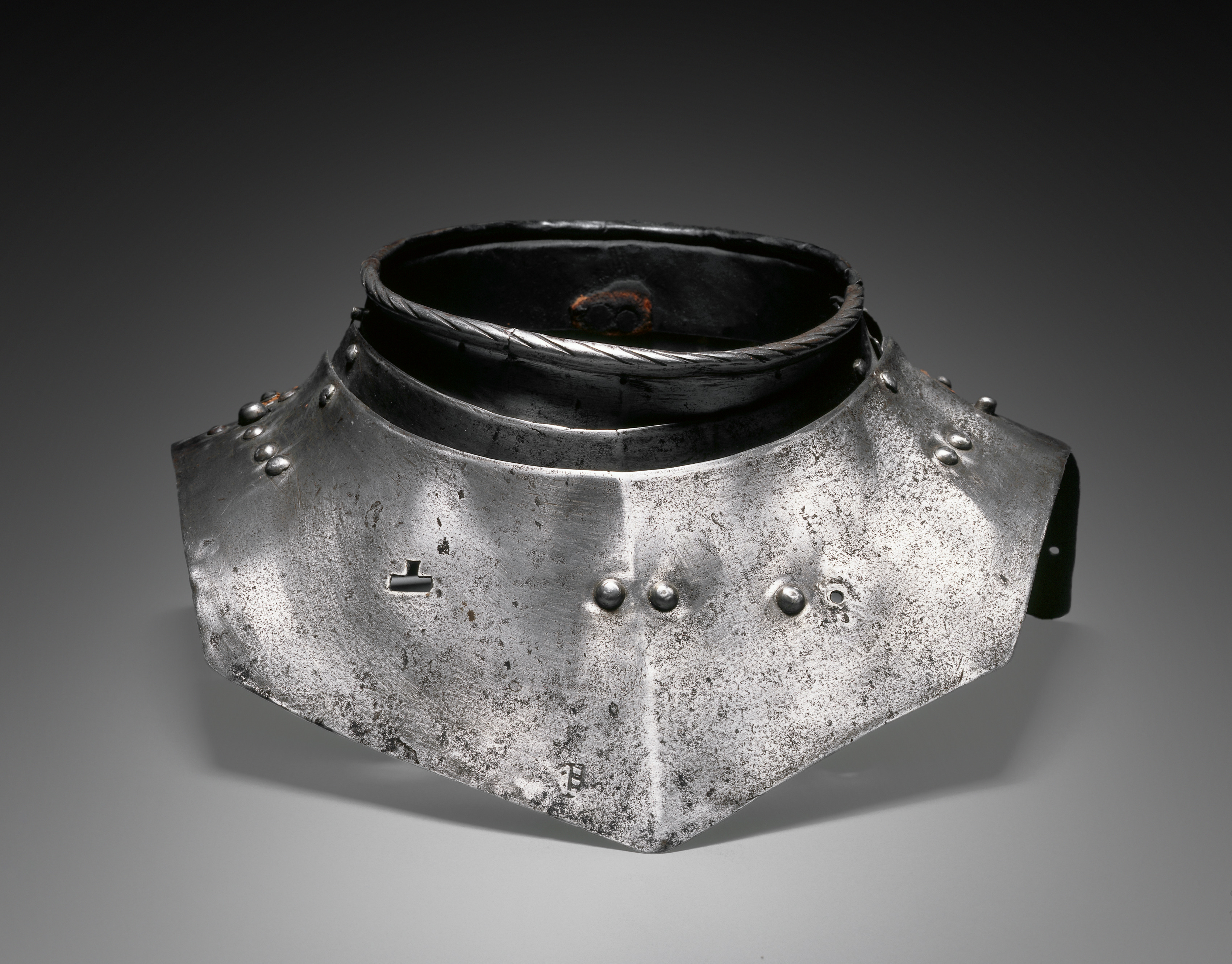
Deconstructing the Gorget: A Zoey Fashion Lab Analysis of German Steel and Avant-Garde DNA
At Zoey Fashion Lab, our mission is to dismantle historical garments and reassemble them as architectural statements for the future. Today, we turn our attention to the gorget, a piece of armor traditionally associated with medieval and Renaissance Europe. Its origin in Germany, specifically from the 15th and 16th centuries, presents a formidable subject. Crafted from steel, the gorget was designed to protect the throat and upper chest—a zone of vulnerability and breath. Our analysis will reinterpret this rigid, protective object through the lens of our New DNA Strand reference, a conceptual framework that treats garment construction as a mutable, organic, and interconnected system. The result is an avant-garde deconstruction that challenges the very notions of armor, adornment, and the human form.
Historical Context: The German Gorget as a Symbol of Power and Constraint
The German gorget, particularly in its late medieval form, was not merely a functional piece of military equipment. It was a symbol of status, rank, and martial identity. Crafted by master armorsmiths in centers like Augsburg and Nuremberg, these steel collars were often etched, gilded, or fluted to display wealth and skill. The gorget’s design was inherently restrictive: it limited neck rotation, forced an upright posture, and created a rigid barrier between the head and the torso. This physical constraint mirrored social and psychological constraints—the wearer was bound by codes of chivalry, duty, and hierarchy. The steel itself, cold and unyielding, represented permanence and defense against external threats. For Zoey Fashion Lab, this historical weight is a rich resource for deconstruction. We ask: What happens when we sever the gorget from its martial context and treat it as a fragment of a larger, living system?
The New DNA Strand Reference: From Rigidity to Fluidity
Our New DNA Strand reference is a conceptual tool that reimagines garment structure as a double helix—intertwined, flexible, and capable of replication and mutation. In a biological DNA strand, the backbone is stable, but the base pairs are variable, allowing for infinite possibilities of expression. Applying this to the gorget, we treat the steel not as a static shell but as a structural backbone that can be unzipped, recombined, and hybridized with softer, more pliable materials. The avant-garde imperative here is to disrupt the gorget’s historical rigidity. Instead of a single, continuous collar, we propose a fragmented helix of steel segments, connected by flexible joints such as woven cables, leather straps, or even transparent polymer links. This allows the gorget to articulate, breathe, and move with the body, rather than against it. The DNA metaphor also suggests a process of genetic modification: we can introduce “mutations” such as asymmetrical cuts, exposed rivets, or oxidized finishes that reference decay and renewal.
Technical Deconstruction: Steel as a Malleable Medium
Steel, in its raw form, is a material of immense strength and resistance. For an avant-garde interpretation, we must exploit its paradoxical properties: it can be both armor and ornament, both heavy and light, both opaque and reflective. Our deconstruction process begins with laser-cutting the steel into irregular, organic shapes that mimic the curves of the human neck and clavicle, but with deliberate asymmetry. The traditional gorget’s front and back plates are separated and reconfigured as modular components. For instance, a front plate might be cut into a series of overlapping scales, each attached to a flexible mesh base, allowing the steel to ripple like reptilian skin. The back plate could be reduced to a single, sweeping blade that extends down the spine, acting as a counterbalance and a visual anchor. Heat treatment is used to create gradients of color—from gunmetal blue to rust orange—that evoke the patina of age and the process of oxidation, a nod to the garment’s own mortality. The edges are left raw and unfinished, rejecting the polished perfection of historical armor in favor of a brutalist, industrial aesthetic.
Avant-Garde Style: The Gorget as a Living Organism
In the avant-garde context, the gorget ceases to be a piece of military hardware and becomes a wearable sculpture that interacts with the human form in unexpected ways. Drawing from the DNA strand reference, we envision the gorget as a symbiotic organism that wraps around the wearer’s neck, not to protect, but to amplify and distort the silhouette. Imagine a structure that begins as a tight collar at the base of the throat, then expands into a series of radiating steel tendrils that climb up the jawline and cascade down the shoulders. These tendrils are not rigid; they are articulated with tiny hinges, allowing them to sway and rustle with movement. The effect is both threatening and beautiful—a hybrid of armor and jewelry, of defense and vulnerability. Transparency is introduced through the use of cutouts and negative space, revealing the skin beneath and creating a dialogue between the hard steel and the soft, living tissue. This interplay is central to the avant-garde ethos: it challenges the viewer to question the boundary between the garment and the body.
Integration with the Zoey Fashion Lab Philosophy
Our work at Zoey Fashion Lab is defined by a commitment to deconstruction as a method of creation. We do not simply destroy; we dismantle to understand, then reassemble with new purpose. The German steel gorget, when filtered through the New DNA Strand reference, becomes a blueprint for a new kind of armor—one that protects not from physical attack, but from the monotony of conventional fashion. It is a statement of individuality and rebellion, a wearable manifesto that rejects the idea of the body as a passive canvas. Instead, the gorget becomes an active participant, a mechanical extension of the wearer’s identity. The avant-garde style demands that we push boundaries, and here, we push the gorget into the realm of the bio-mechanical, where steel and skin coexist in a tense, dynamic equilibrium. The final piece is not a reproduction of history, but a mutation of it—a new strand in the DNA of fashion.
Conclusion: The Future of the Gorget
Through this analysis, Zoey Fashion Lab repositions the German gorget from a relic of martial history to a living, evolving component of avant-garde design. By applying the New DNA Strand reference, we transform steel from a static material into a flexible, mutable system that can grow, adapt, and challenge. The resulting garment is a dialogue between past and future, between protection and exposure, between rigidity and fluidity. It is a testament to the power of deconstruction to reveal new possibilities within even the most hardened of forms. As we continue to explore the intersection of history, technology, and art, the gorget serves as a reminder that the most compelling fashion is born from the reimagining of the familiar—a process that Zoey Fashion Lab is uniquely equipped to lead.