Technical Deconstruction & Material Synthesis: The Flintlock as Avant-Garde Framework
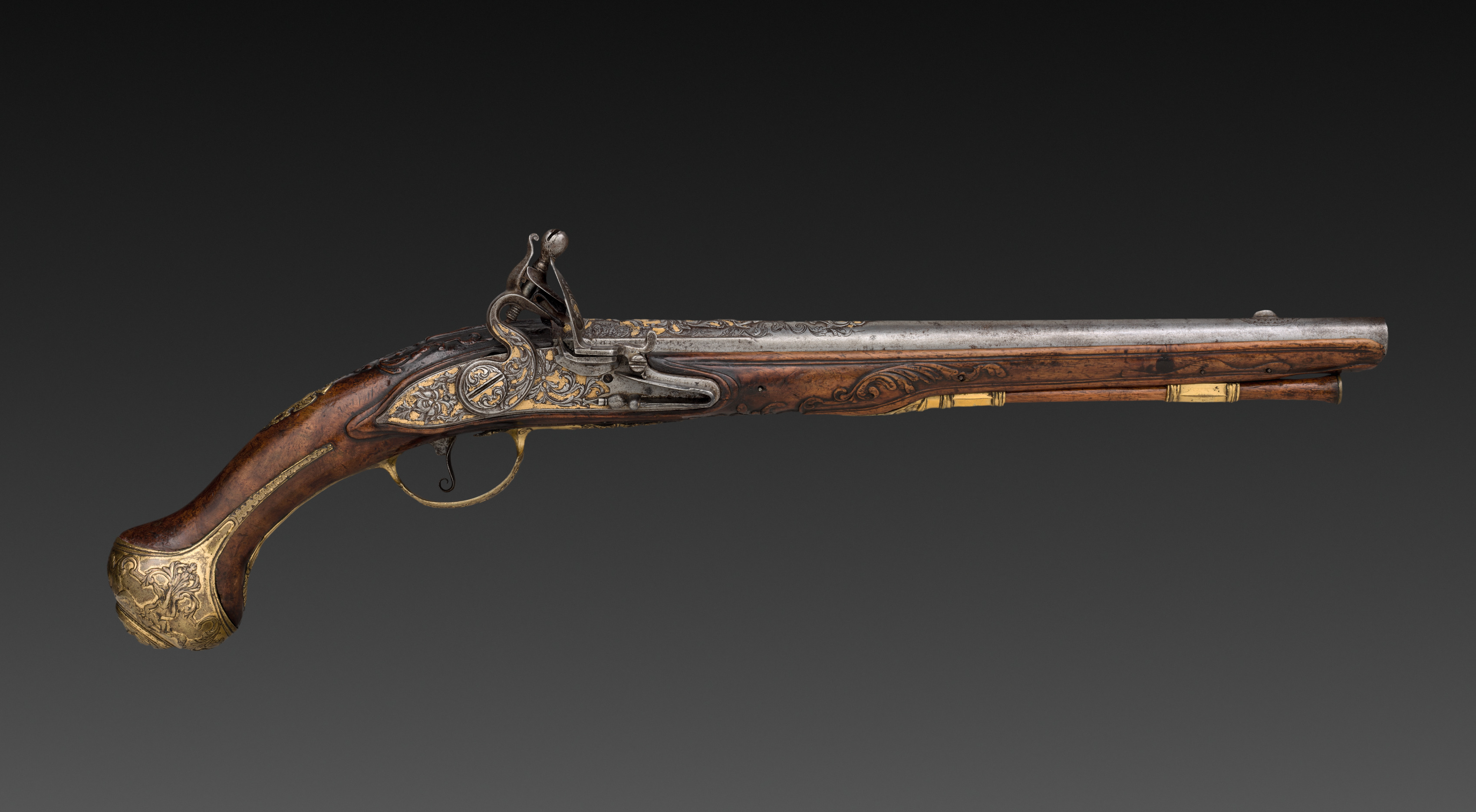
The provided artifact—an early 18th-century Franco-Flemish flintlock pistol from Liège—is not merely an object of historical armament. For Zoey Fashion Lab, it is a dense manifesto of contradiction, a perfect archetype for avant-garde interrogation. Its existence at the crossroads of lethal function and exquisite ornamentation provides a foundational tension. Our analysis moves beyond superficial aesthetic borrowing to engage in a deep material and structural dialogue, treating the pistol as a blueprint for a new sartorial architecture.
Structural DNA: The Walnut Burl Stock as Organic Armature
The walnut burl stock is the first point of deconstruction. Burl wood is a deformity, a growth of dense, swirling grain patterns resulting from stress. This inherent flaw-as-feature philosophy is central to our avant-garde ethos. We translate this not as literal wood grain prints, but as a structural principle. Imagine garments built on a foundational armature inspired by the pistol's grip and stock: curved, ergonomic seaming that follows the body's contours not for minimalism, but for articulated presence. The "stock" becomes a tailored jacket's back or a skirt's hip structure, carved from densely felted wool or molded technical leather, its surface revealing intentional, swirling textural anomalies—a splice of irregular jacquard, an inlay of charred silk velvet—celebrating the beauty of controlled distortion.
This organic armature is then juxtaposed with hard, linear elements mirroring the steel barrel. We propose the integration of rigid boning or lightweight polymer rods as external exoskeletal details. These would not be hidden but showcased as functional decoration, tracing lines along a coat's spine or forming a geometric cage over a sleeve, creating a silhouette that is both protective and revealing, echoing the pistol's fusion of form and deadly purpose.
Surface Narrative: Chiseled High-Relief and the Gold Inlay "Strand"
The chiseled high-relief decoration on steel is a language of shadow and prominence. In textile terms, this translates to an extreme exploration of dimensional surface design. We move beyond embroidery into the realm of constructed textiles: hyper-raised appliqués of layered leather, heat-formed plastic blooms, and densely coiled cordage creating topographic landscapes on a garment's surface. The "chiseled" effect is achieved through severe tailoring—sharp, inverted pleats that catch light like faceted metal, or laser-cut patterns in multiple stacked strata that create deep, dramatic shadows.
The gold inlay is the critical "New DNA Strand" referenced. It is not mere embellishment; it is a conductive thread of luxury and narrative that circuits through the brutal substrate. Our interpretation is a strategic, luminous breach in a somber or textured base. Imagine a severe, matte graphite wool coat traversed by a single, meandering line of gilded chainmail or liquid metallic piping. This "inlay" could be a functional element: a zip track plated in palladium, a closure system of gilt-brass hooks tracing an ornate path. It represents the intrusion of the precious into the pragmatic, the deliberate flaw that completes the design, much like the gold accentuating the steel's strength.
Avant-Garde Synthesis: The Liège Pistol as a Wearable Proposition
The avant-garde outcome is a collection that embodies calculated volatility. The Liège pistol was a tool of ignition, and our garments must carry that latent energy. Silhouettes are poised and dynamic, suggesting movement and potential. A coat may feature an asymmetrical fastening that mimics the pistol's lock plate, with a giant, ornate hook-and-eye closure (the "gilt-brass mount") acting as both centerpiece and functional pivot.
Color palette derives directly from the materials: the deep, variable browns of walnut burl; the cool, severe grays of aged steel; the warm, assertive flash of gold. Textures are paramount—the slick coldness of metal-inspired coatings against the fibrous warmth of burl-wood tweeds, all interrupted by the smooth, cool touch of metallic inlays.
Ultimately, this deconstruction yields a style philosophy of armored elegance. Each piece is a defense and a declaration. It acknowledges the weight of history (the 18th-century craftsmanship) while forcefully re-contextualizing its elements into a modern, disruptive language. The wearer becomes the bearer of a re-purposed iconography, armed not with a weapon, but with the formidable confidence of a design that has been meticulously taken apart, its DNA sequenced, and reassembled into a new, provocative form. The flintlock's spark is no longer for ignition of powder, but for the ignition of a distinct, uncompromising identity.
Conclusion: The New Artefact
For Zoey Fashion Lab, the Franco-Flemish flintlock pistol ceases to be a relic. Through this analysis, it is transformed into a generative codex. The walnut burl dictates organic yet distorted form. The chiseled steel mandates a dialogue of extreme texture and shadow. The gold inlay provides the model for strategic, luminous disruption. Synthesized through an avant-garde lens, these elements coalesce into a proposal for wearables that are structurally innovative, rich in narrative contradiction, and charged with a silent, potent energy. The collection does not reference the pistol; it becomes its contemporary analogue—an object of beauty, craft, and undeniable, formidable intent.