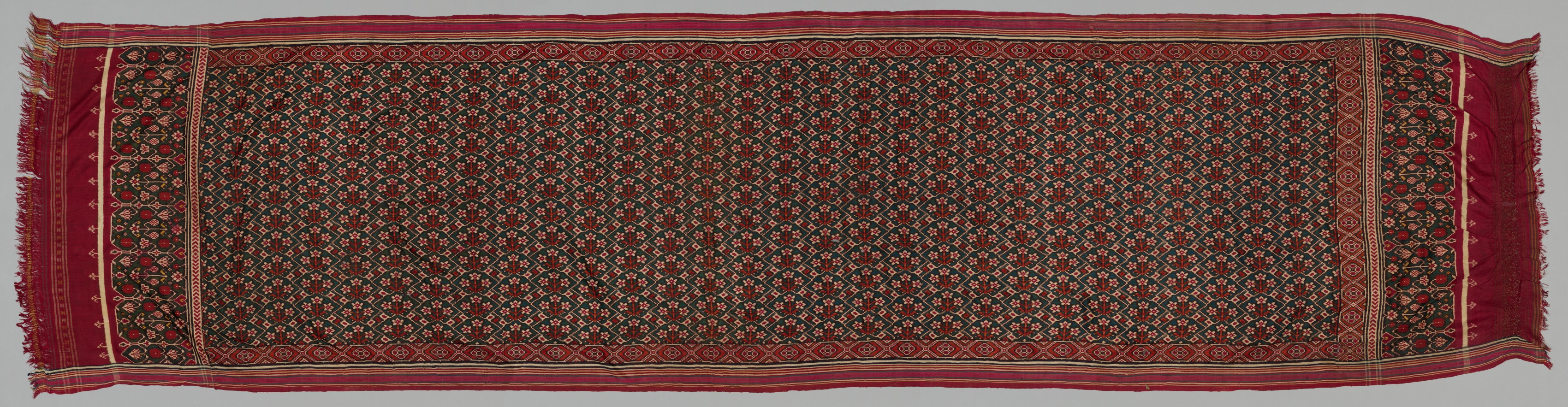
Deconstructing the Silk Patolu Sari: A 19th-Century Genetic Blueprint for Avant-Garde Fashion
At Zoey Fashion Lab, our mission is to unearth the structural and narrative DNA of historical textiles, then splice those genetic codes into avant-garde forms. The subject of this analysis—a 19th-century Silk Patolu Sari from Gujarat, India—represents a pinnacle of artisanal precision and cultural symbolism. Its technical foundation, a tabby weave combined with double ikat, is not merely a craft technique but a complex, pre-industrial algorithm for creating pattern and meaning. For the contemporary avant-garde designer, this sari is not a relic; it is a New DNA Strand—a living template for deconstructing symmetry, redefining drape, and engineering a dialogue between ancient mathematics and futuristic form.
Technical Pillar: The Tabby-Double Ikat Matrix
The Patolu’s technical core is its tabby weave, the simplest and most fundamental of weave structures. In this plain weave, the weft thread passes alternately over and under each warp thread, creating a grid of maximum stability and minimal surface complexity. For a double ikat, this simplicity is essential. The tabby acts as a neutral canvas, a controlled environment where the true complexity—the precision of the resist-dyed yarns—can manifest without interference from a more complex weave structure like twill or satin.
Double ikat is the sari’s defining technological achievement. It requires that both the warp and weft threads are resist-dyed before weaving, according to a predetermined pattern. This demands an extraordinary level of mathematical and spatial reasoning. The dyer must calculate the exact placement of each dyed segment on both sets of threads so that when they intersect on the loom, they align to form a cohesive image. In the Patolu, this process creates the characteristic geometric and figurative motifs—often elephants, flowers, or dancing figures—with a characteristic “blur” or “jitter” at the edges of the pattern. This is not a flaw; it is the signature of the hand-process, a visual trace of the human hand and eye that introduces an organic, almost pixelated quality to the design. For the avant-garde, this “jitter” becomes a design element: a deliberate deconstruction of perfect symmetry, a nod to the digital glitch that reveals the underlying code.
Cultural and Symbolic Architecture
The Patolu sari is not merely cloth; it is a wearable document of community, status, and ritual. Originating in the Patan region of Gujarat, these saris were heirlooms, dowry pieces, and markers of high social standing. The motifs are not arbitrary; they are a visual language. The “paan” (betel leaf) motif symbolizes fertility and prosperity. The “chand” (moon) motif represents cyclical time and feminine energy. The elephant signifies royalty and wisdom. To wear a Patolu was to embody these narratives, to carry a community’s history on one’s body.
For the avant-garde designer, this symbolic density is a resource. The motifs can be extracted, abstracted, and re-coded. The elephant, for instance, can be reduced to its geometric essence—a series of interlocking triangles and curves—and then repeated at a radically different scale or in a negative space. The “blur” of the ikat can be amplified into a deliberate design system, where sharp lines give way to gradients of color, mimicking the visual effect of a digital pixelation or a watercolor bleed. The sari’s original function as a ceremonial garment can be subverted: the 19th-century Patolu was static, meant to be draped with precision. The avant-garde version can be dynamic, engineered for movement, asymmetry, and even deconstruction—cut, layered, and re-stitched into a new silhouette that retains the memory of the original form.
Deconstructing the Drape: From Sari to Sculpture
The traditional sari drape is a study in controlled volume. It wraps, pleats, and falls in a prescribed manner, creating a silhouette that is both modest and majestic. The Patolu’s double ikat pattern is designed to be read when the sari is worn in a specific way: the pallu (the decorative end) is often the most elaborate, meant to be draped over the shoulder or head. The body of the sari, with its repeating field of motifs, creates a rhythmic visual flow.
To deconstruct this for an avant-garde context, we must disrupt the drape. Consider the following strategies:
- Asymmetrical Cutting: The sari’s rectangular form can be cut along diagonal or curved lines, creating panels that wrap, twist, and knot in unexpected ways. The double ikat pattern will now appear fragmented, with motifs sliced and re-joined, creating a visual tension between the original order and the new chaos.
- Negative Space and Transparency: The tabby weave, while stable, is also relatively open. By selectively removing weft threads or creating deliberate gaps, the designer can introduce transparency. This allows the body to become part of the pattern, with skin tones interacting with the dyed silk. The “blur” of the ikat can be echoed by the blur of the body beneath.
- Layering and De-layering: Multiple Patolu fragments, perhaps from different saris or different sections of the same sari, can be layered. The top layer might be a sheer, deconstructed section with large gaps, while the underlayer is a dense, intact motif. This creates a depth of field that mimics the visual complexity of the original double ikat but in a three-dimensional, sculptural form.
The New DNA Strand: Avant-Garde Applications
How does this 19th-century textile become a New DNA Strand for the Zoey Fashion Lab? The answer lies in translating its core principles into contemporary design language:
1. Algorithmic Pattern Generation: The double ikat process is essentially a pre-digital algorithm. The dyer calculates the pattern based on a grid of warp and weft intersections. For an avant-garde collection, we can reverse-engineer this: use computer vision to analyze the original Patolu motifs, then generate new, generative patterns that mimic the “jitter” and “blur” of the ikat. These patterns can be printed onto modern fabrics (e.g., technical knits, neoprene, or laser-cut leather) or woven using digital jacquard looms that can replicate the double ikat effect without the laborious hand-dyeing.
2. Deconstructed Silhouette as Narrative: The Patolu’s cultural narrative can be physically deconstructed. Imagine a jacket where the left sleeve is a complete, intact Patolu fragment (the tradition), the right sleeve is a deconstructed, cut-out version (the disruption), and the body is a new, hybrid fabric that blends silk with metallic threads or recycled fibers (the future). This garment tells a story of transformation, not preservation.
3. Tactile and Visual Contrast: The original Patolu is all silk—smooth, lustrous, and uniform in hand. The avant-garde version can introduce tactile dissonance: combine the silk Patolu with matte, textured elements like raw-edged linen, rubberized coatings, or even 3D-printed polymer structures. The visual “blur” of the ikat can be echoed by a physical blur—a sheer overlay that softens the hard lines of a structural garment.
4. Wearable Architecture: The tabby weave’s stability makes the Patolu a good candidate for structural manipulation. By stiffening sections with resin or interlining, the fabric can be molded into geometric shapes—sharp shoulders, sculptural collars, or floating panels that move independently of the body. The double ikat pattern then becomes a surface decoration on an architectural form, referencing the original sari’s role as a ceremonial structure.
Conclusion: The Living Code
The 19th-century Silk Patolu Sari is not a dead object. It is a living code—a complex system of visual, technical, and cultural information that is waiting to be read, deconstructed, and recompiled. For Zoey Fashion Lab, this analysis reveals that the Patolu’s true value lies not in its preservation as a museum piece, but in its potential as a generative source. The tabby weave provides the foundational grid; the double ikat provides the algorithm for pattern and meaning; the cultural symbolism provides the narrative depth. By treating this sari as a New DNA Strand, we can splice its ancient logic into the avant-garde, creating garments that are not merely inspired by the past, but that evolve from it—wearing the history, the technique, and the disruption on the body, in a form that is both respectful of its origin and radically new. The blur becomes the future. The jitter becomes the design. The Patolu becomes a blueprint for the next century of fashion.