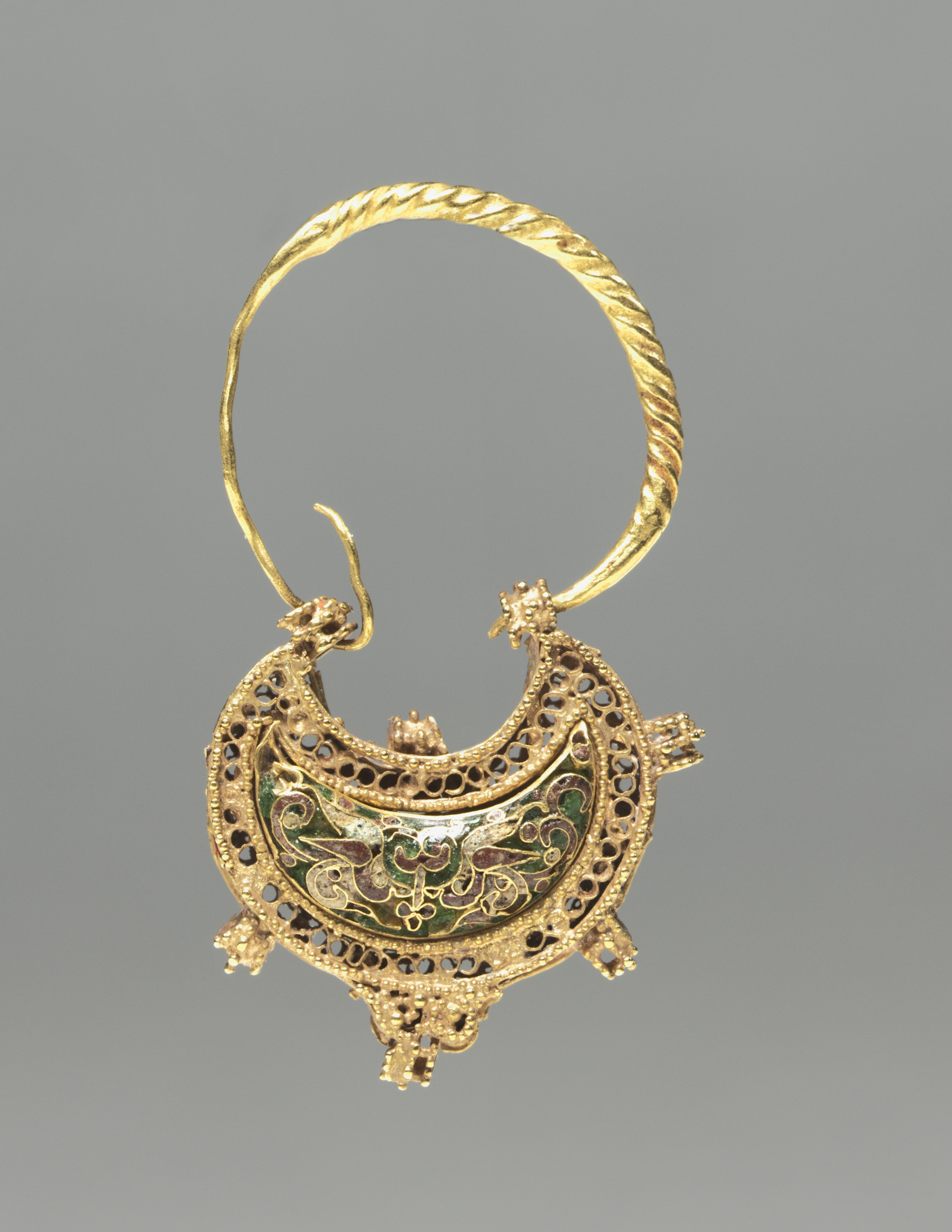
Deconstructing the Crescent: A Filigree of Time and Avant-Garde Vision
At Zoey Fashion Lab, we approach historical artifacts not as relics to be preserved, but as blueprints for future narratives. The subject of this analysis—a crescent-shaped earring from Byzantium, Constantinople, circa 11th century—is a masterclass in material paradox. It is a whisper of imperial power, a fragment of liturgical art, and a surprisingly potent catalyst for avant-garde design. By deconstructing its technical and symbolic architecture, we can extract a new language for the modern wearer: one that marries the sacred geometry of the past with the disruptive energy of the present.
Technical Analysis: Gold Filigree and Cloisonné Enamel
The earring’s construction is a study in controlled chaos. Gold filigree, the delicate twisting and soldering of fine gold threads, forms the foundational crescent. This is not a solid, heavy form; it is a lattice of light and shadow, a skeletal structure that suggests volume through negative space. The filigree is not merely decorative; it is a structural metaphor for the Byzantine worldview—a complex, interconnected web of divine and earthly power, where every strand holds meaning.
Within this gold web, cloisonné enamel acts as a counterpoint. Tiny gold cells (cloisons) are filled with powdered glass, then fired to create luminous, jewel-like planes of color. In the 11th century, these enamels would have depicted saints, imperial monograms, or abstract floral motifs (like the “split-leaf” patterns hinted at in the Archive Resonance reference). The contrast is stark: the filigree is open, airy, and linear; the enamel is dense, opaque, and chromatic. This juxtaposition of structure versus surface, of air versus solid, is the earring’s core technical tension.
For the avant-garde designer, this technique offers a radical lesson: ornament is not an add-on; it is the load-bearing element. The filigree does not support the enamel; the enamel does not fill the filigree. They are co-dependent, each defining the other’s boundary. In a modern context, we can reimagine this as a dialogue between digital lattice (3D-printed metal mesh) and bioceramic infill (translucent, light-reactive materials). The crescent shape becomes a chassis for a new kind of wearable architecture—one that breathes, shifts, and reveals hidden layers under changing light.
Symbolic Resonance: The Crescent as a Liminal Space
The crescent is not a static symbol. In Byzantine iconography, it could represent the moon, the Virgin Mary (as the “Moon of the Church”), or the eternal cycle of death and rebirth. It is a shape of threshold and transition. The earring, worn on the lobe—a point of passage between the head and the air—amplifies this liminality. It is a portal, a fragment of a larger cosmic map.
The Archive Resonance reference deepens this reading: “一面是光洁银镜上以黄金镶嵌的纷繁棕叶纹,另一面是冰冷石棺板上以浮雕诉说的生命叙事” (One side is a smooth silver mirror inlaid with complex palm leaf patterns in gold; the other side is a cold sarcophagus lid telling a life narrative in relief). This duality is critical. The earring’s crescent is not a simple arc; it is a mirror and a tomb. It reflects the viewer’s face while simultaneously referencing the funerary art of the sarcophagus. It is an object of vanity and of mortality, of surface and of depth.
This is where the avant-garde intervention occurs. We are not interested in the crescent as a nostalgic moon. We are interested in it as a fractured mirror—a device that reflects the wearer’s identity while simultaneously fragmenting it. The earring becomes a tool for self-deconstruction. The wearer does not simply adorn themselves with history; they wear a question mark, a broken circle, a promise of incompleteness.
Avant-Garde Reinterpretation: From Artifact to Interface
To translate this 11th-century artifact into an avant-garde piece for Zoey Fashion Lab, we must strip it of its original context while retaining its structural DNA. The crescent shape is no longer a moon; it is a user interface for the body. The filigree becomes a conductive circuit, the enamel a sensor array. The earring is no longer passive; it is active, responsive, and generative.
Consider the following design vectors:
- Material Substitution: Replace gold filigree with titanium lattice (for strength and lightness) and cloisonné enamel with thermochromic liquid crystal (which changes color with body heat). The crescent becomes a live readout of the wearer’s physiological state—a biometric ornament.
- Structural Inversion: The original earring’s filigree is the “background” and enamel the “foreground.” In our version, invert this. The lattice becomes the primary visual mass, and the enamel (now a translucent polymer) becomes a holographic film that projects shifting patterns onto the skin. The earring is no longer an object; it is a light source.
- Narrative Layering: The Archive Resonance speaks of a mirror and a sarcophagus. Our earring can incorporate micro-OLED displays on its inner curve, showing a constantly evolving loop of abstract imagery—a digital “fresco” that references Byzantine iconography but is generated by an AI trained on the wearer’s own biometric data. The earring becomes a personal reliquary, a living tomb of data.
Conclusion: The Earring as a Fractal of History
The 11th-century Byzantine crescent earring is not a dead object. It is a fractal—a self-similar pattern that contains the entire logic of its era within a single, tiny form. For Zoey Fashion Lab, the task is not to copy this fractal, but to re-seed it into a new matrix. The crescent shape, the filigree technique, the enamel’s luminosity—these are not constraints; they are algorithms waiting to be rewritten.
The avant-garde earring we propose is a threshold object: it sits at the boundary between the sacred and the profane, the ancient and the future, the mirror and the tomb. It is a piece that does not complete the wearer’s look; it interrogates it. It asks: What does it mean to wear a broken moon? To carry a fragment of a sarcophagus? To let your own heartbeat dictate the color of your adornment?
This is the essence of Zoey Fashion Lab’s mission: to treat history not as a museum, but as a laboratory. The crescent earring is our starting point. The final form is yet to be forged—in gold, in titanium, in light, in data. The wearer, the designer, and the artifact are now co-authors of a new narrative, one that begins in the 11th century and ends, for now, on the edge of tomorrow.