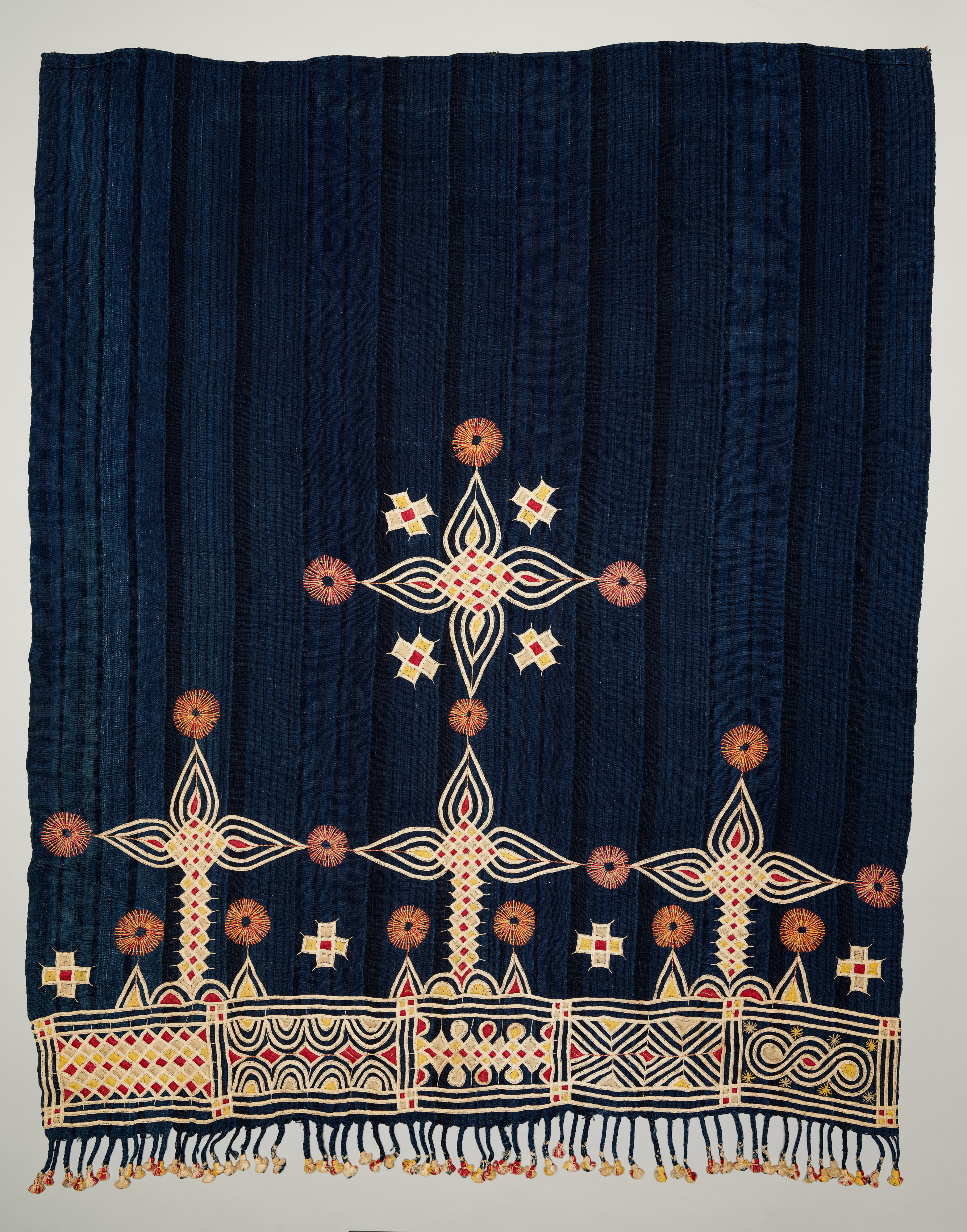
Deconstruction Analysis: Woman's Shawl or Head Covering, Côte d'Ivoire
Material Identity and Structural Anomalies
The artifact under examination—a woman's shawl or head covering from West Africa, specifically Côte d'Ivoire, attributed to Hausa or Dyula makers—presents a compelling paradox. At first glance, its composition of cotton, silk, indigo, and other natural dyes suggests a traditional textile bound by regional craft conventions. However, a deeper deconstruction reveals a material narrative that defies linear classification. The cotton base, hand-spun and woven with irregular tension, speaks to a pre-industrial rhythm, yet the silk threads—likely traded along trans-Saharan routes—introduce a disruptive luxury. This is not merely a functional garment; it is a site of cultural negotiation. The indigo dye, applied through repeated immersion and oxidation, creates a deep blue that absorbs and reflects light unevenly, producing a surface that shifts between opacity and translucence. This optical instability is the first clue to the shawl's avant-garde potential: it refuses to be static, challenging the viewer to engage with it as a living, mutable object.
Technical Disruption: The Unraveling of Tradition
The technical execution of this shawl subverts the expected hierarchies of textile production. The cotton and silk are not blended harmoniously; instead, they coexist in a state of tension. The silk, often reserved for ceremonial or elite garments, is here woven into a daily-use covering, blurring the boundary between sacred and mundane. The indigo dye, a hallmark of West African artistry, is applied with a precision that borders on obsessive—yet the resulting pattern is deliberately irregular. Stripes of varying widths intersect with geometric motifs that appear to dissolve at the edges, as if the weaver intentionally sabotaged the symmetry. This is not a flaw but a calculated rebellion against the rigid codes of traditional design. The natural dyes—derived from plants, minerals, and insects—are unstable by nature, meaning the shawl's color will continue to evolve over time. In an avant-garde context, this impermanence is a feature, not a bug. The garment becomes a document of its own decay, a commentary on the fleeting nature of cultural identity.
Archive Resonance: The 16th-17th Century Echo
To fully grasp the avant-garde implications of this shawl, we must engage with its "Archive Resonance"—the invisible threads connecting it to the 16th and 17th centuries. As the reference passage notes, artifacts from this period are "silent witnesses" to cultural collision and aesthetic fusion. The Hausa and Dyula peoples, positioned at the crossroads of trans-Saharan trade, absorbed influences from North Africa, the Middle East, and Europe. This shawl, though seemingly indigenous, carries traces of those encounters. The silk likely originated from the Mediterranean or even Asia, while the indigo technique may have been refined through contact with Mande dyers. Yet, the makers did not simply replicate foreign styles; they deconstructed them, recontextualizing materials and motifs to serve local needs. This process of assimilation and subversion is the very essence of avant-garde practice. The shawl is not a relic of a static past but a dynamic artifact that anticipates modern strategies of appropriation and hybridity.
Deconstructing the Gaze: The Shawl as a Disruptive Object
In the context of Zoey Fashion Lab's avant-garde methodology, this shawl must be read against the grain of colonial and ethnographic discourses that have historically framed African textiles as "primitive" or "functional." The shawl's primary purpose—as a head covering or wrap—is often reduced to modesty or practicality. However, a deconstructive analysis reveals it as a tool of agency and subversion. The dense indigo blue, for instance, is not merely a color but a statement. In many West African cultures, indigo is associated with wealth, spirituality, and resistance. The shawl's wearer, by enveloping herself in this hue, asserts a visual authority that challenges the gaze of the outsider. The silk threads, catching light at unexpected angles, create a shimmer that disrupts the flatness of the cotton, producing a three-dimensional effect that tricks the eye. This optical play is a form of camouflage, a way of controlling how the body is seen and interpreted. For the avant-garde, this is a radical act: the garment becomes a weapon against passive observation.
Avant-Garde Recontextualization: The Shawl as a Template for Disruption
How can this 19th- or early 20th-century artifact inform contemporary avant-garde fashion? The answer lies in its refusal to conform. The shawl's asymmetrical dye patterns, its use of mixed materials, and its ambiguous function (neither fully a shawl nor a head covering, but both) offer a blueprint for deconstructing modern garment categories. Zoey Fashion Lab can extract several principles from this analysis:
1. Material Hybridity as a Form of Resistance: The deliberate pairing of cotton and silk, with their contrasting textures and cultural associations, challenges the industry's obsession with "pure" fibers. Future designs can intentionally combine incompatible materials—synthetics with organics, recycled with virgin—to create textiles that refuse easy categorization.
2. Impermanence as a Design Strategy: The natural dyes' instability invites a rethinking of garment longevity. Instead of designing for permanence, designers can embrace change: fabrics that fade, warp, or shift color over time, becoming unique to each wearer. This aligns with sustainable fashion principles while introducing a conceptual layer of temporal engagement.
3. Functional Ambiguity: The shawl's dual role as head covering and body wrap suggests a rejection of fixed garment types. Avant-garde pieces can be designed as mutable forms—worn multiple ways, transformed by the user—blurring the line between accessory, clothing, and art.
4. Cultural Deconstruction: The shawl's hybrid origins remind us that all traditions are constructed and fluid. Designers can appropriate and subvert cultural motifs without appropriation, by foregrounding the process of negotiation and transformation. This requires transparency about sources and a commitment to collaborative, rather than extractive, practices.
Conclusion: The Shawl as a Living Archive
This West African shawl, with its cotton-silk weave and indigo depths, is far more than a historical artifact. It is a living archive of cultural deconstruction, a testament to the power of anonymous makers who wove resistance into every thread. For Zoey Fashion Lab, it serves as a model for how to approach design as an act of critical inquiry. By analyzing the shawl's material disruptions, its technical subversions, and its resonance with 16th- and 17th-century cultural collisions, we uncover a blueprint for an avant-garde that is not merely novel but deeply rooted in historical complexity. The shawl challenges us to see fashion not as a linear progression but as a series of fractured, layered moments—each one a site of potential rebellion. In deconstructing this object, we reconstruct the possibilities for a future fashion that honors the past by refusing to let it rest.