Deconstructing the Battle Axe: A New DNA Strand for Zoey Fashion Lab
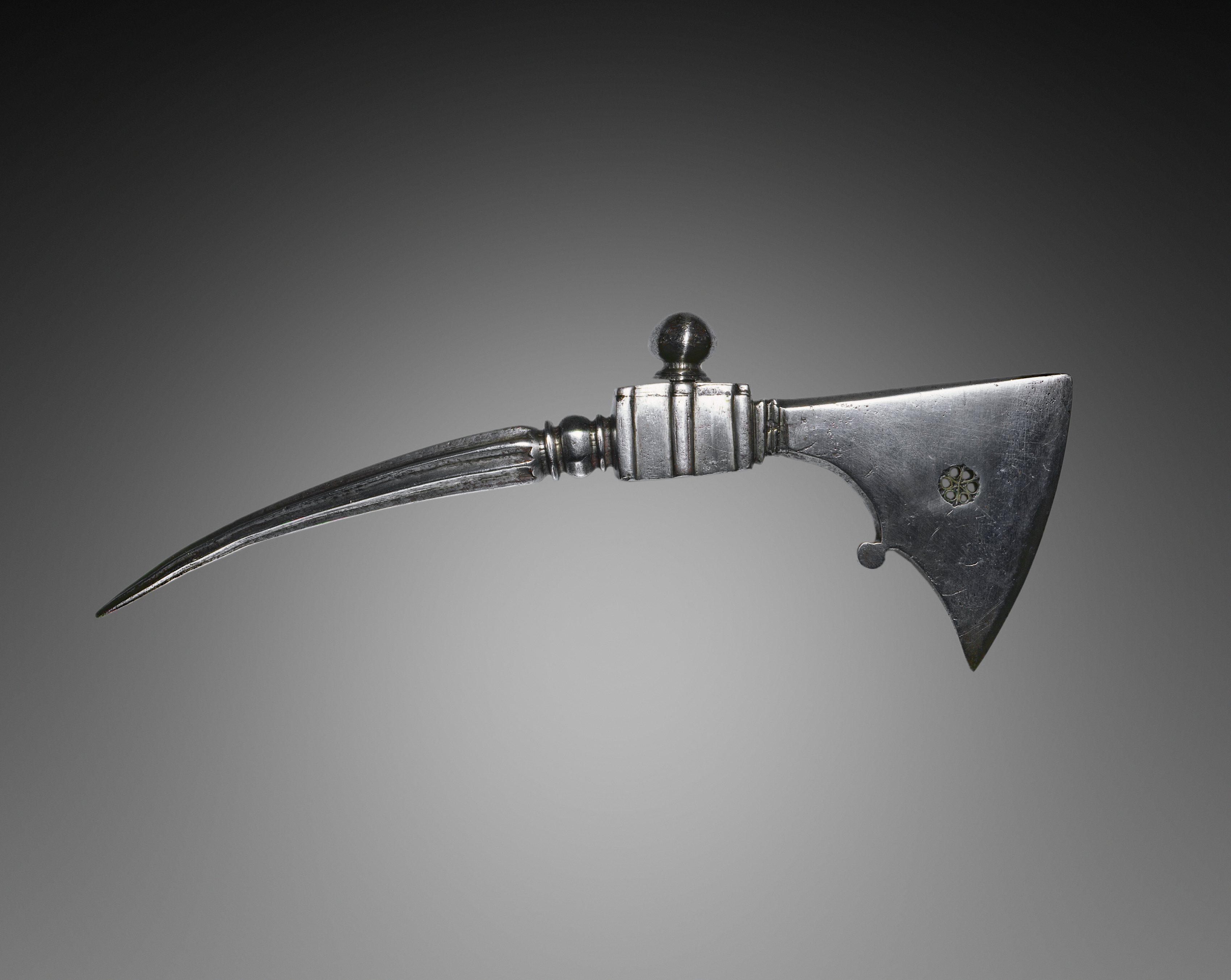
At Zoey Fashion Lab, our mandate is not merely to observe historical artifacts but to dissect their structural, material, and symbolic DNA for reanimation within an avant-garde fashion context. The subject of this analysis—a late 16th-century Italian battle axe, forged in steel and inset with copper rosettes—presents a compelling paradox. It is an object of brutal function, yet its craftsmanship elevates it to a piece of martial jewelry. This document deconstructs the axe into its core components—material tension, geometric aggression, and ornamental fragility—to propose a new design strand for our upcoming collection.
Material Tension: Steel and Copper in Dialogue
The primary technical feature of this artifact is the deliberate juxtaposition of ferrous steel with non-ferrous copper. In the late 16th century, this was a statement of wealth and technical mastery. The steel provides the axe's lethal rigidity, while the soft, warm copper rosettes were inlaid as a decorative counterpoint, often signifying rank or allegiance. For Zoey Fashion Lab, this material dialogue translates directly into textile and hardware engineering.
We propose a dual-fabric construction for a signature garment: a structured, architectural shell of carbon-fiber-infused wool or high-density black denim (representing the steel) that is then “inset” with panels of hammered copper-toned liquid metal fabric or copper-plated chainmail. The rosettes themselves become 3D-printed brass or copper clasps, not merely decorative but functional closures that articulate the garment’s silhouette. The tension here is between the hard, protective outer shell and the softer, glowing interior—a visual and tactile narrative of armor yielding to vulnerability. This is not a costume; it is a structural study in how weapon-grade materiality can be softened into wearable architecture.
Geometric Aggression: The Axe Head as Silhouette
The battle axe’s geometry is defined by its sweeping, crescent-shaped blade and the counterbalancing spike or hammer on the reverse. This is a study in asymmetrical balance and directional force. The blade’s curve suggests motion, a slicing arc; the spike implies a piercing, linear thrust. In fashion terms, this is a blueprint for radical tailoring.
We interpret this as a series of asymmetric shoulder and hip constructions. Imagine a blazer where the left shoulder is extended into a sharp, curved “blade” that extends past the natural shoulder line, stiffened with internal boning or structural resin. The right shoulder, in contrast, is sharply truncated, ending in a pointed, spike-like peak. This creates a dynamic, unbalanced silhouette that forces the eye to trace the garment’s path. The “rosette” motif can be repeated at the pivot points of these extensions—the shoulder joint or the hip bone—acting as both a visual anchor and a mechanical hinge. The avant-garde imperative here is to reject symmetrical comfort in favor of a silhouette that suggests imminent action, a body poised for a strike.
Ornamental Fragility: The Rosette as a System of Contrast
The copper rosettes are the artifact’s most deceptive element. They appear delicate, almost floral, but they are inset into a weapon. This ornamental fragility is a critical design principle. It introduces a layer of vulnerability and preciousness to an object of destruction. In our DNA strand, this becomes a system of applied embellishment that contradicts the garment’s primary function.
We propose a series of laser-cut, hand-painted leather rosettes applied to the seams of a heavy, armored coat. Yet, these rosettes are not sewn on; they are inset into the fabric using a technique of negative space and metal grommets. The fabric is cut away, and the rosette is held in place by a copper ring, creating a literal “window” through the garment. This exposes the skin or an underlying layer, creating a moment of unexpected exposure. The rosette thus becomes a point of weakness and strength—a decorative element that simultaneously weakens the fabric’s integrity while reinforcing it with a metal frame. This is the essence of the avant-garde: a deliberate subversion of material logic.
The New DNA Strand: From Weapon to Wearable Armature
To synthesize these elements, Zoey Fashion Lab proposes a capsule collection strand titled “Arcus Ferri” (Arc of Iron). This strand is not about replicating a medieval aesthetic; it is about internalizing the axe’s structural philosophy. The key design principles derived from this artifact are:
- Structural Asymmetry: Garments will feature a dominant, sweeping curve on one side (the blade) and a sharp, truncated point on the other (the spike). This will be achieved through pattern cutting that prioritizes dynamic tension over static balance.
- Hard-Soft Material Dialectic: Every piece will incorporate a primary “armor” fabric (structured wool, resin-coated canvas, or technical nylon) and a secondary “ornamental” material (copper-toned metallic leather, brass chain, or liquid metal foil). The rosette motif will be reinterpreted as a repeating functional clasp system.
- Negative Space as Detail: The “inset” technique will be a signature. Fabrics will be cut away to reveal metal frames, sheer panels, or skin, creating a visual parallel to the axe’s copper inlay. This is a literal deconstruction of the garment’s surface.
- Weight and Movement: The garments will be intentionally heavy and grounded, mimicking the heft of the axe. However, the copper elements will introduce a clinking, melodic sound with movement, transforming the wearer into a moving instrument of both power and music.
Conclusion: The Avant-Garde as Deconstruction
The late 16th-century Italian battle axe is more than a historical curiosity; it is a blueprint for radical material expression. By deconstructing its steel body, copper ornament, and aggressive geometry, Zoey Fashion Lab extracts a new design language that is both primal and futuristic. The resulting garments will not be costumes of war, but sculptural armatures for the modern body, where every seam, clasp, and silhouette is a deliberate act of deconstruction. This is the new DNA strand: a fusion of martial engineering and couture fragility, forged in the tension between protection and exposure. The battle axe, in our hands, becomes a weapon of style.