Deconstructing the Halberd: An Avant-Garde Analysis for Zoey Fashion Lab
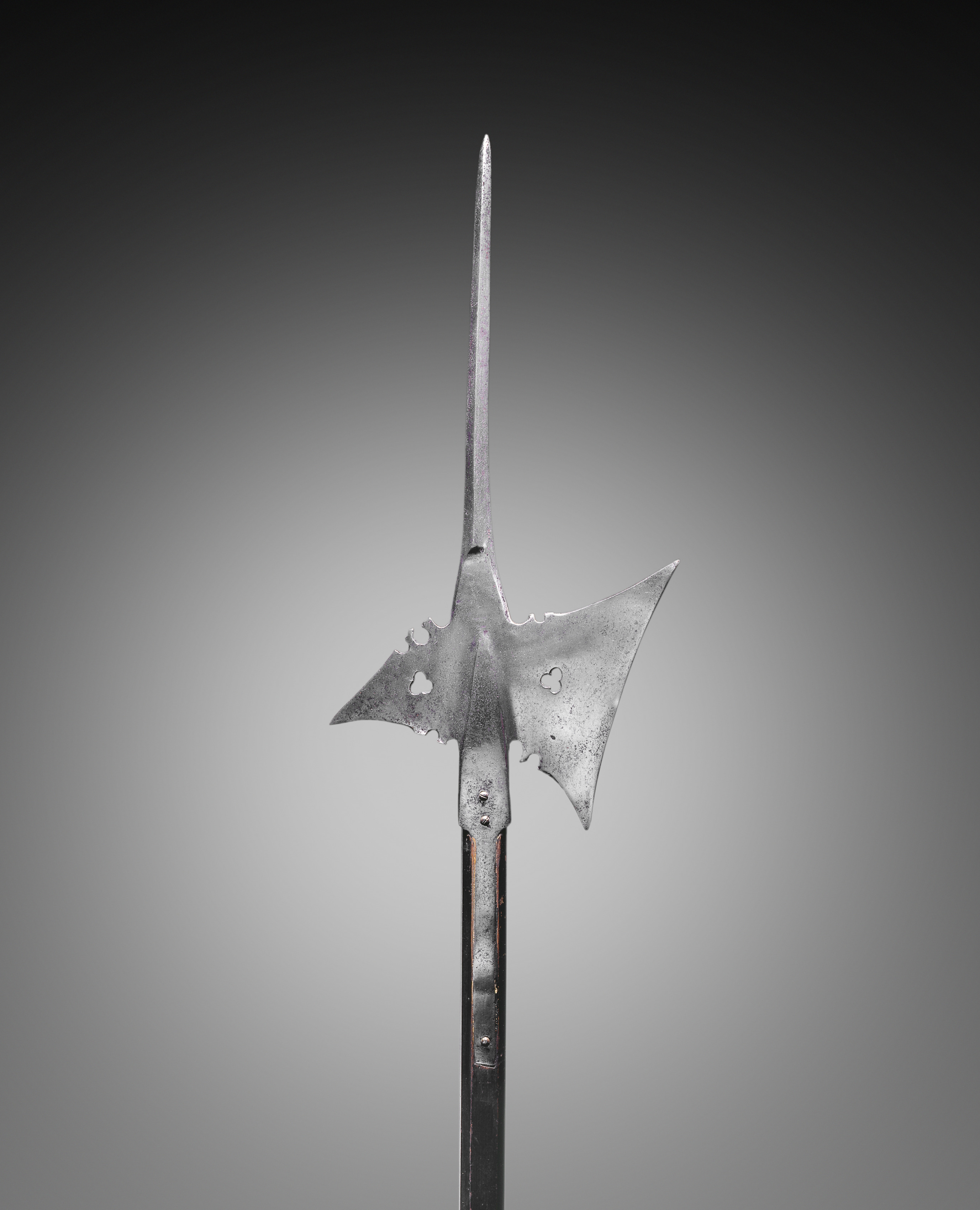
As the Chief Fabric Deconstructionist at Zoey Fashion Lab, my role is to dissect historical artifacts not merely as objects of warfare or craftsmanship, but as proto-fashion narratives—blueprints for radical, avant-garde design. The subject of this analysis, a German halberd dating from the late medieval period, presents a uniquely compelling case. Its technical composition—a steel head with pierced trefoils mounted on a rectangular wood haft with planed corners—offers a rich, multi-sensory vocabulary. This weapon is not a tool of destruction; it is a New DNA Strand for a future collection that fuses brutality with fragility, geometry with organic growth, and historical weight with ephemeral movement.
I. The Steel Head: Pierced Trefoils as Structural Lacework
The halberd’s steel head is its most aggressive yet most ornate component. The pierced trefoils—three-lobed, clover-like cutouts—are the critical element here. In a conventional analysis, these would be seen as decorative relief. In our deconstruction, they are negative-space architecture. The steel is not a solid mass; it is a lattice, a cage, a piece of brutalist lacework. The trefoils create a visual rhythm of voids and solids, a pattern that suggests both vulnerability and deliberate strength. For Zoey Fashion Lab, this translates directly into cut-out construction in rigid materials—think laser-cut leather or molded resin panels where the ‘pierced’ areas become keyholes, breathable zones, or structural seams. The trefoil motif itself, a symbol of the Trinity or natural growth, becomes a repeated emblem across a garment, scaled up on a shoulder pad or miniaturized as a chain-link detail on a sleeve.
The steel’s cold, reflective surface is equally vital. This is not a polished, mirror-like finish; it carries the patina of use, of oxidation, of time. In an avant-garde context, this is not a flaw but a textural signature. We translate this into oxidized, distressed metallic fabrics—perhaps a silver lamé treated with a chemical wash to create a mottled, almost organic surface, or a stainless-steel mesh that is intentionally crushed and re-formed. The weight of the steel is also a factor. Its density suggests a garment that is armor-like in silhouette, but the trefoils introduce a sense of lightness, of air passing through. This contradiction—heavy yet perforated—is the core of our design tension. We will create a structural corset or a shoulder yoke using layered, laser-cut steel-toned leather, with the trefoil apertures allowing the underlying fabric (perhaps a sheer, flowing silk organza) to peek through, creating a dialogue between the rigid and the fluid.
II. The Wood Haft: Rectangular with Planed Corners
The haft of the halberd is often overlooked, but for a fabric deconstructionist, it is a treasure trove of linear and tactile information. The specification—rectangular with planed corners—is not a mere description of shape; it is a lesson in ergonomics and geometry. The rectangular cross-section provides a stable, authoritative grip, while the planed (or chamfered) corners soften its edges, preventing splintering and allowing for a more comfortable, controlled hold. This is a hybrid of the rigid and the ergonomic.
For our collection, this translates into structured, architectural silhouettes with softened edges. The rectangular form suggests a boxy, oversized jacket or a straight-cut, floor-length coat, but the planed corners demand that these sharp lines be subtly eased. We achieve this through strategic draping or asymmetrical closures that break the strict geometry. The haft’s wood grain is another textural source. We will replicate this through embossed or woven patterns in natural fibers—perhaps a heavy, raw linen or a hemp-cotton blend that is treated to have a slightly ribbed, linear texture. The color palette is drawn from the haft’s natural hues: deep walnut, ash gray, and a muted, dusty oak. These earth tones provide the grounding anchor for the steel’s cold, metallic accents.
The haft’s verticality is also paramount. It is the staff, the support, the spine of the weapon. In fashion, this becomes a vertical seam, a long, unbroken line of buttons, or a continuous panel that elongates the body. We will incorporate integrated structural supports—thin, flexible boning or carbon-fiber rods—sewn into the seams of a garment to mimic the haft’s rigidity, creating a silhouette that stands away from the body, a wearable architecture. The planed corners are echoed in the softened, rounded edges of lapels, pockets, and cuffs, ensuring that the collection’s aggression is tempered by a sense of refined, almost monastic, precision.
III. The New DNA Strand: Weaving the Halberd into an Avant-Garde Collection
The reference to a New DNA Strand is not a metaphor; it is a design directive. The halberd is not a costume piece to be copied. It is a genetic code to be spliced, mutated, and re-expressed. Our avant-garde collection will be built on three core genetic sequences derived from this weapon:
1. The Lattice of Power: The pierced trefoils become the primary structural motif. They appear as cut-outs in leather, as negative-space embroidery on mesh, as openwork knit patterns, and as 3D-printed, metallic polymer appliqués that are attached to sheer bases. This lattice is not merely decorative; it is a system of ventilation and movement, allowing the wearer to experience a sense of armor that breathes.
2. The Ergonomic Edge: The rectangular haft with planed corners dictates our silhouette philosophy. Garments will be modular and adjustable, with straps, buckles, and ties that allow the wearer to customize the fit, just as a warrior adjusts their grip on the haft. The planed corners inspire softened tailoring—a sharp, masculine shoulder line that is rounded at the tip, a high, stiff collar that is slightly curved to cradle the neck. The collection will feature asymmetrical closures that mimic the halberd’s off-center balance, such as a single, oversized metal clasp that cinches a coat at the hip.
3. The Patina of Time: The halberd’s surface is a record of its history. We will replicate this through distressed finishes, intentional fraying, and layered, deconstructed hems. Fabrics will be treated with wax, resin, or metallic dust to create a surface that feels aged, weathered, and deeply tactile. The color story will be a monochromatic palette of steel grays, oxidized coppers, deep charcoals, and the warm, organic browns of the wood haft. Accents of tarnished silver or blackened brass will serve as the “steel” of the garment, used for buttons, zippers, and structural grommets.
Ultimately, Zoey Fashion Lab’s halberd-inspired collection will not be about recreating a medieval weapon. It will be about reclaiming its essence—its brutal strength, its delicate ornament, its ergonomic intelligence—and translating it into a new, wearable language. The wearer will not be a warrior; they will be a living, breathing sculpture, moving through the world with the halberd’s quiet, formidable grace. The steel is no longer a blade; it is a seam. The wood is no longer a haft; it is a spine. And the trefoils are no longer cutouts; they are windows into a new, avant-garde reality.