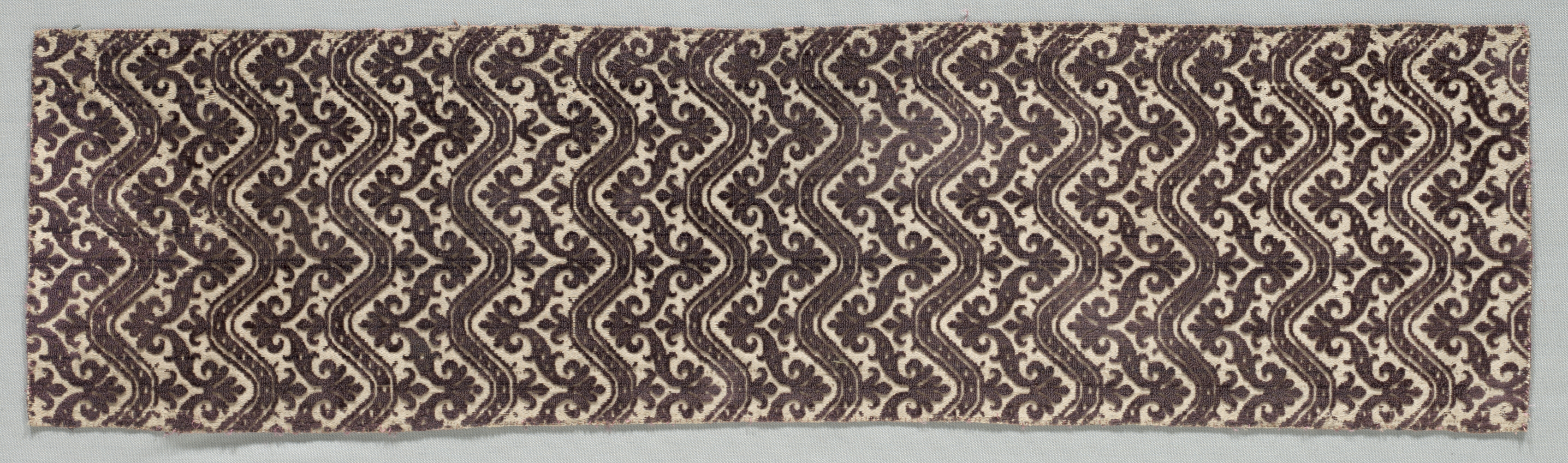
Deconstructing the Baroque: The Italian 17th-Century Velvet Fragment as an Avant-Garde DNA Strand
At Zoey Fashion Lab, our core mission is to unearth the latent potential within historical textiles, treating them not as relics of a bygone era but as living, mutable DNA strands that can be spliced, recombined, and expressed in radically new forms. The subject of this analysis—a velvet fragment originating from Italy in the first third of the 17th century—presents a particularly potent genetic code. Composed of cut, uncut, and voided silk velvet, this piece embodies a pinnacle of Baroque opulence and technical mastery. Yet, for the avant-garde designer, its true value lies not in its historical context, but in its structural and textural contradictions. This fragment is not a finished garment; it is a blueprint for disruption.
Technical Genesis: The Tripartite Velvet Structure
The fragment’s technical composition is the first key to its avant-garde potential. Cut velvet creates a dense, plush pile, offering a surface of deep, absorbent color and tactile luxury. Uncut velvet, or terry velvet, introduces a looped, matte texture that catches and scatters light differently, creating a subtle, almost pixelated visual static. Voided velvet, where the pile is absent, reveals the ground weave—typically a silk satin or taffeta—producing a stark, reflective contrast. The interplay of these three techniques on a single warp and weft system represents a sophisticated, almost proto-programmatic approach to surface design. The Baroque artisan was not merely decorating; they were orchestrating a dialogue between light, shadow, and touch.
For the avant-garde designer, this tripartite structure is a ready-made system for deconstructing form. The cut pile can be interpreted as mass or volume; the uncut pile as a transitional, blurred zone; and the voided areas as negative space or structural seams. This fragment is not a flat surface but a three-dimensional, topographical map of potential. The silk warp and weft, while historically prized for their luster and drape, are equally valuable for their fragility and tendency to split under stress. This inherent vulnerability is not a flaw but a feature—a pre-existing fault line along which to introduce radical cuts, laser-etching, or chemical dissolution.
Textural Dialectics: Opulence Meets Ruin
The avant-garde thrives on tension, and this velvet fragment is a repository of contradictions. Its original function was to signify wealth, power, and divine favor. The deep, jewel-toned colors (likely a faded crimson, emerald, or sapphire, now softened by centuries) were intended to overwhelm the senses. Yet, time has introduced its own layer of meaning: the inevitable patina of decay. The pile may be crushed in some areas, the voided ground may show signs of wear, and the silk may have become brittle. This is not a pristine museum piece; it is a survivor, scarred by history.
This juxtaposition of opulence and ruin is a cornerstone of the Zoey Fashion Lab aesthetic. We are not interested in replicating the Baroque; we are interested in reanimating its ghost. The fragment’s faded glory becomes a commentary on the transience of beauty and the cyclical nature of fashion itself. An avant-garde garment might use the velvet’s plush pile as a base, then deliberately distress it—burning, fraying, or cutting away sections to expose the raw silk ground. The uncut loops could be pulled to create deliberate snags, turning a flaw into a design feature. The voided areas, originally intended as a background, become the primary stage for deconstruction. The fragment’s history of decay is not erased; it is amplified and repurposed.
The New DNA Strand: Splicing Baroque and Brutalism
To treat this fragment as a DNA strand is to recognize that its genetic information—its weave structure, its color palette, its textural grammar—can be isolated, manipulated, and recombined with other, seemingly incompatible codes. The Baroque is a language of excess, curves, and organic ornamentation. The avant-garde, particularly in its brutalist and deconstructivist modes, favors starkness, asymmetry, and exposed structure. The challenge is to create a hybrid that respects the source material’s complexity while forcing it into a new, uncomfortable dialogue.
Consider the following design propositions for Zoey Fashion Lab:
- Structural Subtraction: Use the voided velvet as a guide for laser-cutting. The cut and uncut piles become isolated islands of texture, suspended on a sheer, transparent substrate (like organza or a fine mesh). The Baroque motif is fragmented, its original pattern rendered as a series of floating, tactile glyphs.
- Inverted Pile: Reverse the velvet’s orientation. The plush cut pile, traditionally the face, becomes the lining or the interior of a garment. The voided ground, now exposed on the outside, becomes a raw, skeletal surface. This inversion subverts the velvet’s traditional role as an outer symbol of status, turning it into a secret, intimate experience.
- Textural Conflict: Combine the velvet fragment with industrial materials—neoprene, recycled rubber, or laser-etched leather. The soft, yielding pile clashes with rigid, synthetic surfaces. The Baroque curves are interrupted by sharp, geometric cutouts. The result is a garment that is both luxurious and unsettling, a wearable paradox.
- Digital Encoding: Scan the fragment’s surface at high resolution, mapping the exact locations of cut, uncut, and voided areas. Use this data to generate a digital pattern for a 3D-knitted or printed textile. The original handcraft is translated into a pixel-accurate, algorithmically controlled reproduction. The “DNA” is now a digital file, ready for infinite mutation.
Conclusion: The Fragment as a Catalyst
This Italian velvet fragment from the first third of the 17th century is far more than a historical curiosity. It is a catalyst for radical design thinking. Its technical sophistication—the interplay of cut, uncut, and voided silk—provides a ready-made system for deconstruction. Its historical patina of decay offers a rich vein of commentary on luxury, time, and beauty. And its status as a fragment, a broken piece of a larger whole, invites the designer to complete the narrative on their own terms.
At Zoey Fashion Lab, we do not preserve the past; we re-sequence it. This velvet fragment is a strand of genetic code that, when spliced with contemporary materials, digital processes, and avant-garde sensibilities, can yield a garment that is at once ancient and futuristic, opulent and austere, familiar and alien. The Baroque is not dead; it is merely waiting for a new host. This fragment is the vector.