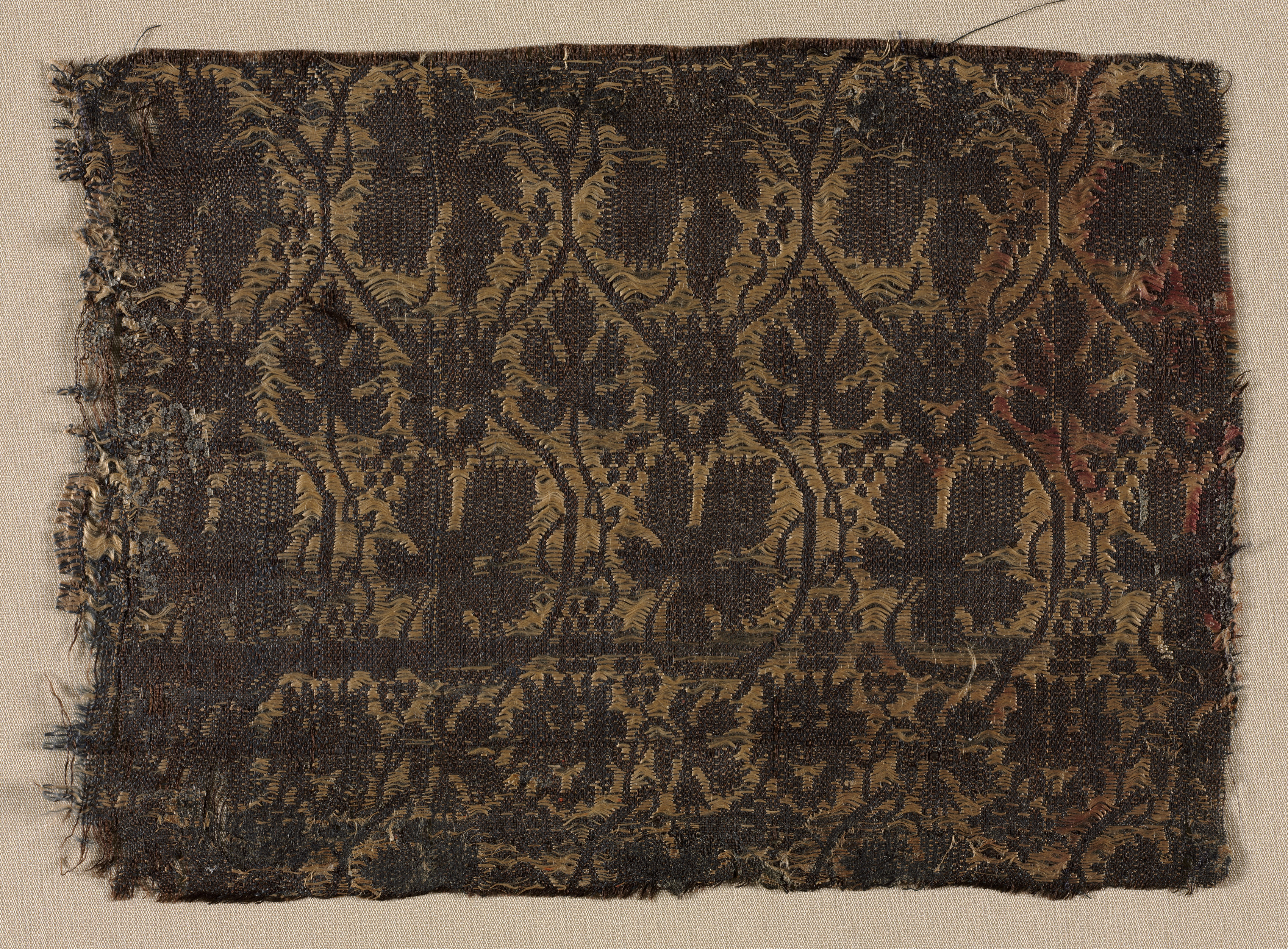
Deconstructing the Past: A Silk Fragment from 14th Century Iran/Iraq
As Chief Fabric Deconstructionist for Zoey Fashion Lab, I am tasked with dissecting not merely the physical composition of a textile, but its narrative, its technological DNA, and its potential for radical reinterpretation. The subject of this analysis is a silk fragment originating from Iran or Iraq, dating to the mid or second half of the 14th century. This is not a relic to be preserved in amber; it is a living blueprint. Its technical structure—a tabby weave with a supplementary weft—and its cultural provenance provide a rich substrate for avant-garde deconstruction. The reference to a “New DNA Strand” is not metaphorical; it is a directive. We will extract the core genetic information of this fragment and mutate it into a form that speaks to the future of fashion.
Technical Analysis: The Tabby with Supplementary Weft
The fragment’s ground weave is a simple tabby, or plain weave, where each weft thread passes over and under each warp thread. This creates a stable, balanced, and unassuming foundation. However, the supplementary weft is the key to its historical and aesthetic significance. This extra set of weft threads, often of a contrasting color or material, is woven in to create pattern, texture, or imagery. In the 14th century, this technique was used to produce intricate geometric designs, stylized floral motifs, or even Kufic script, reflecting the sophisticated textile traditions of the Ilkhanid or Jalayirid periods. The supplementary weft does not contribute to the structural integrity of the fabric; it is a decorative layer, a ghost in the machine.
From a deconstructionist perspective, this is a binary system: a functional core (tabby) and an expressive overlay (supplementary weft). The avant-garde approach does not see these as inseparable. Instead, we identify the points of tension, the areas where the supplementary weft is most vulnerable or most dominant. For example, the weft floats—where the supplementary thread skips over multiple warp threads to create a pattern—are natural stress points. These are the loci of potential rupture, where the fabric’s narrative can be pulled apart. The silk itself, a protein fiber, is both strong and delicate, capable of being teased into fine threads or fractured into a web of filaments.
Cultural and Historical Context: The Silk Road’s Echo
This fragment is not an isolated object; it is a node in a vast network of exchange. The 14th century in Iran and Iraq was a period of cultural synthesis under the Mongol Ilkhanate, followed by the rise of local dynasties. Silk, as a commodity, was a carrier of status, religion, and power. The supplementary weft patterns likely referenced courtly life, celestial orders, or poetic verses. To deconstruct this fragment is to acknowledge its role as a palimpsest—a surface overwritten by history, trade, and conquest. The patterns may have been influenced by Chinese motifs (via the Silk Road), Persian aesthetics, or Islamic geometric traditions.
For Zoey Fashion Lab, we do not treat this history as sacred. Instead, we fragment the narrative. We isolate the geometric motifs, the color palette (likely indigo, madder red, and undyed silk), and the rhythm of the supplementary weft. These elements become raw material for an avant-garde language. The fragment’s age is not a limitation but a source of entropy—the natural decay, fading, and fraying are aesthetic data points. We study how the silk has relaxed, how the supplementary weft has loosened, and how the tabby ground has shifted. This is the fabric’s own deconstruction, a process we accelerate and redirect.
Avant-Garde Reinterpretation: The New DNA Strand
The “New DNA Strand” reference implies a biological, generative approach. We are not recreating the fragment; we are mutating its genetic code. The tabby weave becomes the base pair sequence, and the supplementary weft becomes the variable gene. Our deconstruction process involves three stages: extraction, fragmentation, and reassembly.
Extraction: We isolate the supplementary weft threads from the tabby ground. This is a surgical process, using micro-tools to lift and separate the decorative layer. The tabby ground is preserved as a structural archive, while the supplementary weft is treated as a free-floating element. The colors, the dyes, and the thread thickness are documented and cataloged. This extraction is not destructive; it is a form of analytical dissection that reveals the fabric’s latent potential.
Fragmentation: The supplementary weft is cut, frayed, and re-dyed using contemporary, non-traditional colorants. The geometric patterns are broken into individual motifs—a star, a leaf, a letterform—and these are scattered. The tabby ground is also manipulated: we create deliberate tears, wefts are pulled, and warps are exposed. This is not vandalism; it is a controlled deconstruction that mimics the natural decay of time but accelerates it toward a new aesthetic. The fragment’s original symmetry is deliberately disrupted, creating asymmetry, voids, and unexpected juxtapositions.
Reassembly: The fragmented elements are recombined using non-traditional techniques. The supplementary weft threads are not rewoven into the tabby; they are appliquéd, embroidered, or suspended as independent sculptural elements. The tabby ground becomes a canvas, a base for layering. We might use the extracted threads to create a three-dimensional, net-like structure that hovers above the ground weave, referencing the original pattern but in a state of flux. The color palette is inverted: the faded indigo becomes a vibrant cyan, the madder red is pushed to a neon magenta, and the undyed silk is bleached to a stark white. This is a genetic mutation—the same DNA, but expressed differently.
Practical Application: A Garment or Object
The final output is not a fragment but a wearable artifact. Imagine a jacket or a cape where the body is constructed from the deconstructed tabby ground—a patchwork of torn, re-stitched silk that reveals the warp and weft structure. The supplementary weft motifs are detached and reattached as floating panels, held in place by transparent monofilament or metallic threads. The edges are raw, the seams are exposed, and the original pattern is only partially visible, like a memory. The garment is asymmetrical, with one side dense with pattern and the other almost bare, showing the tabby skeleton.
Alternatively, the fragment could be transformed into a sculptural textile—a wall piece where the supplementary weft is suspended in a resin or acrylic matrix, creating a fossil-like record of the original design. The tabby ground is stretched on a frame, its tears and repairs highlighted as part of the composition. This object is not a reproduction; it is a dialogue between centuries, where the 14th-century silk and the 21st-century deconstruction coexist in a state of tension.
Conclusion: The Avant-Garde as Historical Continuity
This analysis demonstrates that deconstruction is not an act of erasure but of revelation. By dissecting the silk fragment’s tabby weave and supplementary weft, we uncover the structural logic of a 14th-century textile. The avant-garde reinterpretation, guided by the “New DNA Strand” concept, allows us to mutate this logic into a form that challenges traditional notions of preservation and authenticity. The fragment becomes a living entity, its genetic code rewritten for a new context. At Zoey Fashion Lab, we do not preserve the past; we reactivate it, ensuring that even a fragment from the Ilkhanid era can speak to the future of fashion as a radical, transformative practice.