Technical Deconstruction: The Mortuary Sword as Foundational Code
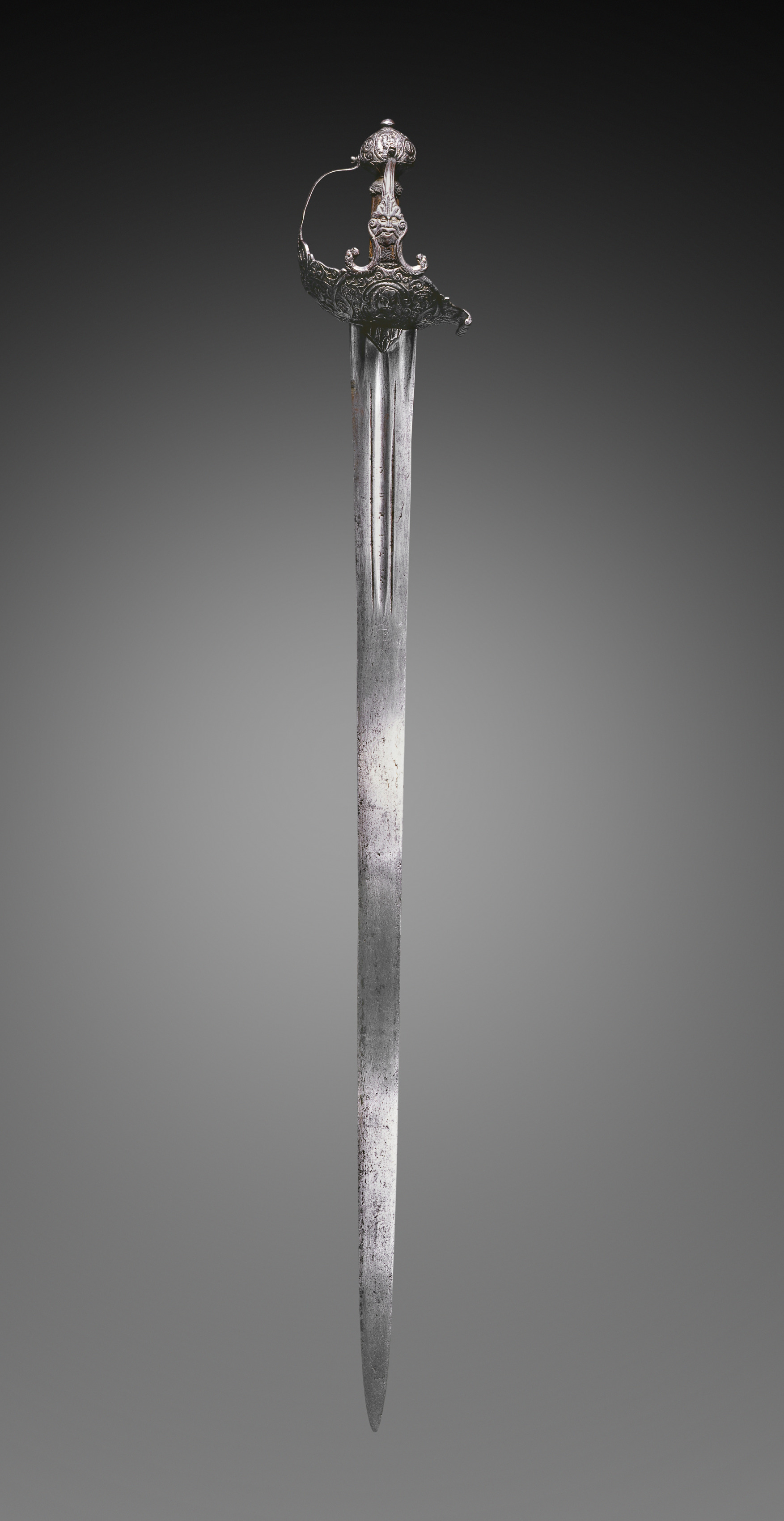
The provided artifact, a Basket-Hilt Broadsword with distinct Anglo-Germanic origins, presents a formidable and rich source code for our avant-garde mission at Zoey Fashion Lab. Its very existence as a composite—a 17th-century English hilt married to an 18th-century German (likely Solingen) blade—is our first and most critical instruction. It rejects monolithic origin, celebrating instead a hybrid vigor, a dialogue across time and geography that results in a superior, functional whole. This is our core principle: deconstructing historical and technical lineages to synthesize a new, potent aesthetic language.
Material & Surface Archaeology: Chiseled Steel and Gilt-Silver Inlay
The primary substrate is steel—cold, hard, and functional. Its treatment, however, is where narrative begins. The chiseled work on the hilt is not mere decoration; it is data inscribed by force, a physical manifestation of memory and craft. For our collection, this translates to techniques that impose texture and history onto fabric: heavy industrial embossing, laser-cutting that mimics chisel marks, or complex darting and seaming that creates topographic relief on a garment's silhouette. Think of leather treated to recall hammered steel, or thick wool felt molded with intentional, artisanal "imperfection."
More pivotal is the inlaid gilt-silver foil. This is the crucial "inlay" in our reference to a "New DNA Strand." Here, a precious, luminous material is not applied atop but is embedded into the base metal. This is our design mantra for the season. We will not simply appliqué or print. We will inlay: splicing ribbons of metallic lamé directly into slashed wool, embedding fine chains into the very seams of a jacket, or using heat-welding techniques to fuse contrasting textiles into a single, inseparable skin. The contrast is not one of overlay but of integral, inseparable duality—the hard and the soft, the dull and the luminous, woven into one genetic code.
Structural Analysis: The Hilt as Exoskeleton and the Grip as Core
The basket hilt is a masterpiece of functional architecture. It is an exoskeletal cage, designed for protection and identity. Its complex, pierced geometry—often featuring scrollwork and figurative elements (the "mortuary" faces that give this sword type its name)—provides a blueprint for avant-garde structuralism. We interpret this as external cage-like structures built over the body: boning that extends beyond the garment's line to form protective ribs in a bodice, or wire-framed sleeves that create a dynamic, spatial volume around the arm. The hilt's purpose was to defend the hand, a vital and vulnerable point; our designs will focus on articulating and amplifying the power of articulation points—shoulders, elbows, knuckles—with analogous architectural forms.
Within this steel cage lies the wood and wire grip. This is the human interface, the private, tactile core within the public armor. The combination of organic wood and tightly wound, functional wire speaks to a harmony of natural warmth and secure, reinforced grip. In our fashion translation, this is the intimate, foundational layer. Imagine a garment where the external shell is all deconstructed steel-grey tailoring and metallic inlay, but the inner lining—the part that touches the skin—is warm, polished wood-toned leather or a grip-textured silk faille, hand-stitched with a raised, wire-like thread. It is the revelation of the vulnerable, essential core within the formidable exterior.
Synthesis: The "New DNA Strand" Avant-Garde Collection
Guided by this deconstruction, the proposed collection, "New DNA Strand: The Mortuary Synthesis," will manifest as follows:
Silhouette & Architecture
Silhouettes will be hybrid and formidable, reflecting the sword's composite nature. Asymmetric hemlines will suggest a blade's taper. Torsos will be cinched and precise (the grip), while shoulders and sleeves explode into cage-like, basket-hilt structures using boning, transparent acrylic, or welded wire forms integrated into the fabric. Coats will feature severe, linear cuts—a blade's edge—contrasted with unexpectedly organic, wrapped closures.
Textile & Surface Development
We will develop proprietary fabrics: a "Chiseled Steel Wool" with a deeply embossed, irregular texture, and a "Gilt-Inlay Fusion" textile, where metallic threads are not woven on top but are laminated between layers of sheer and opaque cloth, revealing themselves only through strategic slashing or wear. Leather will be treated with acid washes and metallic foils pressed into its grain, then scarred with laser etching to replicate centuries of patina and inscription.
Detail & Hardware
Hardware is critical. Fastenings will not be mere zippers or buttons. They will be functional sculptures: clasps that resemble hilt brackets, eyelets that mimic pierced steel guards, and buckle systems that recall the wire-wound grip. Embroidery will be used not florally, but as inlaid, gilt-silver filigree tracing seam lines, like the metalwork on the artifact. Seams will be prominent, often piped with a contrasting metallic cord, celebrating the construction as part of the aesthetic.
The Avant-Garde Statement
This collection moves beyond pastiche. It is not "armor for the modern warrior" in a clichéd sense. It is about coding the body with hybrid history. It embraces the mortuary sword's paradox: an instrument of conflict, yet a deeply personal, commemorative object (often bearing the likeness of a slain monarch); a tool of war assembled from the best components across nations. Our wearer is similarly assembled—a composite of strength and vulnerability, history and futurism, personal memory and public performance. The "New DNA Strand" is this synthesized identity, forged in the fire of deconstructed history and recompiled for a bold, contemporary existence. The garment, like the sword, becomes an interface—both protecting and projecting the self.