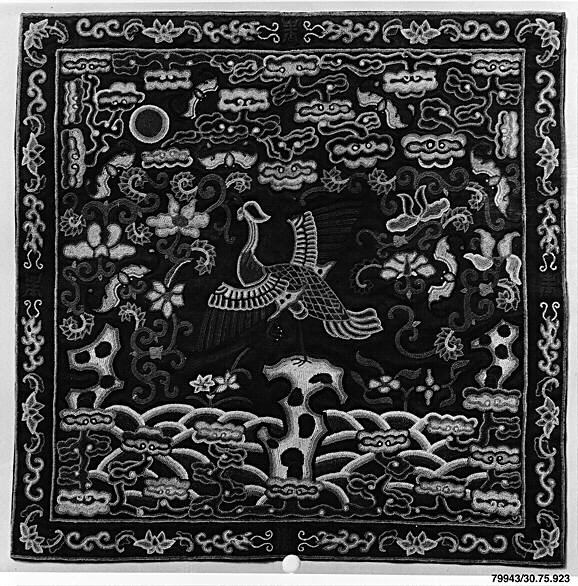
Deconstructing Hierarchy: The Mandarin Duck as a Futuristic Emblem
In the relentless pursuit of sartorial evolution, Zoey Fashion Laboratory interrogates the very foundations of historical dress. The Rank Badge with Mandarin Duck, a quintessential artifact of Qing dynasty bureaucracy, is not a relic to be revered but a code to be broken. This analysis, conceived for our SS26 collection, dissects its latent potential for structural innovation and futuristic silhouette. We are not reconstructing history; we are recomposing its genetic material into a new, avant-garde syntax.
1. The Original Syntax: Hierarchy Woven in Silk
Originally, this badge—embroidered silk on silk—was a declaration of rank. The Mandarin Duck, symbolizing marital fidelity and bureaucratic fidelity, was a static emblem of power. Its placement on the court robe’s chest was a rigid, two-dimensional assertion of order. The materiality—lustrous, hand-stitched silk—was a testament to craftsmanship, but its function was to freeze the wearer in a social hierarchy. For Zoey, this is the starting point for deconstruction: the badge’s geometry, its iconography, and its material constraints become the raw data for a radical reimagining.
2. Deconstructing the Badge: From Emblem to Exoskeleton
Our SS26 proposition begins by severing the badge from its historical anchor. We treat the Mandarin Duck as a fractured architectural motif, not a narrative symbol. The duck’s wings, beak, and tail are dissected into modular, angular components. These are not embroidered flat; they are laser-cut from bonded silk and metallic mesh, creating a three-dimensional, lattice-like structure. The original silk-on-silk technique is inverted: we use transparent organza as a base, allowing the duck’s silhouette to float as a holographic shadow against the body.
The rank badge’s traditional square format is extruded into a curved, aerodynamic shell. This shell, worn as a detachable shoulder yoke, becomes an exoskeleton. The Mandarin Duck’s symmetrical pose is asymmetrically fragmented: one wing extends into a sharp, cantilevered sleeve, while the other is reduced to a negative-space cutout on the chest. This is not decoration; it is functional armor for a future where hierarchy is fluid, performative, and self-authored.
3. Futuristic Silhouettes: The Duck as a Propulsion System
The Mandarin Duck’s aquatic and aerial duality inspires our SS26 silhouette. We envision a gown that mimics the duck’s takeoff trajectory. The bodice is constructed from rigid, molded silk satin, shaped into a biomimetic carapace that flares outward at the hips, not as a skirt, but as a series of articulated, overlapping panels. These panels, inspired by the duck’s plumage, are laser-perforated with the rank badge’s original pattern, casting shifting shadows as the wearer moves.
A key innovation is the “floating” neckline. The Mandarin Duck’s head, embroidered in phosphorescent thread, appears to hover above the collarbone, suspended by invisible wire. This creates a dislocated, cybernetic effect—the emblem is no longer a marker of past status but a projected identity for a post-human elite. The silhouette is not about volume, but about controlled tension: the garment hugs the torso, then explodes into a fractal, wing-like train that can be detached and reconfigured as a shoulder cape.
4. Structural Innovation: Silk as a Composite Material
The original silk-on-silk construction is a testament to layering. For SS26, we push this to its logical extreme. The badge’s embroidered threads are digitized and translated into 3D-printed silicone filaments, which are then woven into a transparent, flexible lattice. This lattice is fused with recycled silk microfibers to create a memory-foam-like material that can be heat-set into sharp, permanent folds. The result is a fabric that behaves like a composite: soft to the touch, but structurally rigid.
We introduce magnetic closures embedded within the silk panels, allowing the wearer to reconfigure the badge’s placement in real-time—from chest to back, from shoulder to hip. This is a dynamic hierarchy, where the Mandarin Duck can ascend or descend the body based on the wearer’s intent. The traditional rank badge’s fixed symbolism is obsolete; in its place, we offer a modular system of self-expression.
5. The Color Palette: From Imperial Gold to Digital Iridescence
The original badge’s palette—deep azure, imperial gold, and vermillion—is recalibrated for a digital age. We replace the gold thread with liquid-metal-coated silk that shifts from silver to copper under light. The azure is bleached to a ghostly cyan, creating a UV-reactive gradient that glows in low light. The vermillion is fractured into a spectrum of neon coral and magenta, applied via digital embroidery that mimics pixelation. This is not a nostalgic revival; it is a chromatic mutation that speaks to a world where color is a programmable interface.
6. The Future of Rank: A Fluid Iconography
In our SS26 narrative, the wearer is not a bureaucrat of a past empire, but a curator of their own symbolic language. The Mandarin Duck becomes a cyborg totem, its beak replaced by a miniature LED display that streams abstract data. The badge is no longer a marker of fixed status; it is a live, mutable badge of honor that can be updated via a companion app. This is the ultimate avant-garde statement: hierarchy is not inherited; it is performed.
The garment itself is a portable architecture. The shell-like yoke can be collapsed into a flat, geometric pouch, referencing the original badge’s portability, but now with a futuristic, origami-like precision. The Mandarin Duck’s image is projected onto the wearer’s skin via embedded fiber optics, blurring the line between garment and body. This is not fashion; it is wearable interface design.
7. Conclusion: The Badge as a Catalyst
The Rank Badge with Mandarin Duck is not a historical artifact to be preserved; it is a catalyst for structural innovation. By deconstructing its iconography, materiality, and spatial logic, Zoey Fashion Laboratory proposes a futuristic silhouette that is both armor and canvas. For SS26, we do not look back with nostalgia; we extract the core principles of hierarchy, craftsmanship, and symbolism and reforge them into a new, avant-garde lexicon. The Mandarin Duck, once a symbol of static order, now soars as a dynamic, deconstructive emblem for a generation that writes its own rank in light, shadow, and silk.