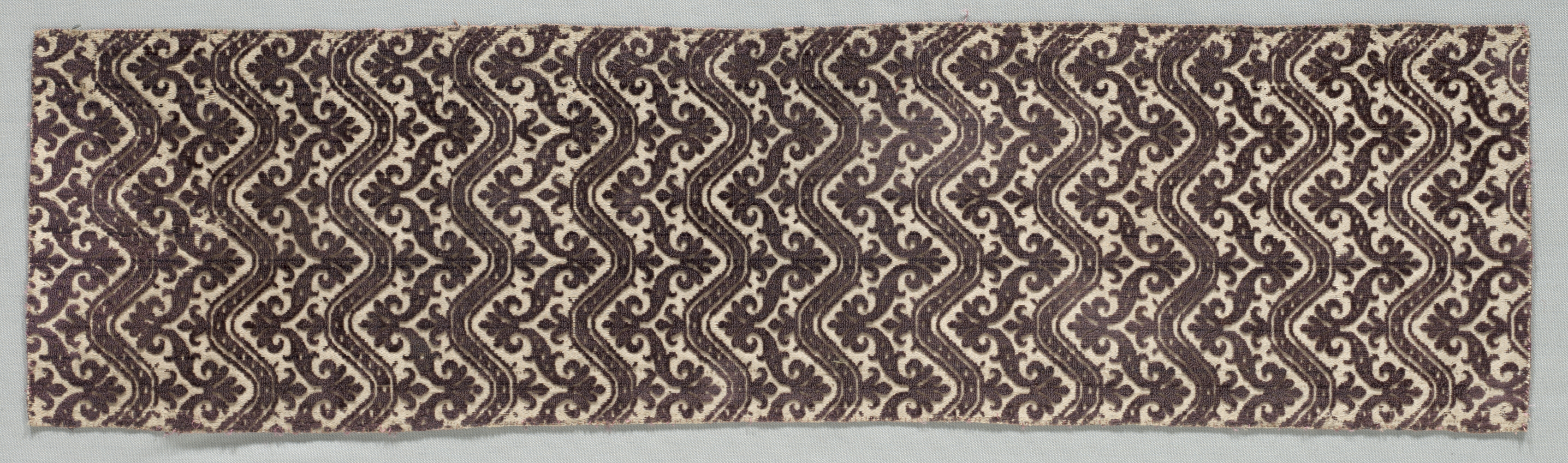
Deconstructing the Velvet Fragment: A 17th-Century Italian Textile as an Avant-Garde DNA Strand
At Zoey Fashion Lab, our mission is to dismantle historical textiles not as relics, but as living, mutable codes. The subject of this analysis—a fragment of Italian velvet from the first third of the 17th century—represents far more than a sumptuous artifact. It is a genetic blueprint, a “New DNA Strand” that, when recombined through an avant-garde lens, can yield entirely new expressions of structure, texture, and narrative. This document provides a professional deconstruction of the velvet’s technical and aesthetic properties, and proposes a methodology for its transformation into a contemporary, radical design language.
Technical Autopsy: The Velvet’s Core Architecture
1. The Triadic Pile System: Cut, Uncut, and Voided
The fragment’s most defining technical characteristic is its simultaneous employment of three distinct pile techniques. Cut velvet (ciselé) creates a dense, lustrous surface where loops are severed, producing a soft, reflective pile. Uncut velvet (bouclé or terry) retains its loops, offering a matte, granular texture that absorbs light. Voided velvet introduces areas where the pile is entirely absent, exposing the ground weave—typically a silk satin or taffeta. This triadic system is not merely decorative; it is a three-dimensional structural score.
In the context of an avant-garde analysis, we interpret these three states as material phonemes: cut pile as the assertive, declarative statement; uncut pile as the quiet, iterative pulse; and voided ground as the negative space—the silence between sounds. The 17th-century weaver used these to create chiaroscuro effects, often depicting floral or heraldic motifs. For Zoey Fashion Lab, this becomes a tactile grammar for constructing non-linear, sculptural surfaces.
2. Silk as a Conductor of Light and Time
The substrate is pure silk—a protein fiber that, in its 17th-century Italian form, was often dyed with madder, kermes, or woad. The fragment’s coloration, likely a deep ruby, aubergine, or emerald green, is not static. Silk’s triangular cross-section refracts light differently depending on the pile’s orientation. The cut pile reflects light in a concentrated, mirror-like flash; the uncut pile diffuses it; the voided ground absorbs it. This creates a chromatic motility that shifts with the viewer’s angle.
In an avant-garde context, we treat silk not as a fabric but as a photonic medium. The fragment’s age has introduced patina—fading, uneven dye migration, and surface wear—which we consider not as damage, but as temporal texture. This aging is a fourth dimension of the material, a record of its exposure to light, air, and human touch. For our lab, this suggests a design strategy where controlled degradation becomes a feature: garments that evolve through wear, revealing hidden layers or shifting in color over time.
Avant-Garde Recombination: The Fragment as a New DNA Strand
1. Structural Deconstruction and Reassembly
The velvet’s triadic pile system offers a direct analog to digital or genetic code. We propose a physical algorithm where the fragment’s pattern is extracted, pixelated, and then re-woven using a hybrid of traditional and digital technologies. For instance, the cut pile zones could be translated into 3D-printed silicone or resin filaments that mimic the soft, reflective quality of silk but with a synthetic, almost industrial precision. The uncut piles could become laser-cut loops in thermoplastic polyurethane (TPU), creating a flexible, matte armor. The voided areas could be left as transparent or perforated membranes, revealing the body or an underlying layer.
This recombination is not a reproduction but a translation. The 17th-century weaver’s pattern—perhaps a pomegranate, thistle, or fleur-de-lis—is not preserved as a motif but fractured into its constituent vectors. The avant-garde outcome is a garment that echoes the original’s rhythm of light and shadow but in a completely new material language: one that is rigid yet pliable, synthetic yet organic, historical yet futuristic.
2. The Voided Ground as a Spatial Concept
The voided areas in the original velvet are not empty; they are active negative spaces that define the pile’s shape. In an avant-garde interpretation, these voids can be expanded into architectural openings. Imagine a coat where the voided zones become cutouts that reveal a second, contrasting fabric—a metallic mesh or a bio-luminescent film. Alternatively, the voids could be functional gaps for ventilation, movement, or modular attachment points (e.g., for magnetic accessories).
This approach aligns with the “New DNA Strand” reference: the void is not a flaw but a coding site for future customization. The wearer becomes a co-designer, able to insert or remove elements into these voids, much like plugging into a circuit board. The velvet fragment thus becomes a prototype for adaptive, responsive fashion.
Material and Cultural Implications for Zoey Fashion Lab
1. Craftsmanship as Algorithm
The 17th-century Italian velvet was produced on a drawloom, a proto-computational device where pattern instructions were stored on a chain of cords. This is a direct precursor to the Jacquard loom and, by extension, to modern binary code. Our analysis frames the fragment as a hard copy of an early algorithm. By reverse-engineering its weave structure, we can extract a set of rules—a grammar of density, height, and spacing—that can be applied to any material system.
For Zoey Fashion Lab, this means treating the velvet as a software. The cut, uncut, and voided states become variables in a parametric design tool. A designer could input a new shape (e.g., a geometric grid or a data visualization) and the tool would output a weaving plan that mimics the 17th-century logic but in a contemporary material—say, recycled polyester, carbon fiber, or even conductive threads for wearable technology.
2. The Avant-Garde Imperative: Disruption and Continuity
The avant-garde is not about rejection of the past but its radical recontextualization. This velvet fragment, with its opulence and technical mastery, could be dismissed as aristocratic excess. However, when viewed as a DNA strand, it becomes a source of structural innovation. The challenge is to extract its essence—its play of light, its tactile contrast, its rhythmic voids—and re-express it in forms that challenge contemporary notions of wearability, sustainability, and identity.
For example, a garment inspired by this fragment might be made entirely from recycled silk and biodegradable polymers, with the cut piles acting as solar-absorbing surfaces and the voids as cooling vents. The uncut loops could serve as attachment points for sensors or micro-LEDs, creating a living, responsive textile. The original’s heraldic motif could be replaced with a QR-code-like pattern that, when scanned, reveals the garment’s provenance and lifecycle data.
Conclusion: The Fragment as a Generative Seed
This Italian velvet fragment from the first third of the 17th century is not a museum piece. It is a generative seed—a complex, multi-layered code that, when deconstructed and recombined, can produce entirely new species of fashion. Its triadic pile system offers a structural vocabulary; its silk substrate provides a lesson in light and time; its voided ground suggests spatial and interactive potential.
At Zoey Fashion Lab, we will not replicate this velvet. We will mutate it. We will extract its DNA—its technical grammar, its chromatic behavior, its narrative of craft—and splice it with digital fabrication, smart materials, and sustainable systems. The result will be an avant-garde collection that honors the fragment’s origin not through imitation, but through evolution. The velvet becomes a strand in a new, living textile genome, one that continues the 17th-century weaver’s conversation with light, texture, and form, but in a language that speaks to the 21st century’s most radical possibilities.