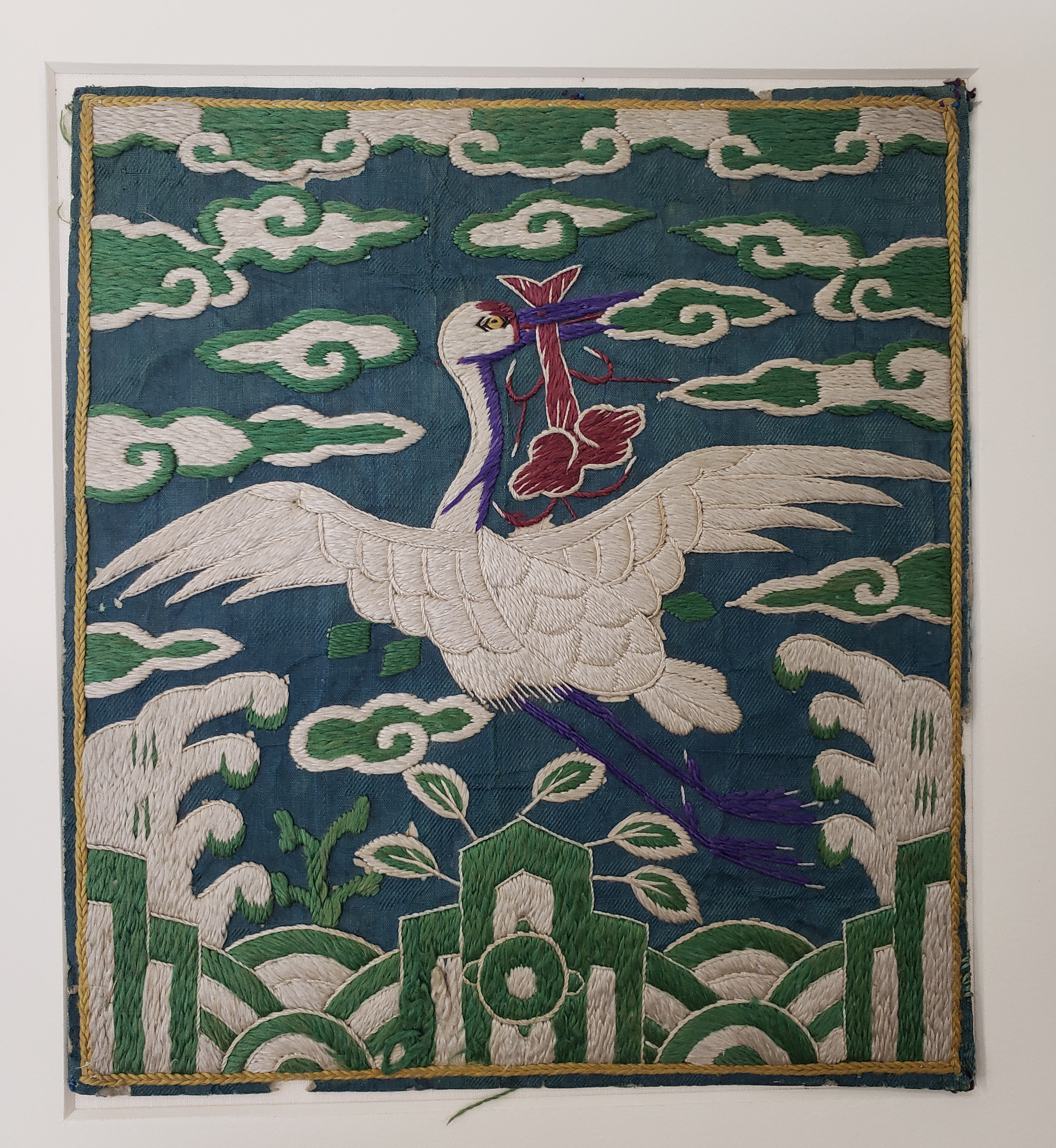
Deconstructing Authority: The Rank Badge with White Crane as a Blueprint for SS26 Structural Avant-Garde
The Korean rank badge, or hyungbae, featuring the white crane is not merely a historical artifact of Confucian bureaucracy; it is a radical proposition for the future of garment architecture. For Zoey Fashion Laboratory’s SS26 collection, this silk emblem—once a symbol of civil service and hierarchical precision—becomes a catalyst for a new language of futuristic silhouettes and deconstructive innovation. The crane, a bird of longevity and transcendence, now represents the flight from tradition into a realm of hyper-structural, biomechanical elegance. This analysis dissects the rank badge’s intrinsic properties—its materiality, its graphic geometry, and its symbolic weight—to propose a definitive avant-garde study for the coming season.
Material Alchemy: Silk as a Structural Paradox
The original badge, rendered in lustrous silk, presents a fundamental tension: a fabric of fluidity used to signify rigid social order. For SS26, this paradox is the foundation of a new structural innovation. We reject silk as mere drape and reimagine it as a composite armor. Imagine the white crane motif not as embroidery but as a laser-cut, bonded silk laminate fused with a micro-sculptural base of recycled polymer mesh. The crane’s wings are no longer passive; they extend outward as articulated, cantilevered panels that float three inches from the torso, held by invisible, carbon-fiber-reinforced seams. This transforms the badge from a flat insignia into a three-dimensional exoskeletal element, a futuristic silhouette that suggests both flight and defense. The silk is preserved not for its softness but for its iridescent, almost liquid sheen under UV light, creating a visual dissonance between the organic bird and the machine-like structure it inhabits.
Futuristic Silhouettes: The Deconstructed Crane
The rank badge’s geometric composition—a symmetrical, often square or circular field—is the starting point for radical silhouette manipulation. The white crane, with its long neck and sweeping wings, is a natural blueprint for asymmetry and extension. For SS26, we propose the “Crane Armor” jacket: a single-sleeve, asymmetrical cocoon coat where the left side is a clean, architectural shell, and the right side erupts into a wing-like, scalloped sleeve constructed from multiple layers of silk organza. Each layer is bonded at a different tension, creating a dynamic, kinetic silhouette that shifts with movement, mimicking the bird’s flight. The badge itself is relocated to the shoulder blade, but deconstructed: the crane’s body is a sculpted, padded form that rises two inches from the jacket’s surface, while its beak extends into a sharp, structural dart that cuts diagonally toward the hem. This is not decoration; it is functional architecture that redefines the wearer’s posture and presence.
Structural Innovation: The Badge as Load-Bearing Element
The true avant-garde leap lies in treating the rank badge as a load-bearing component of the garment’s internal structure. In traditional Korean court attire, the badge was applied to the surface. In our SS26 vision, the badge becomes the keystone of a new garment system. Using a technique we call “negative-space bonding,” the silk crane motif is cut into precise, interlocking shapes—the neck, wings, and tail—and fused onto a transparent, flexible lattice of recycled nylon. This lattice forms the garment’s internal skeleton, visible through sheer outer layers. The crane’s wings are not just decorative; they are structural struts that support the garment’s volume, allowing for extreme, gravity-defying silhouettes without traditional seams or darts. For example, a “Floating Gilet” uses the crane’s outstretched wings as horizontal support beams that hold the garment away from the body, creating a negative space that evokes the bird’s air sacs. The result is a garment that breathes, floats, and redefines the relationship between fabric and form.
Symbolic Transcendence: From Rank to Radicality
The white crane in Korean culture signifies purity, longevity, and high civil rank. In our avant-garde recontextualization, it signifies the transcendence of hierarchy itself. The badge is no longer a marker of social position but a symbol of individual architectural agency. For SS26, we propose a series of “Crane Command” pieces where the badge is not sewn on but suspended via a system of micro-magnets and adjustable tension cables. The wearer can manipulate the badge’s position—raising it to the collar for a more authoritative, shield-like presence, or lowering it to the hip for a fluid, deconstructed line. This interactive structural innovation makes the garment a living system, a dialogue between the wearer and the design. The crane becomes a modular totem, a futuristic silhouette that adapts to the wearer’s movement and intention, embodying a new form of dynamic authority that is personal, not prescribed.
Conclusion: The Crane as a Catalyst for SS26
The Korean rank badge with white crane, in its original silk form, is a masterpiece of restraint and symbolism. In the hands of Zoey Fashion Laboratory, it becomes a radical blueprint for SS26. By deconstructing its material, reimagining its silhouette, and reengineering its structure, we transform a historical emblem of rank into a futuristic manifesto. The crane no longer stands still; it takes flight into a new era of garment architecture—one where silk is armor, the badge is a load-bearing beam, and the wearer is the architect of their own silhouette. This is not fashion as decoration; it is fashion as structural rebellion, a definitive avant-garde study for the season to come.