Deconstructing the Tunjos: A Muisca Votive Offering in Avant-Garde Context
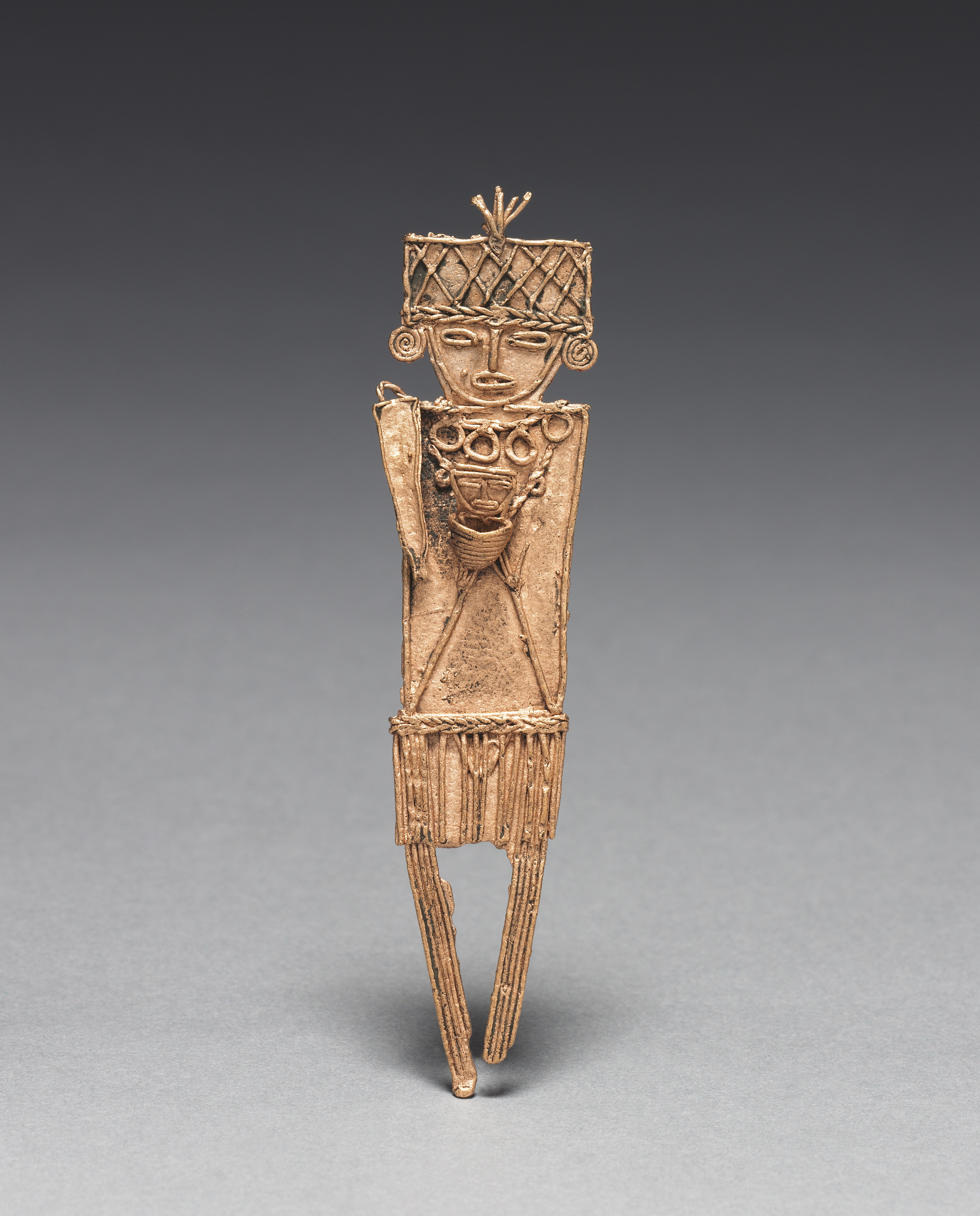
As Chief Fabric Deconstructionist for Zoey Fashion Lab, my analysis of the Tunjos (Votive Offering Figurine)—a cast gold artifact from the Muisca culture of Colombia—extends beyond conventional archaeological reverence. This object, weighing approximately 200 grams and measuring 15 centimeters in height, is not merely a historical relic. It is a material manifesto that challenges our contemporary understanding of adornment, ritual, and the very fabric of wearable art. The Muisca, who inhabited the Altiplano Cundiboyacense from 600 to 1600 CE, crafted these figurines as offerings to deities, often deposited in sacred lakes like Guatavita. For Zoey Fashion Lab, the Tunjos serves as a blueprint for deconstructing the boundary between the sacred and the sartorial, a theme that resonates deeply with our avant-garde ethos.
Materiality as Narrative: Cast Gold and the Illusion of Permanence
The Tunjos is fabricated through the lost-wax casting technique, a process that involves creating a wax model, encasing it in clay, melting the wax, and pouring molten gold into the void. This method, perfected by Muisca metallurgists, yields a figure that is both structurally precise and symbolically fluid. The gold alloy—typically a blend of copper, silver, and gold—creates a surface that is not uniformly bright but rather patinated, with areas of oxidation that tell a story of time, humidity, and ritual immersion. In our lab, we interpret this as a textile of temporality: the gold's surface is a fabric woven from chemical reactions, each stain a thread in the narrative of its journey from sacred lake to museum vitrine.
The avant-garde lens forces us to question the fetishization of permanence. The Tunjos, despite its gold composition, is inherently fragile. Its thin walls—often less than a millimeter thick—suggest a deliberate ephemerality. This is not a monument to eternal wealth but a votive whisper, an object designed to be consumed by the water, to dissolve into the divine. For Zoey Fashion Lab, this challenges our industry's obsession with durability. We ask: What if garments were designed to decay gracefully? The Tunjos inspires a collection where seams are left raw, where gold thread is woven into biodegradable silk, and where the wearer's body becomes the sacred lake that completes the ritual of dissolution.
Form and Function: The Figurine as a Wearable Abstraction
The Tunjos typically depicts a humanoid figure with exaggerated features: a flat, trapezoidal head, outstretched arms, and a stylized, often genderless torso. These proportions are not anatomical but symbolic. The head, often adorned with a diadem or nose ornament, signifies the seat of spiritual power. The arms, raised in a gesture of offering, create a negative space that invites the viewer to complete the form. In our deconstruction, we see this as a pattern for avant-garde silhouettes. The figure's outstretched arms become a cape-like structure, its flat head a collar or headpiece, and its torso a corset that does not cinch but expands, creating a volume that mimics the offering gesture.
The Muisca did not wear gold as a display of status; they wore it as a conduit for the sacred. The Tunjos, when placed in a lake, was a garment for the deity, a way to clothe the divine in material form. For Zoey Fashion Lab, this redefines the purpose of clothing. Our avant-garde pieces are not meant to be seen but to be experienced as ritual objects. We propose a line of “votive wearables”—garments that are incomplete without the wearer's intention. A dress might have a hollow chest cavity, a void where a gem or a prayer could be placed. A jacket might have sleeves that are sewn shut, requiring the wearer to tear the seam to activate the garment, echoing the Muisca's act of offering.
Archive Resonance: The Mirror and the Stone
The provided reference—“一面是光洁银镜上以黄金镶嵌的纷繁棕叶纹,另一面是冰冷石棺板上以浮雕诉说的生命叙事——《Mirror with Split-Lea...”—offers a crucial binary: the mirror and the stone. The silver mirror, inlaid with gold palm-leaf patterns, represents surface, reflection, and the ephemeral. The stone coffin, with its relief-carved life narrative, represents depth, memory, and the eternal. The Tunjos exists in the tension between these two poles. Its gold surface is a mirror that reflects the sun, the water, and the supplicant's face. Yet its form is a stone-like narrative, a frozen moment of offering.
In our avant-garde practice, we deconstruct this resonance by layering materials that contradict. A garment might have a silver lamé outer layer that catches light like a mirror, but beneath it, a gold-threaded inner lining that feels heavy as stone. The palm-leaf pattern, a motif of tropical abundance and the Muisca's agricultural cycles, is reinterpreted as cut-out appliqués that reveal the body beneath, creating a dialogue between the visible and the hidden. The stone coffin's narrative is translated into embroidery that tells a story—not of a life, but of a ritual, with each stitch representing a prayer, an offering, a moment of connection.
Avant-Garde Provocation: The Tunjos as a Challenge to Fashion's Gaze
The Muisca Tunjos challenges the fashion industry's commodification of the exotic. Too often, indigenous artifacts are reduced to surface decoration—a print, a motif, a silhouette. Our deconstruction insists on a deeper engagement. The Tunjos is not a source of patterns but a philosophical model. It asks: What is the purpose of adornment? For the Muisca, it was a bridge between the human and the divine. For Zoey Fashion Lab, it is a bridge between the wearer and their own ritual of self.
We propose a collection of “anti-garments” that resist the gaze of the spectator. A dress might be designed to be worn only in water, its gold thread dissolving slowly, leaving a trace on the skin. A coat might have a weighted hem that pulls it downward, mimicking the sinking of a Tunjos into a lake. These pieces are not for the runway but for the sacred space of the individual. They are votive offerings to the self, a way to clothe not the body but the intention.
Conclusion: The Fabric of the Sacred
The Tunjos, in its cast gold form, is a textile of the divine. Its threads are not fibers but metal, time, and ritual. For Zoey Fashion Lab, this artifact is a call to reimagine fashion as a sacred practice. We deconstruct its form to rebuild it as a wearable philosophy, where every seam is a prayer, every button an offering, and every garment a vessel for the transcendent. The Muisca did not create art; they created vessels for the sacred. In our avant-garde practice, we do not create fashion; we create vessels for the wearer's own divinity. The Tunjos is not a relic; it is a living instruction for how to clothe the soul.