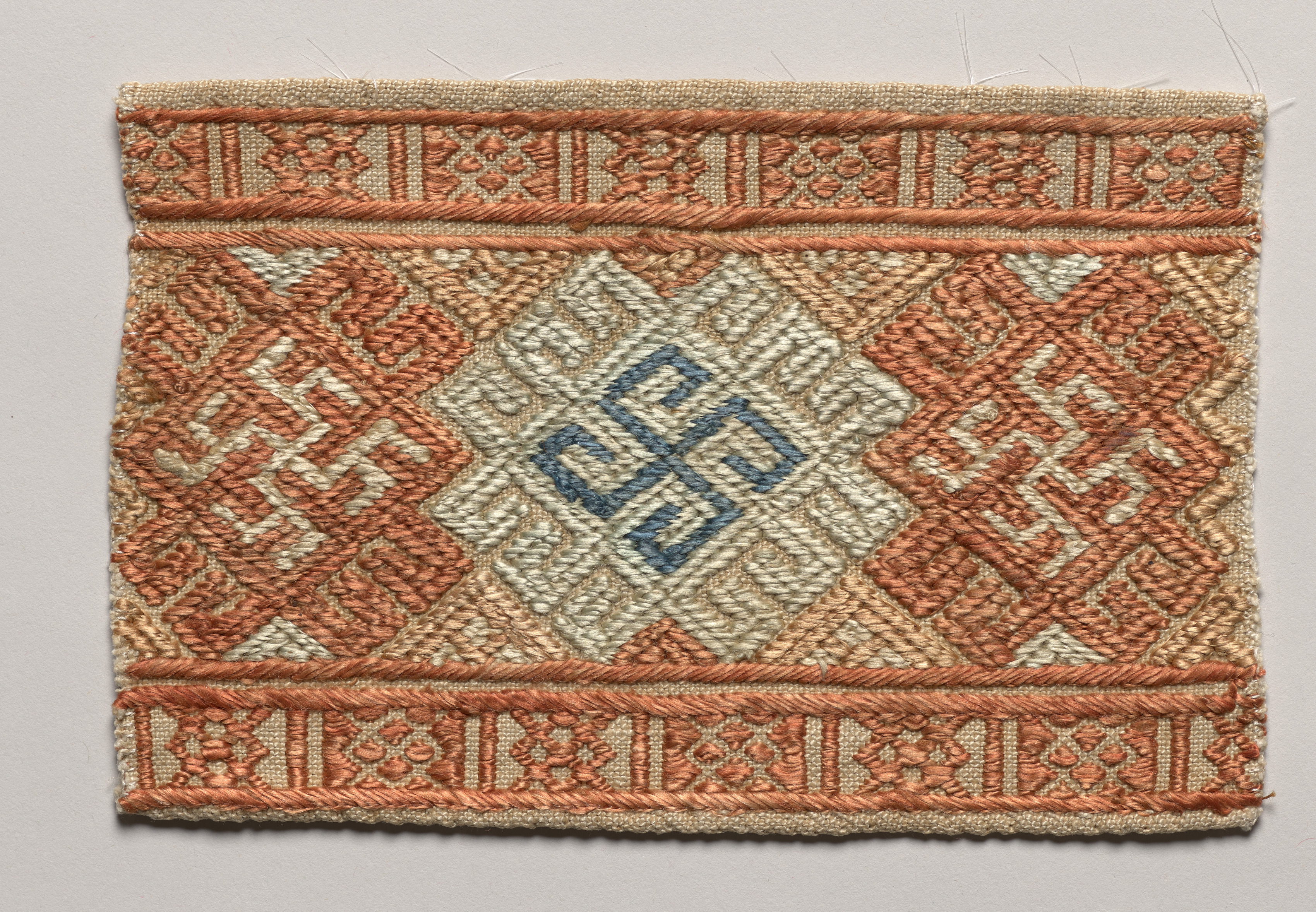
Deconstructing the Tambov Headdress Panel: A Study in Archaic Avant-Garde
As Chief Fabric Deconstructionist for Zoey Fashion Lab, my analysis of this headdress panel from Russia’s Tambov province reveals a profound dialogue between archaic craftsmanship and the disruptive potential of avant-garde design. The artifact, composed of handwoven linen in a plain weave and embellished with silk embroidery, is not merely a relic of regional costume but a textural manifesto. Its technical simplicity—the plain weave of linen—serves as a rigorous, almost monastic canvas, while the silk embroidery introduces a counterpoint of luxury and narrative. This tension between the humble and the opulent is precisely where the avant-garde finds its most fertile ground. The reference to “Archive Resonance” and the sixteenth to seventeenth centuries underscores that this piece is a silent witness to cultural collision and aesthetic synthesis, a quality we at Zoey Fashion Lab seek to amplify, not preserve.
Technical Analysis: Linen Plain Weave as Structural Purity
The foundation of this panel is a linen plain weave, a structure so fundamental it borders on the invisible. In avant-garde terms, this is a zero-degree fabric—a material stripped of ornamentation, existing as pure utility. The linen fibers, likely harvested and retted locally in Tambov, exhibit a characteristic stiffness and irregular slubs that speak to hand-spinning and hand-weaving processes. This is not the homogenized, machine-perfect linen of industrial production; it is a fabric that records its own making. For the avant-garde designer, this irregularity is gold. It introduces a tactile dissonance against which the silk embroidery can react. The plain weave’s grid structure—warp and weft crossing at right angles—provides a rigid, almost architectural armature. Yet, the natural variability of hand-spun yarns introduces micro-movements, a subtle organic pulse that prevents the grid from becoming sterile. This is the same principle that animates deconstructivist fashion: a rigorous system that is simultaneously destabilized by material truth.
Embroidery Analysis: Silk as Dissident Narrative
The silk embroidery on this panel is where the cultural memory and aesthetic ambition reside. Silk, a material historically associated with trade routes, luxury, and foreign influence, is here applied to a local, utilitarian ground fabric. This juxtaposition is itself an avant-garde gesture. The embroidery stitches—likely a combination of satin, stem, and chain stitches—create motifs that are both geometric and organic, echoing the folk symbolism of the region. However, from a deconstructionist perspective, the embroidery is not merely decorative; it is a structural intervention. The silk threads, with their high tensile strength and lustrous sheen, physically alter the drape and weight of the linen. They create areas of tension and release, pulling the plain weave into new topographies. The embroidery becomes a surface architecture, a built environment on the fabric plane.
The reference to “cultural collision” is embodied in the silk itself. In sixteenth- and seventeenth-century Russia, silk was an imported good, often from Persia or Byzantium, and its use in folk costume signifies a negotiation between local identity and external influence. For Zoey Fashion Lab, this is a critical lesson: the avant-garde does not reject tradition; it recontextualizes it. The embroidery on this panel is not a passive decoration but an active agent of transformation. It disrupts the uniform field of the linen, creating zones of opacity and transparency, of matte and shine. This is a visual and tactile polyphony that prefigures the layered, contradictory textures of contemporary avant-garde fashion.
Form and Function: The Headdress as Avant-Garde Object
A headdress panel, by its nature, is an object of framing and display. It is worn on the body’s most expressive and visible site—the head—and thus carries immense symbolic weight. In Tambov tradition, such panels were likely part of a kokoshnik or similar ceremonial headgear, signifying marital status, regional identity, and ritual occasion. To extract this panel from its original context and analyze it through an avant-garde lens is to perform a radical act of defamiliarization. The headdress becomes not a costume but a sculptural object, a wearable architecture that redefines the silhouette. The linen’s stiffness lends itself to structured forms—sharp angles, exaggerated peaks, and asymmetrical volumes—that echo the work of designers like Rei Kawakubo or Yohji Yamamoto. The silk embroidery, meanwhile, introduces a fluid, painterly quality that softens and complicates the rigid geometry.
The panel’s original function—to adorn and signify—is preserved but inverted. In an avant-garde collection, this headdress panel could be reimagined as a detachable collar, a shoulder piece, or a face-framing visor. Its historical weight becomes a conceptual anchor, grounding the collection in a specific material memory while allowing for radical formal experimentation. The “Archive Resonance” is not about nostalgia; it is about activating the past to destabilize the present. The panel’s silence—its status as a mute witness—is broken by the designer’s intervention. We do not restore; we reanimate.
Cultural Collision: From Tambov to the Global Atelier
The sixteenth- and seventeenth-century context of this panel is one of intense cultural exchange. Russia’s Tambov province, while geographically interior, was not isolated. Trade routes, military campaigns, and religious missions brought textiles, motifs, and techniques from across Eurasia. The silk in this embroidery is a material evidence of that exchange. For Zoey Fashion Lab, this historical reality is a template for contemporary practice. The avant-garde is not a Western invention; it is a global phenomenon that emerges from the friction between local traditions and external influences. This panel embodies that friction. The plain weave linen is local, vernacular, and grounded. The silk embroidery is cosmopolitan, luxurious, and mobile. Together, they form a hybrid object that resists easy categorization. This is the essence of the avant-garde: a refusal to be fixed, a constant state of becoming.
Deconstructionist Methodology: Unmaking to Remake
My analysis concludes with a methodological note. At Zoey Fashion Lab, we do not treat historical artifacts as sacred relics. We approach them as material texts to be read, interpreted, and rewritten. The Tambov headdress panel is a text composed in the languages of weave and stitch. To deconstruct it is to unmake its original meaning while preserving its material integrity. We might unpick a section of embroidery to reveal the linen ground, or we might isolate a single motif and scale it to architectural proportions. We might combine the linen with industrial materials like neoprene or latex, creating a dialogue between the handcrafted and the synthetic. The goal is not to replicate the past but to extract its latent potential. The panel’s plain weave is a lesson in restraint; its embroidery is a lesson in expression. Together, they teach us that the avant-garde is not a style but a method—a way of seeing the new in the old, the radical in the traditional, the global in the local.