Deconstructing the Avant-Garde: The Tang Dynasty Phoenix as a Textile Ornament
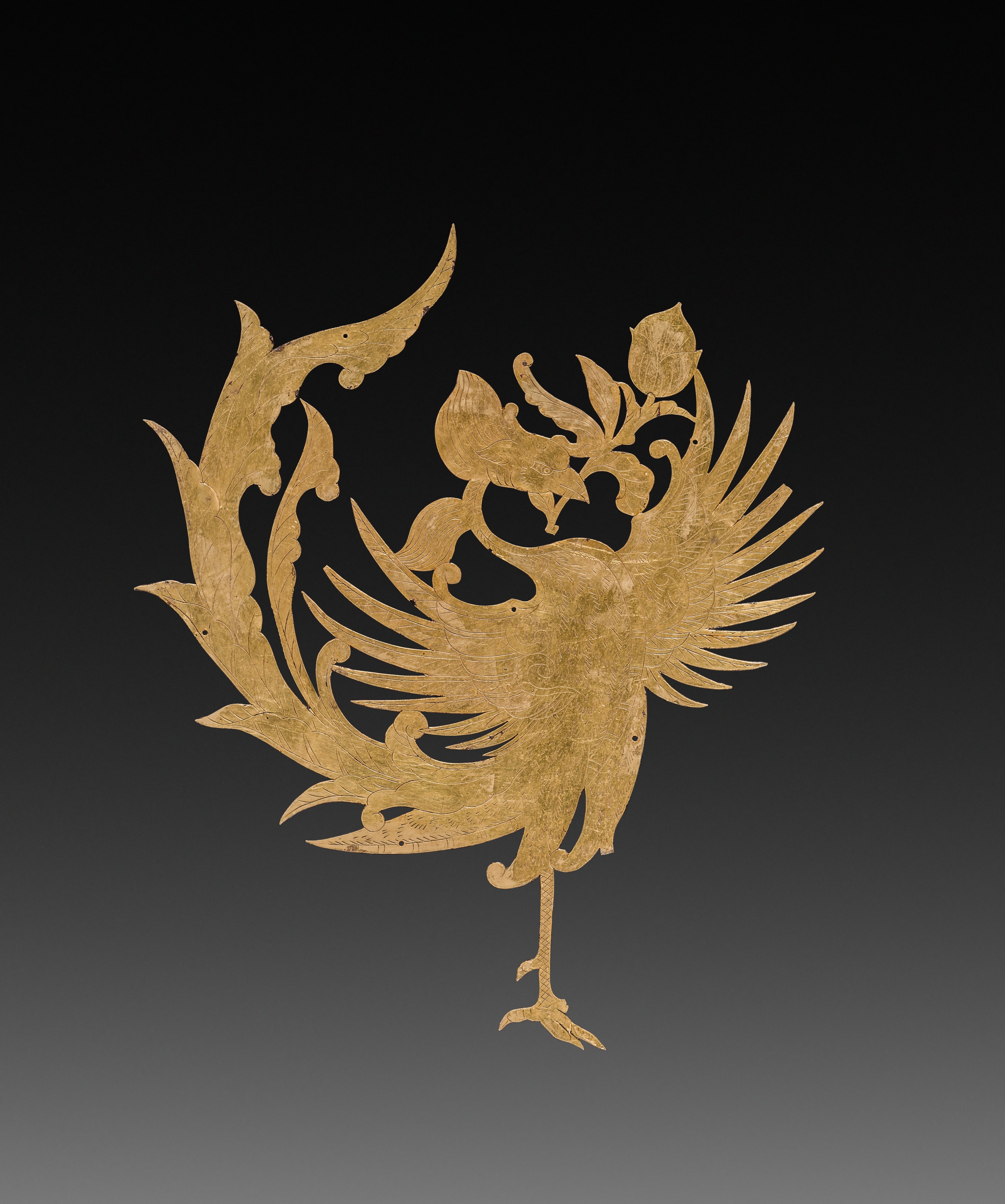
At Zoey Fashion Lab, our mission is to unearth the latent narratives embedded within historical artifacts and reimagine them through a contemporary, avant-garde lens. The subject of this analysis—a Tang dynasty (618-907) textile ornament depicting a phoenix, crafted from beaten gold with chased detail—presents a profound opportunity. This piece is not merely a decorative element; it is a condensed universe of power, cosmology, and material mastery. By deconstructing its technical, symbolic, and contextual layers, we can extract principles that resonate with the most radical fashion design today.
Technical Mastery: The Alchemy of Beaten Gold and Chased Detail
The technical execution of this ornament is paramount. Beaten gold—a process of hammering the metal into thin, pliable sheets—demonstrates a profound understanding of material behavior. This technique is not about rigid casting but about coaxing the metal into form, allowing it to retain a subtle, organic irregularity. The light-catching surface of beaten gold is inherently dynamic; it shimmers and shifts with every movement, creating a living, breathing quality. This is a direct precursor to the kinetic textiles we explore at Zoey, where surface manipulation—through pleating, laser-cutting, or metallic threading—creates a similar illusion of perpetual motion.
The chased detail further elevates the piece. Unlike engraving, which removes material, chasing displaces it. The artisan uses a hammer and small punches to push the gold from the reverse side, creating raised, sculptural lines. This process demands immense precision and patience, as each stroke is irreversible. The resulting phoenix is not a flat image but a low-relief sculpture, its feathers, beak, and talons articulated with a delicate, almost calligraphic line. This technique imbues the ornament with a tactile depth that invites touch—a quality often lost in modern, digitally produced embellishments. For Zoey, this underscores the importance of haptic design, where the garment’s surface is not just seen but felt, creating a sensory dialogue with the wearer.
Symbolic Resonance: The Phoenix as a Transcultural Archetype
The phoenix, or fenghuang, in Chinese cosmology is a composite creature, embodying the union of yin and yang, and representing virtue, grace, and the empress. Its appearance was a sign of peace and prosperity. However, the Tang dynasty’s cosmopolitanism, fueled by the Silk Road, imbued this symbol with additional layers. The phoenix was not a static emblem but a fluid icon that absorbed influences from Persia, India, and Central Asia. This hybridity is crucial for an avant-garde interpretation. The phoenix is not a fixed identity but a transcultural meme, constantly mutating and adapting.
In the context of Archive Resonance, the phoenix ornament stands in stark contrast to the referenced artifact: 一面是光洁银镜上以黄金镶嵌的纷繁棕叶纹,另一面是冰冷石棺板上以浮雕诉说的生命叙事 (“One side is a smooth silver mirror inlaid with intricate palm leaf patterns in gold, the other side is a cold stone sarcophagus with a relief telling the narrative of life”). The mirror reflects the self, the external, the surface; the sarcophagus speaks of the internal, the eternal, the depth. The phoenix ornament, as a textile adornment, occupies a liminal space between these two poles. It is worn on the body—a living, moving surface—yet it carries the weight of cosmic symbolism. This duality is the essence of avant-garde fashion: the garment is both a reflection of the present self and a vessel for timeless narratives.
Contextualizing the Ornament: From Tang Court to Avant-Garde Catwalk
In the Tang court, such gold ornaments were likely sewn onto silk garments, transforming the wearer into a mobile tableau of imperial power. The beaten gold would catch the flickering light of oil lamps, creating a mesmerizing spectacle. The phoenix, as a symbol of the empress, linked the wearer to celestial order. This is not mere decoration; it is political and spiritual branding. For Zoey, this principle is translated into the concept of the garment as a manifesto. An avant-garde piece does not just clothe the body; it declares the wearer’s allegiance to a particular aesthetic philosophy, a subversive worldview.
The Tang dynasty was a period of unprecedented cultural exchange, and its art reflects a fearless appropriation of foreign motifs. The phoenix, while distinctly Chinese, shares formal similarities with the Persian simurgh and the Indian garuda. This cross-pollination is a blueprint for the avant-garde, which thrives on collision and synthesis. Zoey Fashion Lab can draw from this by juxtaposing the Tang phoenix with non-traditional materials—carbon fiber, recycled plastics, bio-fabricated leather—or by deconstructing its form into abstract, geometric fragments. The goal is not to replicate the ornament but to channel its energy of transformation.
Deconstructing the Ornament for Avant-Garde Fashion
To translate this historical artifact into a contemporary design language, we must first deconstruct its components:
1. The Materiality of Light: The beaten gold’s reflective quality can be reinterpreted through iridescent micro-pleating or metallic organza. Instead of a single, static ornament, the entire garment could become a field of shifting light, with the phoenix’s form suggested through negative space or strategic cutouts. The chased detail can be echoed through thermoplastic texturing or 3D-printed filigree that rises from the fabric’s surface.
2. The Kinetic Silhouette: The phoenix’s dynamic pose—often depicted with wings spread, in mid-flight—lends itself to asymmetrical draping and sculptural sleeves. The garment should feel as if it is in motion, even when static. Consider a cape that fans out like a tail, or a bodice with layered, feather-like panels that rustle with each step.
3. The Narrative of the Body: The ornament was placed on the body to signify status. In an avant-garde context, we can subvert this by placing the phoenix motif in unexpected locations—the back of a jacket, the interior of a lining, or as a detachable brooch that can be repositioned. This challenges the hierarchy of traditional adornment and empowers the wearer to author their own narrative.
4. The Dichotomy of Surface and Depth: Drawing from the Archive Resonance reference, the garment can explore the tension between mirror and sarcophagus. One side of a coat could be a smooth, reflective surface (the mirror), while the other is a textured, relief-like pattern (the sarcophagus). The phoenix acts as the bridge between these two states, embodying the transition from external appearance to internal meaning.
Conclusion: The Phoenix as a Blueprint for Radical Design
The Tang dynasty phoenix ornament, in its technical brilliance and symbolic complexity, offers a rich vocabulary for avant-garde fashion. It teaches us that true ornamentation is never superficial; it is a condensation of culture, power, and craft. At Zoey Fashion Lab, we do not simply borrow historical motifs. We deconstruct them, interrogate their origins, and reassemble them in ways that challenge our present assumptions about beauty, identity, and the body. The phoenix, with its promise of rebirth and transformation, is the perfect emblem for this process. It reminds us that fashion, at its most radical, is not about covering the body but about revealing the soul’s potential for flight.