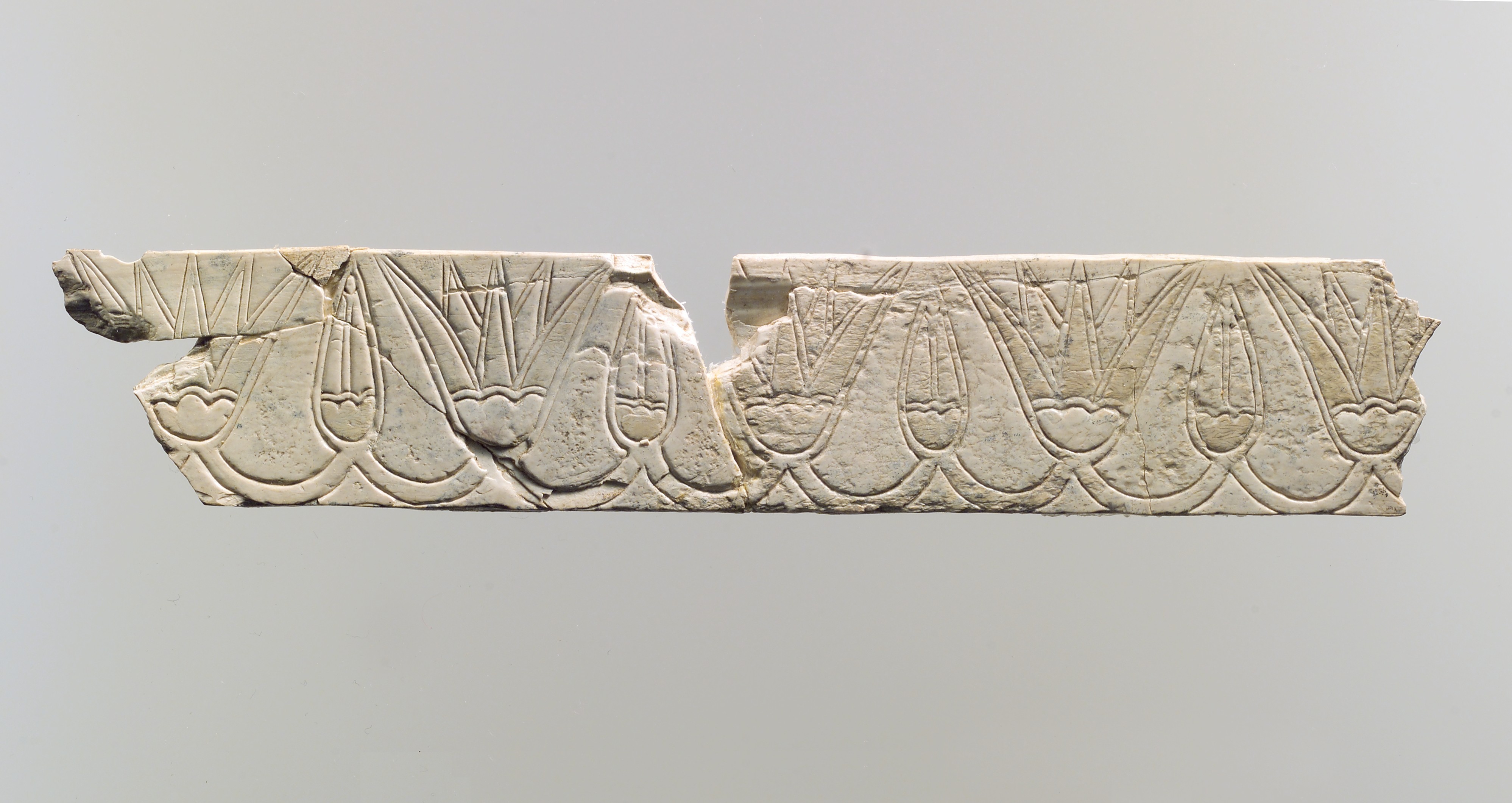
The Assyrian Codex: Deconstructing the Incised Plaque for SS26 Avant-Garde Silhouette
The incised furniture plaque, a relic of Assyrian opulence from the 9th to 8th century BCE, is not merely an artifact of historical ornamentation. Carved from ivory with traces of pigment, its frieze of lotus blossoms and buds represents a sophisticated system of rhythmic repetition, sacred geometry, and architectural restraint. For Zoey Fashion Laboratory’s SS26 collection, this ancient object becomes a blueprint for a radical reimagining of the human form—a dialogue between the rigidity of empire and the organic flow of nature. This analysis dissects the plaque’s structural DNA to forge a futuristic couture language grounded in deconstructive aesthetics and high-concept garment architecture.
I. The Geometry of Repetition: From Frieze to Fractal Silhouette
The plaque’s defining feature is its serialized lotus motif—a vertical procession of blossoms and buds, each meticulously incised with parallel lines and curved contours. This is not mere decoration; it is a system of rhythmic segmentation. For SS26, this translates into a silhouette strategy where the body is not draped but fragmented into repeating architectural units. Imagine a gown where the torso is composed of layered, laser-cut panels, each echoing the lotus’s petal geometry. The buds become sharp, angular shoulder pads, while the blossoms unfurl into asymmetrical hip projections. The result is a fractal silhouette—a garment that appears to multiply and contract as the wearer moves, challenging the static nature of traditional couture.
The materiality of ivory—its density, its capacity for fine incision—informs the choice of structural fabrics. We propose a hybrid of rigid, resin-coated organza and thermoplastic polyurethane (TPU) panels, which can be heat-pressed to mimic the plaque’s precise, shallow grooves. These panels are not sewn but interlocked via magnetic or snap-fit joints, allowing the silhouette to be reconfigured. The lotus frieze’s vertical orientation dictates a columnar elongation of the human form—a silhouette that rises from a narrow base (a fitted, high-waisted pant) to a dramatic, tiered bustier that mirrors the plaque’s ascending blossoms.
II. Deconstructive Aesthetics: The Trace of Paint and the Unfinished Edge
The plaque’s “paint traces” are not incidental; they are a testament to time’s erosion of perfection. In avant-garde couture, this decay becomes a design principle. We introduce chromatic abrasion—a technique where pigment is applied in controlled, partial layers, then partially removed to reveal the ivory-toned base fabric. This creates a ghostly gradient on the garment’s surface, as if the lotus pattern is fading into the wearer’s own skin. The incised lines themselves are reinterpreted as cutouts and perforations in the fabric, allowing light to pass through and cast shadows that shift with movement.
The unfinished edge is paramount. The plaque’s borders are sharp, yet the interior carving suggests a hand that left the material with intentional roughness. For SS26, we reject hemming in favor of laser-scorched edges that fray into fine filaments, mimicking the ivory’s ancient fractures. Sleeves are not closed; they are slit from shoulder to wrist, with the resulting strips bound only at intervals by metallic clasps shaped like lotus seeds. This deconstruction allows the garment to breathe, to exist in a state of perpetual becoming—a nod to the Assyrian artifact’s own journey from functional object to fragmented relic.
III. Futuristic Silhouettes: The Lotus as Structural Scaffold
The lotus blossom, in Assyrian art, often symbolizes rebirth and the sun’s daily cycle. For a futuristic wardrobe, this translates into a modular exoskeleton that transforms the body into a living monument. The central motif—a fully open lotus—becomes the keystone of the garment’s architecture. We propose a shoulder cage constructed from lightweight carbon fiber, molded into lotus petals that curve outward and upward, creating a halo-like circumference around the head. This is not a hat but an aural framework that extends the wearer’s presence into the surrounding space.
The buds, smaller and more closed, are deployed as dynamic hinges at the joints—elbows, knees, wrists. These are not passive ornaments; they are kinematic points that allow the garment to fold and expand. When the wearer raises an arm, the bud-shaped hinge rotates, exposing a hidden layer of iridescent silk that catches the light. This movement echoes the plaque’s frieze, where each bud seems to push upward toward the blossom. The result is a silhouette that is simultaneously rigid and fluid—a paradox of imperial strength and organic growth.
IV. Structural Innovation: The Incised Line as Seamless Joint
The plaque’s incised technique—where the design is cut into the surface rather than applied on top—suggests a negative-space construction for couture. Instead of seams that join separate pieces, we propose milled channels in the fabric that act as structural grooves. These channels are not visible from the front; they are hidden within the garment’s inner layer, creating a monolithic appearance. The lotus petals are thus not appliqués but integral extrusions of the fabric itself, achieved through a combination of 3D knitting and heat-setting.
The plaque’s symmetrical frieze also informs a biomimetic fastening system. Each lotus blossom on the garment is fitted with a magnetic core that aligns with a corresponding bud on an adjacent panel. This creates a self-adhering grid that can be assembled without zippers or buttons. The wearer can reconfigure the garment’s silhouette by snapping different panels together—a nod to the plaque’s modular, repeatable pattern. For the runway, this allows for live transformation: a model begins in a floor-length coat, then disassembles it into a cropped jacket and skirt by detaching the lotus panels.
V. Chromatic and Textural Palette: Ivory, Ochre, and the Digital Afterglow
The plaque’s ivory base and paint traces dictate a restrained yet potent color story. The primary palette is bleached bone (a matte, off-white) punctuated by burnt sienna and lapis lazuli blue—the latter a nod to the Assyrian love for precious pigments. These colors are not applied uniformly; they are airbrushed in concentric rings around each lotus motif, creating a halo effect that mimics the plaque’s original polychromy. The texture is equally deliberate: the main fabric is a double-faced matte jersey that feels cool and smooth like polished ivory, while the incised channels are lined with a micro-pleated metallic foil that catches light like ancient gilding.
For a futuristic twist, we introduce thermochromic pigments that shift from ivory to deep blue when exposed to body heat. This creates a living surface—the lotus pattern becomes more vivid as the wearer’s temperature rises, echoing the Assyrian belief in the lotus as a symbol of the sun’s transformative power. The overall effect is a garment that feels both ancient and alien, a relic from a civilization that never was.
Conclusion: The Plaque as Prophecy
The incised furniture plaque is not a passive source of inspiration; it is a structural manifesto for SS26. Its frieze of lotus blossoms and buds offers a system of repetition, decay, and rebirth that aligns perfectly with avant-garde couture’s mission to deconstruct and reimagine the body. By translating its incised lines into channels, its paint traces into chromatic abrasion, and its symmetry into modular exoskeletons, Zoey Fashion Laboratory creates a collection that is both a tribute to Assyrian craftsmanship and a prophecy of future fashion. The garment is no longer a covering; it is an architectural organism that grows, shifts, and decays with the wearer, embodying the eternal cycle of the lotus itself.