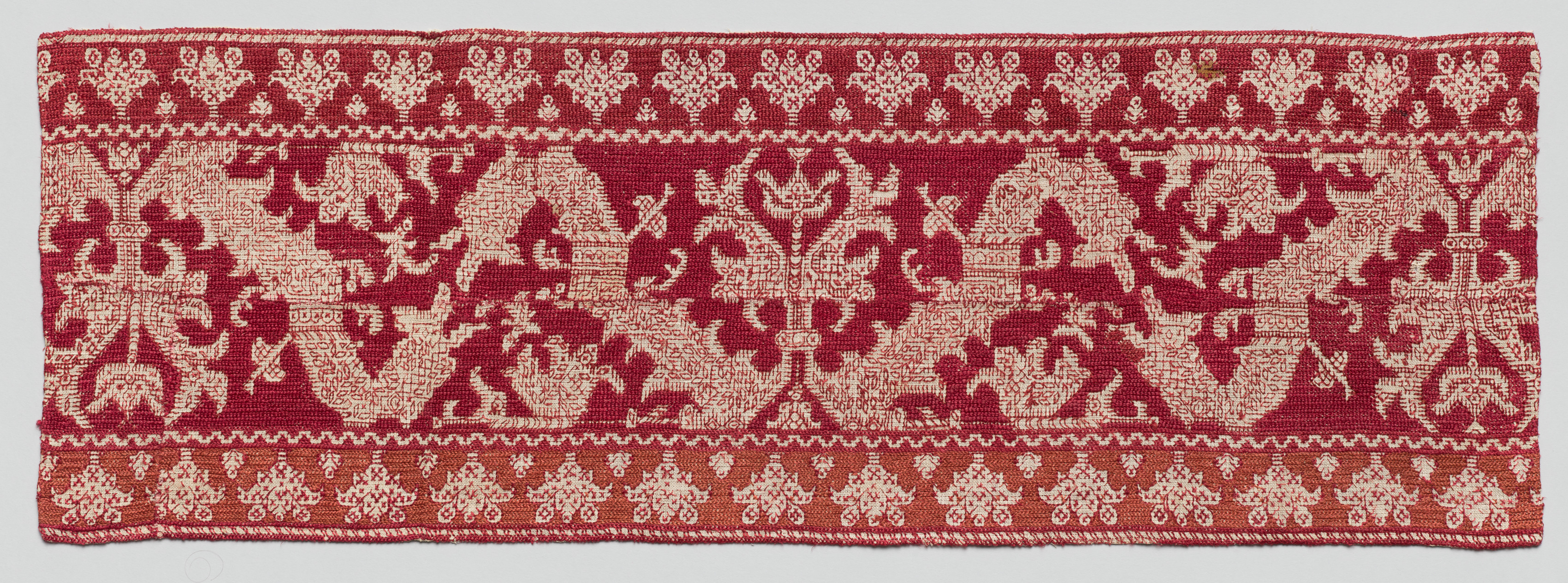
Deconstructing the Fragment: A Zoey Fashion Lab Analysis
At Zoey Fashion Lab, we approach historical textile fragments not as relics, but as dynamic blueprints for avant-garde design. The subject of this analysis—a fragment of a furnishing textile from Azemmour, Morocco, embroidered by a local artisan in the 16th to 17th centuries—is a profound case study. It embodies a cultural collision between North African, Islamic, and European aesthetics, a resonance that our lab seeks to amplify through radical deconstruction. This fragment, composed of linen, silk, and dye, offers a rich vocabulary of texture, structure, and narrative that can be reimagined into contemporary fashion that challenges conventional form and function.
Material Archaeology: Linen, Silk, and Dye
The technical composition of this fragment is its first point of departure. The warp and weft of linen, a bast fiber derived from the flax plant, provide a foundational structure that is both robust and breathable. Linen’s inherent stiffness and tendency to crease—often viewed as flaws in traditional tailoring—become assets in an avant-garde context. We envision leveraging this rigidity to create sculptural silhouettes, such as exaggerated shoulders or asymmetric, architectural folds that hold their shape without internal boning. The linen’s natural, off-white patina, aged by centuries, can be preserved as a base for reactive dyeing or left raw to contrast with more opulent materials.
The silk threads used in the embroidery introduce a tension between the humble linen ground and the luxurious embellishment. In the original piece, silk likely formed intricate geometric or floral motifs, reflecting both Islamic artistic traditions (avoiding figural representation) and European influences from trade routes. For Zoey Fashion Lab, we deconstruct this relationship by extracting the silk threads and re-embedding them as structural elements rather than surface decoration. Imagine a garment where silk filaments are woven into the seams to create tension lines that pull the fabric into a new, dynamic shape—a form of textile engineering that blurs the line between embroidery and architecture.
The dye—likely derived from natural sources such as indigo, madder, or cochineal—adds a layer of chromatic history. The fragment’s surviving hues, perhaps a faded crimson or deep blue, are not static colors but records of chemical reactions with light, air, and time. In our avant-garde reinterpretation, we treat dye as a living medium. We might apply reactive pigments that shift with body heat or UV exposure, causing the garment’s color to evolve throughout the day. Alternatively, we could extract the original dye molecules and re-synthesize them into a new palette, creating a “ghost” of the original color that appears only under specific lighting conditions—a nod to the fragment’s ephemeral history.
Cultural Resonance: The Azemmour Embroidery
The fragment’s origin in Azemmour, a coastal city in Morocco, places it at a crossroads of trade and conquest. During the 16th and 17th centuries, this region was a melting pot of indigenous Berber, Arab, and Portuguese influences. The embroiderer, likely a woman working within a domestic or guild context, would have synthesized motifs from Islamic geometric patterns, European heraldic symbols, and local flora. This cultural hybridity is the core of the fragment’s “Archive Resonance.”
Zoey Fashion Lab’s avant-garde approach does not seek to replicate these motifs but to abstract their underlying logic. For instance, the repetitive, interlocking nature of Islamic geometric patterns can be translated into a modular garment system—a jacket composed of interchangeable hexagonal panels that can be reconfigured by the wearer. The European influence might manifest as a deconstructed collar or cuff that references Renaissance tailoring but is rendered in asymmetrical, raw-edged forms. The embroiderer’s hand—the irregular tension of her stitches, the slight variations in thread thickness—becomes a blueprint for intentional imperfection. We might program a digital embroidery machine to mimic these “errors,” creating a controlled chaos that honors the artisan’s humanity.
Structural Deconstruction: From Flat to Form
The fragment’s original function as a furnishing textile—likely a cushion cover, wall hanging, or bedspread—is key to its avant-garde potential. Furnishing textiles are designed for static, horizontal surfaces, while fashion demands dynamic, vertical forms. Our deconstruction process begins by breaking the fragment’s planar logic. We cut the linen ground along the warp and weft, separating the embroidery into individual components. These components are then reassembled as three-dimensional volumes: a silk-embroidered motif becomes a pocket, a collar, or a sleeve gusset; the linen base is pleated and folded to create a skirt that flares from the waist like an unfolded map.
We also explore inversion and transparency. The fragment’s backside—where the embroidery threads are visible as loose, tangled stitches—is often more intriguing than its front. By exposing the reverse side as the garment’s exterior, we reveal the labor behind the ornament. This technique aligns with the avant-garde tradition of “anti-fashion,” where construction is laid bare. Additionally, we might laser-cut portions of the linen to create a lattice effect, allowing the skin or an underlayer to peek through, transforming a dense, heavy textile into a light, breathable garment.
Avant-Garde Application: The Zoey Fashion Lab Collection
In a hypothetical Zoey Fashion Lab collection titled “Resonance,” this fragment would inspire multiple pieces. A deconstructed trench coat uses the linen ground as the main body, with the silk embroidery extracted and re-woven into the sleeves as structural webbing. The dye is reactivated through a heat-sensitive coating, so the coat shifts from a faded indigo to a vibrant cobalt as the wearer moves from a cool to a warm environment. A modular dress is composed of panels that mirror the fragment’s geometric motifs; each panel can be detached and reattached via magnetic fasteners, allowing the wearer to customize the silhouette. The embroidery itself is digitized and printed onto sheer silk organza, creating a ghost layer that floats over the linen base—a literal resonance of the original pattern.
Finally, we consider the philosophical dimension. The fragment is a testament to the value of slow, handmade craft in an era of fast fashion. Our avant-garde reinterpretation does not discard this ethos but amplifies it. By deconstructing and reconstructing, we create a dialogue between past and future, between the embroiderer’s hand and the designer’s vision. The resulting garments are not costumes but wearable artifacts—each stitch, each dye molecule, each cultural reference is a layer of meaning that the wearer carries into the world.
In conclusion, this fragment from Azemmour is more than a historical curiosity; it is a catalyst for innovation. Zoey Fashion Lab’s analysis reveals that its true value lies not in preservation but in transformation. By applying avant-garde principles of deconstruction, abstraction, and material re-engineering, we unlock new forms of expression that honor the original while pushing fashion into uncharted territory. The fragment’s resonance, once archived, now becomes a living, breathing force in contemporary design.