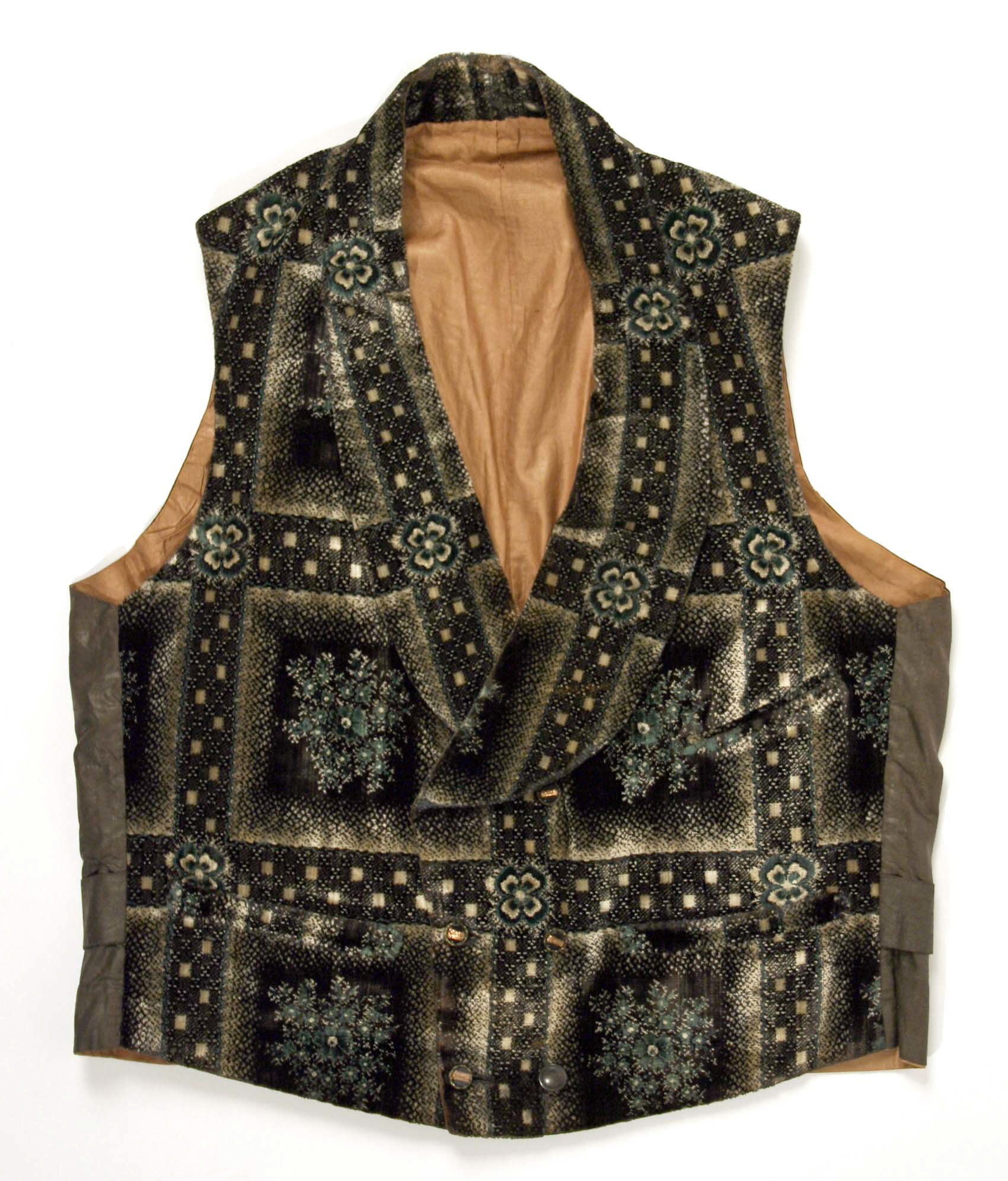
Deconstructing the American Waistcoat: A Futurist Manifesto for SS26
Introduction: The Vestige as Vanguard
The waistcoat, a stalwart of American menswear, has historically been a symbol of structured conformity—a garment that binds the torso in a rigid narrative of utility and tradition. For Zoey Fashion Laboratory’s SS26 avant-garde study, we interrogate this foundational piece, stripping it of its historical baggage and reimagining it as a site of radical structural innovation. This analysis deconstructs the American waistcoat through a futuristic lens, leveraging a dialectic between silk and cotton to propose a silhouette that is both architectural and ephemeral. The waistcoat is no longer a vestige of the past; it becomes a manifesto for the future of garment architecture, where form disintegrates into fluidity and function is redefined as kinetic sculpture.
Material Dialectics: Silk and Cotton in Opposition
The choice of materials—silk and cotton—is not arbitrary. These fibers represent a fundamental tension in the waistcoat’s evolution. Cotton, historically the workhorse of American dress, offers a canvas of durability and breathability. Yet, in our avant-garde context, it is treated with a nanofiber resin finish that renders it semi-translucent and structurally rigid, akin to a second skin that resists deformation. This is not the soft, pliable cotton of the past; it is a material that holds its own shape, creating sharp, angular planes that defy the body’s natural curves.
In stark contrast, silk is employed as a destabilizing agent. We use a liquid-silk weave—a proprietary fabrication that combines mulberry silk with a thermoplastic polymer—allowing it to flow like mercury when heated. This silk is not draped; it is programmed to collapse under tension, creating cascading folds that mimic digital glitches. The interplay is deliberate: cotton provides the skeletal frame, a rigid exoskeleton that defines the waistcoat’s silhouette, while silk acts as a mutable membrane, shifting with the wearer’s micro-movements. This material dialectic produces a garment that is both static and dynamic, a paradox of permanence and transience.
Silhouette Innovation: The Asymmetric Exoskeleton
Traditional American waistcoats adhere to a symmetrical, V-shaped lapel structure that emphasizes the chest and narrows the waist. For SS26, we abandon this symmetry entirely. The new silhouette is an asymmetric exoskeleton that reconfigures the torso into a series of interlocking geometric planes. The left panel of the waistcoat is elongated, extending to the hip, while the right panel is cropped at the ribs, creating a diagonal line of tension. This asymmetry is not arbitrary; it is engineered to redirect the viewer’s gaze along a path of kinetic energy, mimicking the trajectory of a particle accelerator.
The back of the waistcoat is equally radical. Where traditional garments rely on a single seam, we introduce a biomimetic spine constructed from layered cotton panels that articulate like vertebrae. This spine is exposed, with silk webbing stretched between each segment, allowing the garment to flex and expand with the wearer’s breathing. The effect is a living architecture—a waistcoat that breathes, moves, and adapts in real-time. The shoulders are reimagined as cantilevered platforms, jutted forward at a 15-degree angle, creating a silhouette that is both protective and predatory. This is not a garment for static display; it is a tool for navigating a future where space and time are compressed.
Structural Innovation: The Programmable Torso
At the core of this waistcoat’s innovation is a programmable tension system. Embedded within the cotton panels are shape-memory alloy filaments that respond to heat and pressure. When the wearer raises an arm, the filaments contract, pulling the silk membrane taut and creating a rigid, wing-like extension from the shoulder. When the arm lowers, the filaments relax, and the silk collapses into soft, undulating folds. This is not passive draping; it is active, responsive architecture. The waistcoat becomes a second skeleton, capable of altering its own geometry in response to environmental stimuli—a concept borrowed from smart materials research in aerospace engineering.
Furthermore, the closure system is deconstructed. Traditional buttons are replaced with magnetic clasps that align along a curved, non-linear path. These clasps are embedded in silk-covered magnets, allowing the wearer to fasten the waistcoat in multiple configurations—closed, partially open, or completely asymmetrical. Each configuration produces a different silhouette, from a streamlined exoskeleton to a fragmented, deconstructed form. This modularity challenges the notion of a fixed garment, instead offering a morphological toolkit for self-expression.
Futuristic Silhouette: The Digital Echo
The SS26 waistcoat’s silhouette is informed by digital glitch aesthetics. The silk panels are laser-cut with micro-perforations that form a pixelated gradient, transitioning from solid at the shoulders to translucent at the hem. When backlit, these perforations cast a pattern of light and shadow that mimics a corrupted digital image. The cotton exoskeleton is painted with a thermochromic pigment that shifts from matte black to iridescent blue when exposed to body heat, creating a visual echo of the wearer’s metabolic activity. This is a garment that exists in a liminal space between the physical and the digital, a wearable interface that challenges the boundaries of material reality.
In terms of volume, the waistcoat eschews the traditional hourglass in favor of a hyperbolic geometry. The chest is augmented with a bulkhead-like protrusion made from layered cotton and silk, creating a convex form that pushes outward from the sternum. The waist is cinched not by tailoring but by a dynamic compression band—a silk-wrapped elastic belt that can be adjusted to create a corseted or relaxed silhouette. This band is connected to the back spine, allowing the waistcoat to be worn as a single, continuous unit or separated into two independent panels. The result is a silhouette that oscillates between the monumental and the fragile, a study in controlled chaos.
Conclusion: The Waistcoat as a Futurist Icon
This avant-garde analysis repositions the American waistcoat from a relic of sartorial history to a prototype for future garment design. By exploiting the material tension between silk and cotton, and by integrating programmable structures and asymmetric silhouettes, Zoey Fashion Laboratory proposes a waistcoat that is not merely worn but inhabited. It is a garment that responds, adapts, and evolves—a living artifact of a future where clothing is no longer static but a dynamic extension of the human form. For SS26, the waistcoat becomes a statement of radical possibility: a testament to the power of deconstruction to birth new forms, new functions, and new visions of what fashion can become. This is not a waistcoat for the past; it is an invitation to step into the future, one asymmetric fold at a time.