Deconstructing the Silla Necklace: An Avant-Garde Analysis for Zoey Fashion Lab
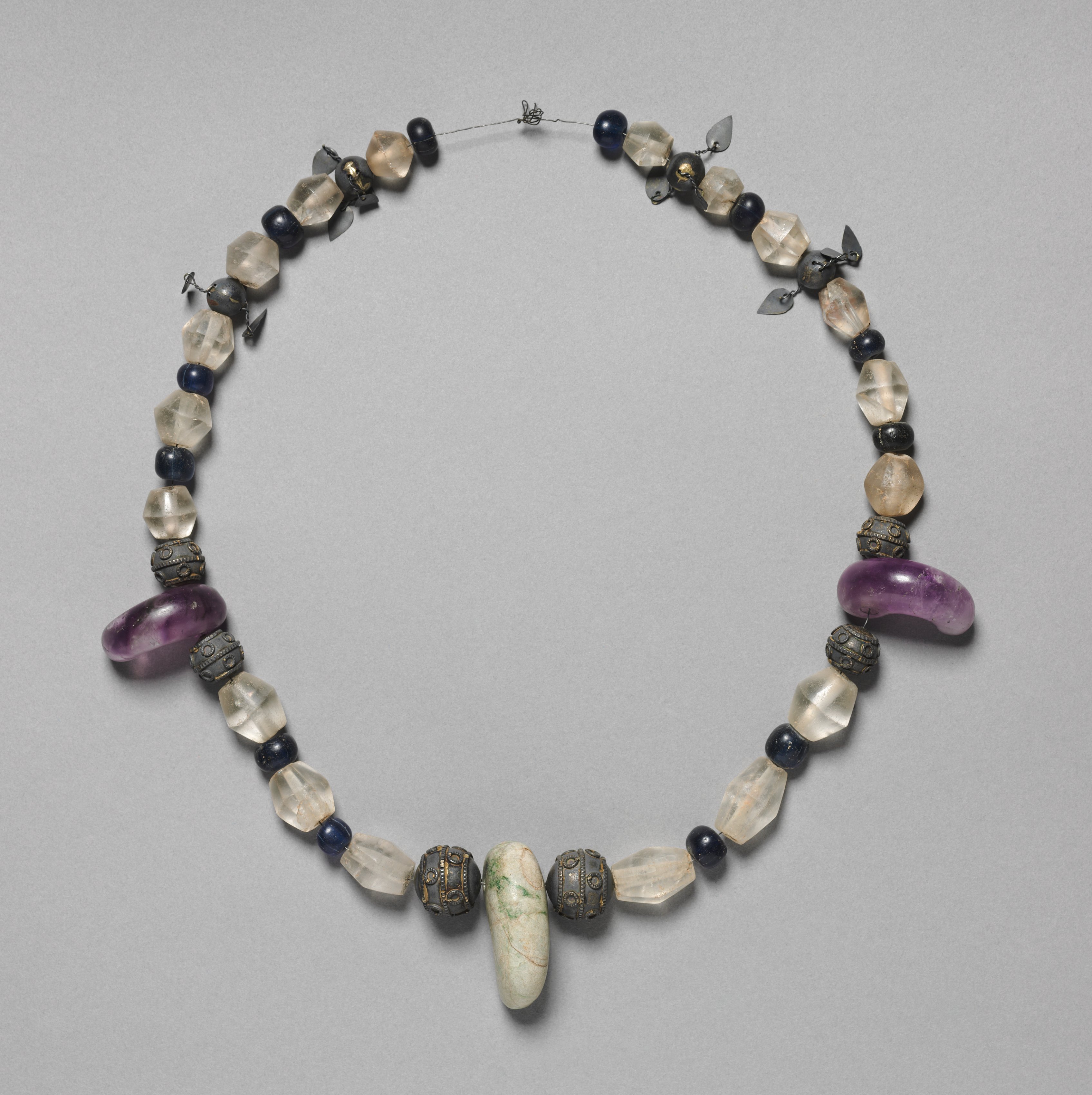
At Zoey Fashion Lab, we approach historical artifacts not as relics to be preserved, but as raw material for deconstruction and reinvention. The Unified Silla necklace—crafted from jade, amethyst, gold, and rock crystal—presents a compelling case study. Its origins in Korea (676-935) and its technical composition offer a rich palette for the avant-garde. However, the most provocative element is the reference to a New DNA Strand. This is not merely a necklace; it is a genetic blueprint, a coded message from a past civilization that we are tasked with re-encoding for the future. Our analysis will dissect its material, structural, and symbolic DNA, proposing a radical reinterpretation that aligns with Zoey Fashion Lab’s ethos of deconstruction-as-creation.
Material Deconstruction: The Alchemy of Stone and Metal
The necklace’s materials—jade, amethyst, gold, and rock crystal—are not arbitrary. In Unified Silla, each held profound cosmological significance. Jade symbolized purity and immortality; amethyst, spiritual clarity; gold, divine authority; and rock crystal, the clarity of the mind. For the avant-garde, these stones are not precious; they are agents of transformation. The jade’s deep green, the amethyst’s violet, and the gold’s luster create a chromatic tension that we can exploit.
Deconstruction Strategy: We propose a fragmented material hierarchy. Instead of a polished, symmetrical arrangement, we will treat the jade and amethyst as geological fragments—raw, unpolished, and irregularly shaped. The gold should be oxidized and distressed, not gleaming. The rock crystal will be shattered into sharp, angular shards. This is not destruction for its own sake; it is a deliberate act to expose the material’s internal structure. The “New DNA Strand” reference suggests that these materials are not inert; they are living, evolving elements. We will embed micro-circuitry within the gold settings, allowing the stones to pulse with low-frequency light—a heartbeat for the necklace. The jade will be treated with a bio-luminescent coating, activating under UV light to reveal hidden veins of color. The amethyst will be laser-etched with microscopic patterns that mimic cellular division. This transforms the necklace from a static ornament into a bio-technological organism.
Structural Deconstruction: The Necklace as a Non-Linear System
The original Silla necklace likely followed a linear, symmetrical pattern—a central pendant flanked by balanced strands. This reflects a worldview of order, hierarchy, and cosmic balance. For the avant-garde, we reject linearity. The “New DNA Strand” implies random mutation, recombination, and non-linearity.
Deconstruction Strategy: We will design the necklace as a chaotic, asymmetrical network. The central pendant is removed; instead, multiple focal points are distributed irregularly along the strand. The gold chain will be replaced with a woven mesh of titanium wire, interwoven with fiber-optic threads that change color based on the wearer’s body heat. The jade and amethyst fragments will not be strung in sequence; they will be suspended at varying lengths from the mesh, creating a three-dimensional, kinetic sculpture. The rock crystal shards will be attached at random intervals, their sharp edges catching light unpredictably. This structure mimics the fractal geometry of a DNA helix—repetitive yet infinitely variable. The necklace will not lie flat against the skin; it will hover and shift with movement, its components colliding and separating like particles in a quantum field. This is a necklace that refuses to be still, a living system in constant flux.
Symbolic Deconstruction: From Divine Authority to Genetic Code
In Unified Silla, the necklace was likely a marker of aristocratic or religious status—a symbol of connection to the divine and to ancestral lineage. The “New DNA Strand” reference subverts this entirely. We are not preserving lineage; we are rewriting it. The necklace becomes a repository of genetic memory—not of a single bloodline, but of a synthetic, hybridized future.
Deconstruction Strategy: Each material will be encoded with digital data representing a different aspect of human identity. The jade fragments will contain DNA sequences from extinct species; the amethyst, neural patterns from ancient meditation practices; the gold, cryptographic keys to lost languages; the rock crystal, quantum states from theoretical physics. The wearer will interact with the necklace via a biometric interface—a small sensor embedded in the clasp that reads their pulse, skin conductivity, and micro-expressions. The necklace will respond in real time, altering the light patterns and the arrangement of its components. This is not jewelry; it is a symbiotic interface between human and machine, past and future. The “New DNA Strand” is a manifesto: we are no longer bound by biological inheritance. We are free to splice, edit, and hybridize our own cultural and genetic codes.
Avant-Garde Execution: A Wearable Performance
To realize this deconstruction, Zoey Fashion Lab proposes a limited-edition wearable performance piece. The necklace will be presented not on a mannequin, but on a live model in a controlled environment—a dark room with a single, pulsing light source. The model will wear a translucent, sensor-laden garment that amplifies the necklace’s bio-responses. As the model moves, the necklace’s fiber-optic threads will trace their movements in the air, creating ephemeral light drawings. The audio component will consist of sonified data from the necklace’s digital encoding—a low, rhythmic hum that shifts in pitch and tempo. This is a multi-sensory experience that blurs the line between jewelry, sculpture, and performance art. The piece will be unwearable in a conventional sense—it is heavy, asymmetrical, and requires constant adjustment. This is intentional. The avant-garde rejects comfort and utility in favor of provocation and intellectual engagement.
Conclusion: The Necklace as a New Species
The Unified Silla necklace, when deconstructed through the lens of the New DNA Strand, becomes a prototype for a new species of ornament. It is no longer a passive object of beauty or status; it is an active, evolving entity that interrogates our relationship with history, technology, and identity. At Zoey Fashion Lab, we do not seek to replicate the past. We seek to extract its latent potential and recombine it into forms that challenge our present. This necklace is a genetic mutation—a deliberate deviation from the original code. It is a statement that the future of fashion lies not in preservation, but in radical, informed deconstruction. The Silla necklace is dead. Long live the new DNA strand.