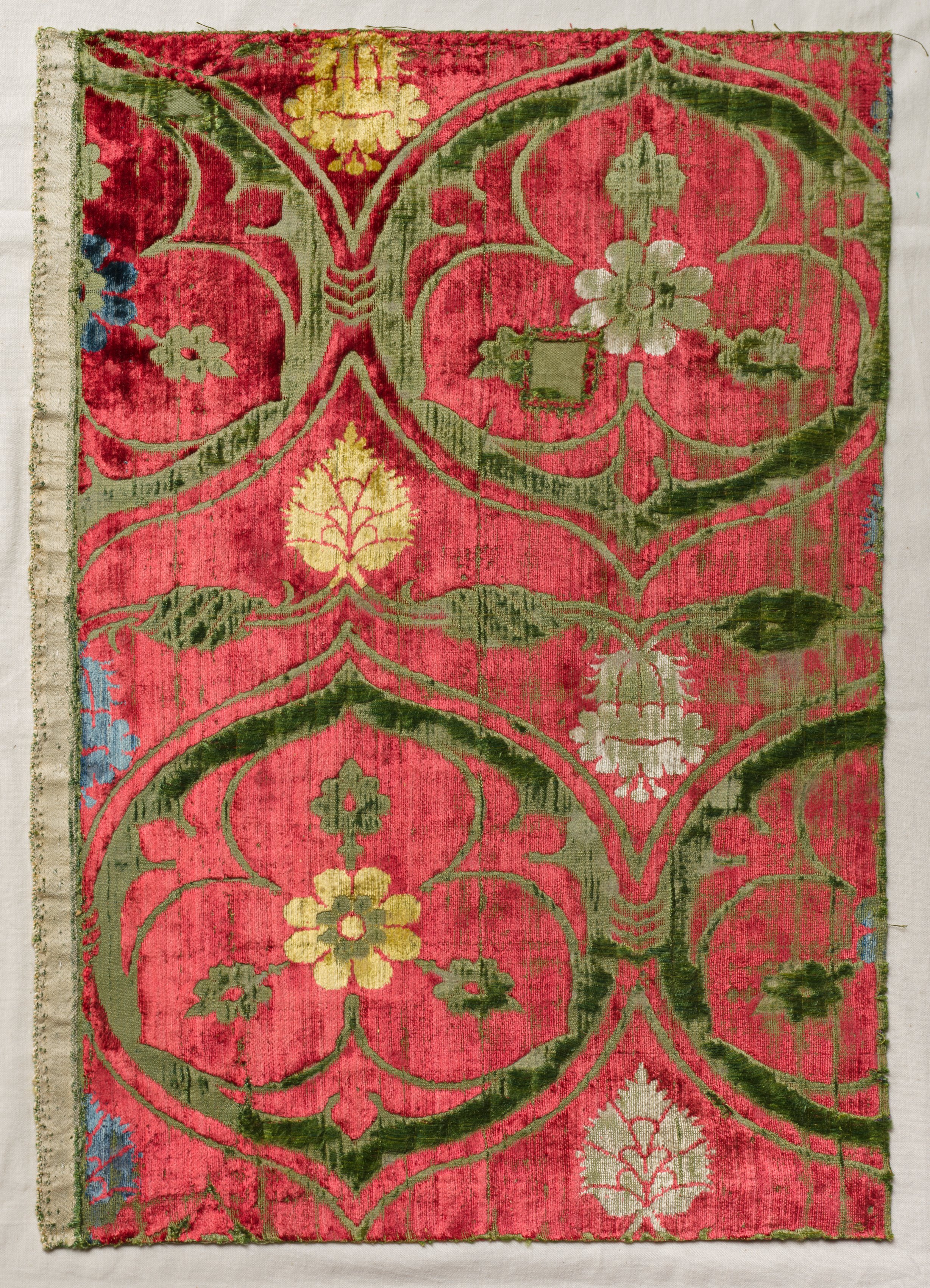
Deconstructing Polychrome Velvet: A Renaissance Artifact Reimagined for the Avant-Garde
As the Chief Fabric Deconstructionist for Zoey Fashion Lab, my role is to dissect historical textiles not merely as artifacts, but as living, breathing sources of design intelligence. Today, we turn our focus to a singular specimen: a fragment of Polychrome Velvet, originating from early 15th-century Italy. This is not a relic to be preserved under glass; it is a New DNA Strand—a genetic code of color, texture, and structure that we will sequence, mutate, and re-synthesize into an avant-garde expression for the modern silhouette.
Technical Foundation: The Weave of Power and Illusion
The technical specifications of this velvet are paramount to understanding its potential for deconstruction. It is a cut and voided velvet weave, executed in lustrous silk thread. The term “voided” is critical: it refers to areas where the pile is deliberately absent, leaving a flat, shimmering ground weave. This creates a dramatic, almost sculptural contrast between the raised, plush pile—the velvet itself—and the recessed, satin-like ground. In the early 15th century, this technique was a marvel of engineering, requiring immense skill on a drawloom. The result was a fabric that played with light, depth, and texture in ways that simulated the opulence of gold and jewels.
For Zoey Fashion Lab, we do not see this as a finished product. We see it as a layered system. The cut pile represents density and absorption; the voided areas represent transparency and release. The polychrome aspect—the use of multiple colors, often red, green, blue, and gold—was achieved through complex dyeing and weaving processes. These colors were not merely decorative; they were symbolic, often representing wealth, religious devotion, or civic power. Today, we strip them of their original context and re-code them as chromatic data—a spectrum to be fragmented, inverted, and recombined.
Deconstruction Protocol: Unraveling the Renaissance Strand
Our deconstruction begins with a systematic dismantling of the velvet’s core attributes. We treat the fabric as a New DNA Strand, meaning we extract its fundamental building blocks—pile height, color frequency, void density, and thread twist—and treat them as mutable genetic sequences.
1. The Pile as Architecture: The cut pile is the most obvious feature. In the original, it is uniform and dense. For the avant-garde, we will vary the pile height in a single garment. Imagine a jacket where the shoulders feature a 10mm pile, creating a padded, almost armor-like volume, while the torso tapers to a 2mm micro-pile, revealing the voided ground. This creates a topographical map of the body, a landscape of touch and sight.
2. The Void as Negative Space: The voided areas are not absences; they are deliberate voids. In our re-synthesis, we will expand and distort these voids. Instead of a traditional floral or geometric pattern, we will use laser-guided cutting to create organic, cellular voids that mimic biological membranes. These voids will be lined with iridescent organza or left as sheer windows, allowing the skin or an underlayer to become part of the fabric’s narrative. This transforms the velvet from a solid surface into a permeable, interactive membrane.
3. Polychrome as Digital Palette: The original polychrome palette was limited by natural dyes. We will digitize and hyper-saturate these colors. Using a custom-dyed silk thread, we will create a gradient that shifts from a deep, oxidized crimson (like aged blood) to a synthetic, neon chartreuse. This is not a historical reproduction; it is a chromatic mutation. The colors will be woven in a fractal pattern, not a repeating motif, so that the garment appears to shift and change as the wearer moves.
Avant-Garde Synthesis: The Zoey Fashion Lab Manifestation
The final garment is not a dress, a coat, or a top. It is a wearable sculpture that references the original velvet’s opulence while rejecting its rigidity. The silhouette will be asymmetrical, with one sleeve constructed entirely of the cut pile (a dense, monolithic form) and the other sleeve composed of a deconstructed voided lattice (a skeletal, transparent structure). The body of the garment will be a hybrid: a corseted bodice of cut velvet, but with the voided areas cut away and replaced with a network of silk cords, creating a tensioned, almost architectural frame.
We will also introduce a tactile dissonance. The original velvet is soft and plush. We will integrate thermochromic pigments into the pile, so that body heat causes the fabric to change color from deep burgundy to a pale, ghostly lavender. This is a direct evolution of the polychrome tradition—color as a living, responsive element rather than a fixed decoration.
The voided areas will be further reimagined. We will use a digital jacquard loom to weave a pattern that references the original 15th-century pomegranate motif, but distorted through a glitch algorithm. The result is a pattern that appears to be a corrupted file—a Renaissance design breaking down under the pressure of modern data. This is the New DNA Strand in action: the historical code is preserved, but its expression is transformed.
Conclusion: The Fabric as a Living System
Polychrome velvet from early 15th-century Italy is not a dead textile. It is a genetic archive of human ingenuity, color science, and social hierarchy. By deconstructing it through the lens of the avant-garde, Zoey Fashion Lab does not simply create a new garment. We create a new species of fabric—one that retains the DNA of its Renaissance ancestor but expresses it in a form that challenges, surprises, and engages the contemporary body. The cut pile becomes a topography of power; the voided areas become windows into other dimensions; the polychrome palette becomes a living, breathing spectrum. This is the future of fashion: not a rejection of history, but a radical, loving, and intellectually rigorous mutation of it.