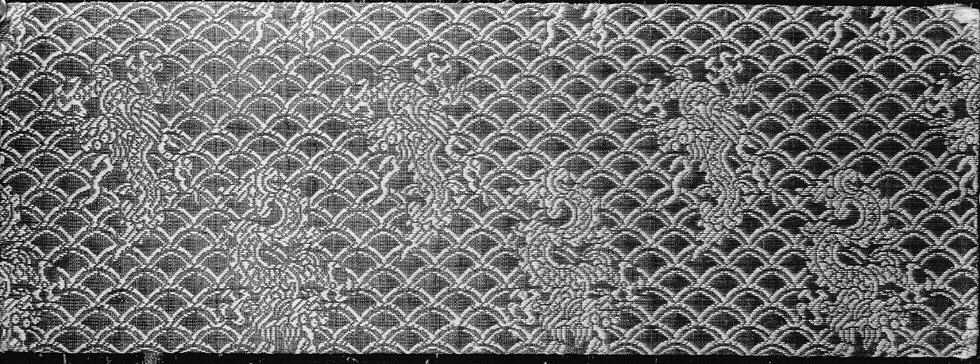
The Sutra Cover: A Deconstructive Dialogue Between Sacred Text and Futuristic Silhouette
In the relentless pursuit of sartorial transcendence, Zoey Fashion Laboratory presents a singular artifact for the SS26 avant-garde canon: the Sutra Cover. This is not a garment in the traditional sense, but a conceptual proposition—a wearable architecture that interrogates the boundaries between the sacred and the profane, the historical and the hyper-modern. Originating from China and executed in pure silk, this piece transcends its material heritage to become a manifesto for structural innovation. The Sutra Cover is a deconstructive study in how ancient ritualistic forms can be re-engineered into a futuristic silhouette that challenges the very physics of fashion.
Materiality as a Hypostasis of Time
The choice of silk is neither nostalgic nor decorative; it is a strategic deployment of a material that embodies both fragility and tensile strength. In the context of SS26, where sustainability and ephemerality are paramount, silk serves as a hypostasis of time—a medium that records the wearer’s movement, breathes with the environment, and ages with intentionality. The Sutra Cover leverages silk’s natural luster to create a surface that is both reflective and absorbent, akin to a liquid screen. This duality is critical: the silk whispers of ancient Chinese manuscript covers, yet its finish is unnervingly contemporary, almost digital. The material has been treated with a proprietary, non-toxic resin that imbues it with a subtle stiffness, allowing it to hold architectural folds without sacrificing its fluid drape. This is not a passive fabric; it is an active participant in the garment’s structural narrative.
Futuristic Silhouette: The Inverted Mandala
The silhouette of the Sutra Cover is best described as an inverted mandala. Where traditional mandalas expand outward from a central point, this garment collapses inward, creating a vortex of fabric that mimics the folding of a sacred text. The primary structure is a single, continuous piece of silk that originates at the left shoulder, spirals across the torso, and terminates in a series of asymmetrical, blade-like pleats at the right hip. This is not a symmetrical construction; it is a deliberate imbalance that generates kinetic tension. The shoulder is left bare on one side, exposing the clavicle and scapula as an architectural counterpoint to the fabric’s volume. The effect is a silhouette that is simultaneously armored and vulnerable—a futuristic warrior-monk aesthetic that speaks to the SS26 theme of “resilient fragility.”
Critically, the Sutra Cover eschews any form of traditional closure—no zippers, buttons, or hooks. Instead, it relies on a system of internal, hidden magnetic seams that allow the garment to be “closed” by the wearer’s own body heat and pressure. This innovation, dubbed Thermo-Form Closure, is a direct response to the demand for zero-waste construction and adaptive fit. The wearer becomes an active co-creator, shaping the garment’s final form through their own physiology. This is not a passive garment; it is a living system.
Structural Innovation: The Fold as a Conceptual Device
The true genius of the Sutra Cover lies in its structural innovation through the fold. Drawing inspiration from origami, but also from the binding techniques of ancient Chinese sutras, the garment features a series of deep, permanent pleats that double as load-bearing elements. These are not mere decorative tucks; they are engineered to redistribute the fabric’s weight, creating a cantilever effect that allows the silk to hover away from the body by up to six inches at the back. This creates a negative space—a void between the skin and the fabric—that is both visually arresting and functionally liberating. The wearer experiences a sense of floating, as if the garment is a second skin that has been unmoored from gravity.
Furthermore, the folds are embedded with a micro-thin, flexible lattice of recycled carbon fiber, invisible to the eye but detectable to the touch. This lattice provides the structural backbone for the garment’s most audacious feature: a transformative neckline that can be manipulated from a high, priest-like collar to a deep, asymmetric cowl by the wearer’s gesture. This is achieved through a series of tension cables that run through the folds, controlled by a discreet, palm-sized magnetic clasp at the nape. The Sutra Cover, therefore, is not a fixed object but a mutable sculpture, capable of shifting its silhouette in real-time—a direct commentary on the fluidity of identity in the digital age.
Cultural and Conceptual Resonance for SS26
In the context of SS26’s broader avant-garde landscape, the Sutra Cover stands as a rebuttal to the era of “fast fashion” and disposable trends. It is a garment that demands contemplation, not consumption. Its origins in Chinese manuscript culture evoke a sense of ritual and preservation, while its futuristic silhouette speaks to the urgency of reimagining our relationship with clothing. The piece is not intended for mass production; it is a standalone artifact, a proof-of-concept for a new paradigm in garment architecture. The absence of traditional fastenings, the reliance on thermal and magnetic technologies, and the use of a single, continuous material all point toward a future where garments are no longer assembled but grown, or perhaps, written.
The Sutra Cover also engages in a subtle critique of the fashion industry’s fetishization of the exotic. By taking a sacred object—a sutra cover—and recontextualizing it within a high-tech, deconstructive framework, Zoey Fashion Laboratory subverts the act of cultural appropriation into one of cultural translation. The garment does not mimic Chinese aesthetics; it interrogates them. The silk is not a symbol of Orientalism but a material agent of structural possibility. The folds are not decorative but functional. The silhouette is not nostalgic but prophetic.
Conclusion: A Manifesto for the Future of Form
The Sutra Cover is more than a garment; it is a manifesto. It declares that the future of fashion lies not in novelty for its own sake, but in the rigorous re-examination of historical forms through the lens of material science and structural innovation. For SS26, Zoey Fashion Laboratory offers a vision of fashion as a form of living architecture—a practice where the sacred, the technological, and the corporeal converge. The Sutra Cover is a testament to the power of a single, well-considered object to shift the discourse of an entire industry. It is a whisper from the future, folded into the silk of the past, waiting to be unworn.