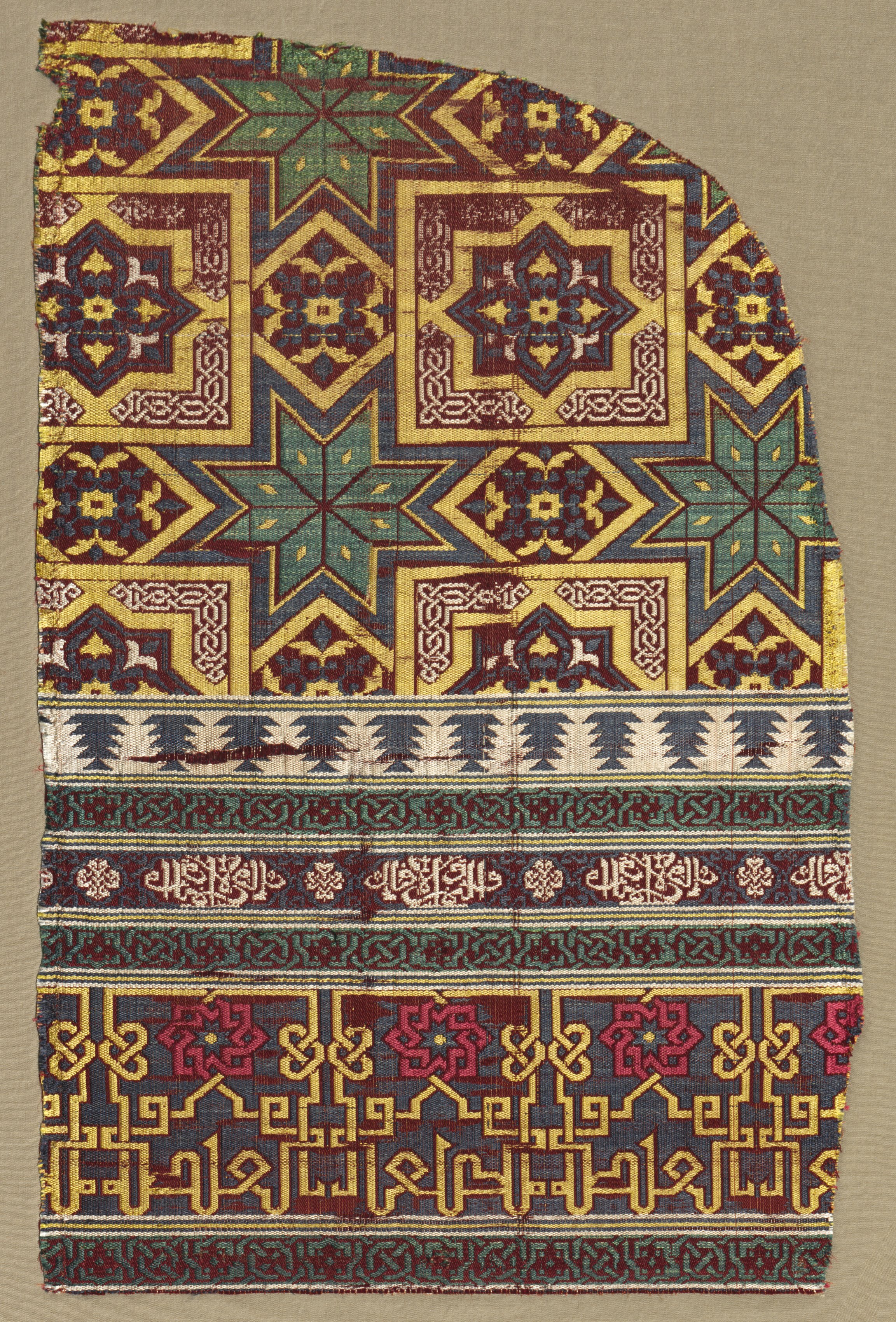
Deconstructing the Alhambra: A Technical and Stylistic Analysis of the Hanging Fragment
As the Chief Fabric Deconstructionist for Zoey Fashion Lab, my role is to dissect historical textiles not merely as artifacts, but as living blueprints for avant-garde expression. The subject of this analysis—a hanging fragment from Alhambra, Spain, originating in Granada—presents a profound case study. This piece, executed in silk using a sophisticated combination of lampas and taqueté weaves, is far more than a relic of Nasrid artistry. It is a New DNA Strand for our design philosophy, offering a structural and aesthetic vocabulary that resonates powerfully with contemporary avant-garde sensibilities. This analysis will deconstruct its technical composition, decode its decorative bands, and articulate its direct lineage to the disruptive, textural, and conceptually rich garments we create at Zoey Fashion Lab.
Technical Deconstruction: The Silk Architecture
The foundational DNA of this fragment lies in its dual-weave structure. The use of lampas and taqueté is not merely a historical footnote; it is a masterclass in engineered surface tension and depth. Lampas, a compound weave, allows for a pattern to be created on a ground weave using a supplementary warp and weft. In this fragment, the lampas technique likely renders the intricate, geometric arabesques and epigraphic bands in a matte or slightly raised profile against the ground. The taqueté weave, a weft-faced structure where the weft threads are bound by a fine warp, creates a dense, almost rigid surface. This is the fabric’s backbone, providing structural integrity and a subtle, woven ribbing.
For Zoey Fashion Lab, this technical duality is pure inspiration. The lampas element translates directly into our signature technique of surface quilting and layered appliqué. We can replicate the effect of a supplementary pattern floating above a base fabric by using a high-density base (like a technical neoprene or bonded silk organza) and then applying a secondary, contrasting silk or sheer mesh in a pattern derived from the Alhambra’s geometry. The taqueté weave informs our approach to structural wefting. By manipulating the density and tension of weft threads in a jacquard loom, we can create zones of rigidity and flexibility within a single garment. Imagine a coat where the shoulders are woven in a dense, taqueté-inspired structure, providing architectural form, while the sleeves transition to a looser, lampas-like pattern for fluidity. This is not just fabric; it is wearable architecture.
Decoding the Decorated Bands: A Visual Lexicon of Power and Geometry
The fragment’s decorated bands are the true narrative. These are not random embellishments; they are a codified language of Nasrid power, faith, and mathematical perfection. The bands typically feature three core elements: epigraphic inscriptions (often the Nasrid motto “There is no victor but God”), geometric star patterns (derived from complex Islamic geometry), and floral arabesques (ataurique). In the context of avant-garde fashion, we must re-read these as abstract, deconstructed motifs.
The epigraphic bands are the most direct link to our concept of text-as-texture. In the original, the Kufic script is both legible and decorative. For Zoey Fashion Lab, we will abstract this into a woven binary code. Using a digital jacquard loom, we can translate the calligraphic strokes into a series of raised and lowered threads, creating a tactile, unreadable script that mimics the visual rhythm of the original. This becomes a secret language on the garment—a hidden message only the wearer and the initiated can perceive. The geometric star bands are our primary source for pattern cutting and seam construction. The 8-pointed star, a hallmark of Alhambra design, is not just a print; it is a structural principle. We will use it to design laser-cut seams and modular garment panels. A sleeve or bodice can be constructed from multiple star-shaped panels that interlock, creating a garment that is both fragmented and unified, reflecting the fragment’s own incomplete state.
The floral arabesques are the most fluid element. In the original, they soften the rigid geometry. In our avant-garde translation, they become asymmetrical, hand-embroidered or heat-set appliqués that appear to grow organically from the woven structure. We will use monofilament thread and metallic foils to create a three-dimensional, almost holographic effect, mimicking the way light played across the original silk in the Alhambra’s courtyards. The bands are not just decoration; they are structural markers that guide the eye and define the garment’s silhouette.
Avant-Garde Synthesis: From Fragment to Future
How does this 14th-century fragment become a New DNA Strand for Zoey Fashion Lab? The answer lies in the principle of deconstruction and reconstruction. We do not copy the Alhambra; we extract its core algorithms—its weave structures, its geometric logic, its use of light and shadow—and re-encode them for a contemporary, disruptive audience.
Consider a deconstructed trench coat inspired by this fragment. The base fabric is a high-tech, matte-finish nylon bonded to a silk organza, replicating the taqueté’s density. The lampas pattern is recreated using a laser-engraved, heat-reactive film that shifts color with body heat, echoing the way the original silk caught the Andalusian sun. The decorated bands are not printed; they are woven directly into the fabric using a digital jacquard, creating a gradient from dense geometric stars at the shoulders to looser, calligraphic strokes at the hem. The garment’s asymmetry—one sleeve longer, the other cut away—mirrors the fragment’s incomplete state, celebrating the beauty of the broken. The lining is a reverse print of the original fragment’s geometric pattern, visible only when the coat is worn open, a secret for the wearer.
Another application: a modular evening gown. The bodice is constructed from interlocking, laser-cut panels shaped like the Alhambra’s 12-pointed stars, connected by invisible magnetic snaps. The skirt is a cascade of silk organza strips, each printed with a different band from the fragment—epigraphic, geometric, floral—in a digitally distorted, abstracted form. The effect is a garment that is both rigid and fluid, historical and futuristic. The wearer becomes a walking archive, a deconstructed artifact.
Conclusion: The Fragment as Catalyst
The Alhambra hanging fragment is not a museum piece to be preserved; it is a catalyst for innovation. Its technical complexity—the interplay of lampas and taqueté—teaches us about structural depth. Its decorated bands provide a visual lexicon of geometry, text, and nature that can be abstracted into pure form. For Zoey Fashion Lab, this fragment is a New DNA Strand precisely because it is incomplete. Its fragmentation invites us to complete it, to reimagine it through the lens of avant-garde design. We are not replicating history; we are mutating it, creating garments that are as intellectually rigorous as they are visually arresting. The Alhambra’s silk speaks across centuries, and at Zoey Fashion Lab, we are listening, deconstructing, and weaving its ghost into the future of fashion.