The Reticule Reimagined: Deconstructing Archival Form for SS26 Avant-Garde Silhouettes
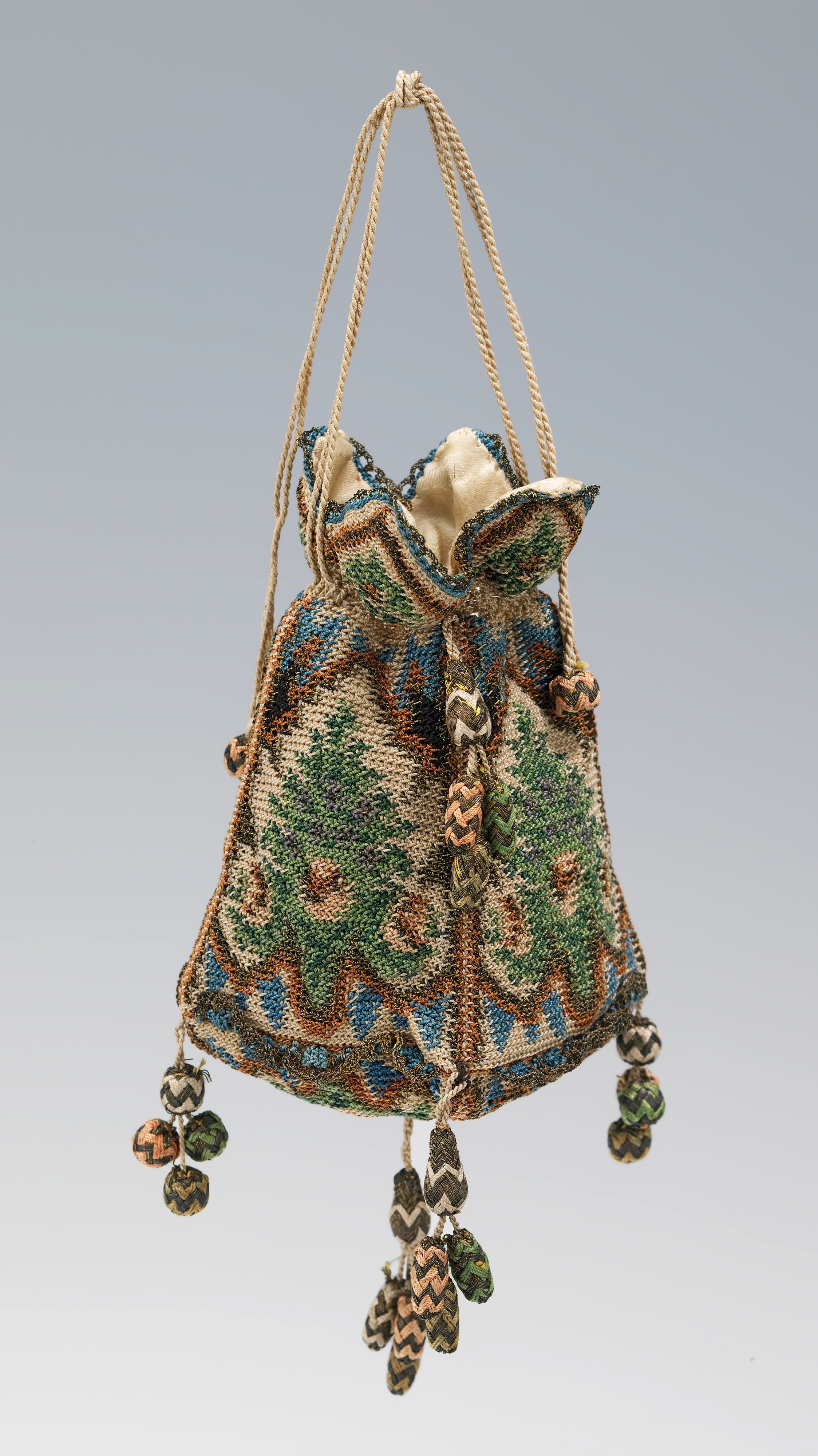
In the relentless pursuit of sartorial evolution, the Zoey Fashion Laboratory posits that the most radical futures are often encrypted within the most forgotten pasts. The subject of this definitive analysis—the Reticule, a small drawstring handbag of probable German origin from the late 18th or early 19th century—presents a paradox. Crafted from silk and metal, this object was a vessel for personal intimacy, a micro-architecture of containment. For SS26, we deconstruct this relic not as nostalgia, but as a structural catalyst. By extracting its core principles—tension, containment, and suspended volume—we can engineer a new language of futuristic silhouettes that challenge the very notion of garment as boundary.
Structural Deconstruction: From Vessel to Silhouette
The reticule’s defining architectural feature is its reliance on a drawstring mechanism to collapse volume. This is not a passive closure; it is an active, kinetic system that transforms a flat plane of silk into a three-dimensional, organic form. For SS26, we extrapolate this principle to the human torso. Imagine a garment constructed from panels of liquid, high-tenacity silk satin, interwoven with a lattice of micro-fine, shape-memory metal alloys. The drawstring is no longer a cord, but a system of tension cables running along the spine, the clavicles, and the iliac crest. When the wearer activates these cables—through a discrete, haptic interface embedded in the metal hardware—the garment constricts or expands, morphing from a cocoon-like, amorphous volume into a sharply defined, almost skeletal silhouette.
This is not mere tailoring; it is wearable architecture. The metal, traditionally used for the reticule’s frame or drawstring rings, is re-engineered as a flexible exoskeleton. We propose a series of articulated, laser-sintered metal joints that mimic the behavior of a drawstring’s gathering effect. These joints sit at the waist, the shoulders, and the hips, creating points of compression that force the silk to billow and collapse in controlled, dramatic folds. The result is a silhouette that is simultaneously primitive and hyper-futuristic—a fusion of the organic drape of the original reticule and the precision of a cybernetic chassis.
Material Alchemy: Silk and Metal as a Single System
The material dichotomy of the original reticule—soft silk versus rigid metal—is not a conflict but a dialectic. For SS26, we dissolve this binary. The silk is treated with a thermochromic and photochromic coating, allowing it to shift from a matte, almost lunar white to a deep, iridescent black when exposed to UV light or body heat. This dynamic surface mirrors the reticule’s historical role as a private, intimate object that only reveals its contents when opened. The metal, meanwhile, is not merely structural. We incorporate thin-film photovoltaic cells into the metal alloy, allowing the hardware to harvest ambient light energy. This energy powers micro-LED filaments woven into the silk, creating a garment that glows from within—a literal illumination of the hidden volume.
The drawstring itself is reimagined as a woven, conductive fiber that serves as both a structural element and a data conduit. As the wearer adjusts the tension, the fiber transmits data about the garment’s volume and the wearer’s movement to a central processing unit embedded in a metallic belt buckle. This creates a feedback loop: the garment learns the wearer’s preferred silhouette for different environments. A crowded, high-energy runway demands a compact, armored silhouette; a private, contemplative moment allows the garment to expand into a voluminous, almost cloud-like form.
Futuristic Silhouettes: The Reticule as Bodily Prosthesis
The most radical innovation for SS26 is the conceptual shift from the reticule as a separate object to the reticule as an extension of the body. We propose integrated, detachable volume modules that attach to the garment via magnetic, metal-based docking points. These modules, shaped like compressed, gathered silk pouches, can be positioned at the hips, the back, or the chest. When deployed, they expand to create exaggerated, biomorphic protrusions, echoing the reticule’s historical function of carrying hidden essentials. In this context, the “essential” is not a handkerchief or a coin, but compressed air, scent, or even sound-dampening materials.
Consider a silhouette where the left hip is a smooth, taut silk sheath, while the right hip features a cascading, multi-layered reticule module that inflates with a gentle hiss of air, creating a dramatic, asymmetrical volume. The metal hardware—snaps, grommets, and rings—becomes a visual and tactile landscape, a topography of function. The drawstring cords, now made from a memory-metal mesh, can be pulled to alter the module’s shape, creating sharp, angular folds or soft, rounded billows. This is not a dress; it is a living, responsive system that challenges the static nature of traditional couture.
Conclusion: The Reticule as a Blueprint for Inhabited Space
The reticule, in its original context, was a symbol of feminine privacy and discreet luxury. In the Zoey Fashion Laboratory’s SS26 analysis, it becomes a blueprint for a new kind of garment—one that is volumetric, kinetic, and intelligent. By deconstructing its core principles of drawstring tension, material duality, and contained volume, we have engineered a series of silhouettes that are not merely worn, but inhabited. The silk and metal are no longer separate; they are a single, responsive organism. The future of avant-garde couture is not about covering the body, but about negotiating space with it. The reticule, once a small, secret pouch, now expands to encompass the entire form, a testament to the power of archival deconstruction to unlock the most radical of futures. For SS26, we do not look back; we look through the past to see the horizon.