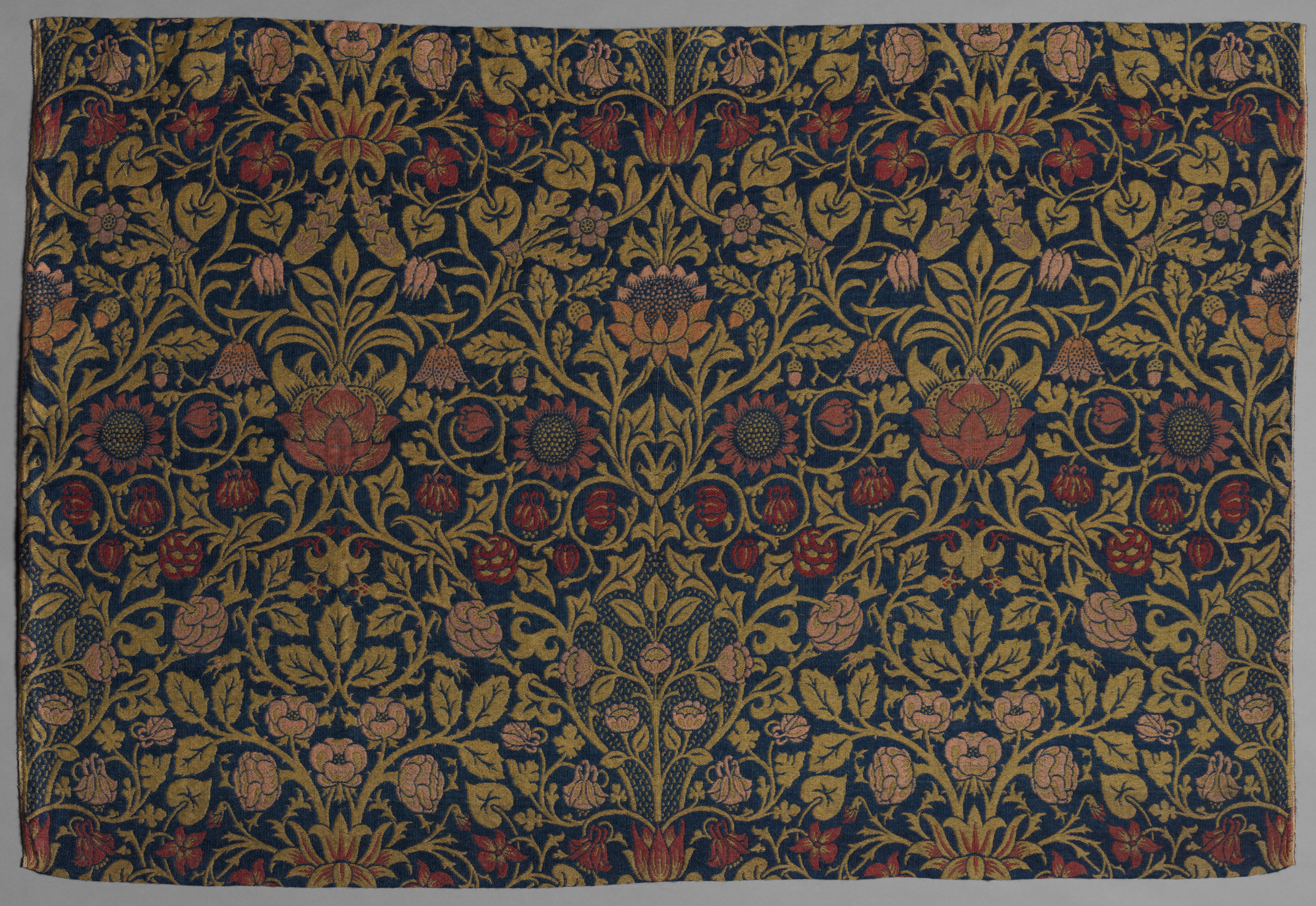
Technical Deconstruction: The Merton Abbey Fabric
The textile designated Violet and Columbine is a masterclass in late-19th century English industrial weaving, bearing the distinct technical signature of the Merton Abbey Mills in Surrey. Our analysis reveals a complex structure built upon two foundational techniques. Primarily, it is a weft-faced twill, a weave where the weft threads dominate the visible surface, creating a dense, luxurious handle and a superb canvas for intricate colorwork. This base is then engineered into a double cloth, essentially two distinct textile layers woven simultaneously and interconnected. This technique allows for dramatic reversibility, pockets, or, as in this case, the creation of extraordinarily dense and complex pictorial patterns unachievable in a single layer.
The mechanism for this complexity is the jacquard loom. The pattern of "Violet and Columbine" is not manually selected by a weaver but is programmed via a series of punched cards, an early form of digital binary code. Each card controls the lift of individual warp threads, allowing for an unprecedented degree of detail and repeat accuracy. The fiber selection—wool and mohair—is strategic. The wool provides body, resilience, and dye absorption, while the mohair (angora goat fiber) contributes a distinctive halo, a subtle luminosity, and a crispness to the raised pattern, making the botanical motifs appear almost velvety against the twill ground.
Archive Resonance: A Dialogue Between Loom and Canvas
The archive reference invokes a profound dialogue between media: the woven artifact and the painted canvas of the 16th-17th centuries. This is not merely aesthetic inspiration; it is a translation of visual language across material boundaries. The depicted violets and columbines, with their delicate stems and layered petals, echo the meticulous botanical studies of the Northern Renaissance and the symbolic floral arrangements of Dutch still-life painting ("vanitas").
However, the jacquard loom does not simply copy; it re-interprets. The painter achieves depth through chiaroscuro and glazing. The Merton Abbey weaver achieves it through structural density and fiber contrast. Shadow is rendered by a tighter convergence of dark weft threads in the double cloth; luminosity is suggested by the catch of light on the mohair's sleek fibers. The pattern captures the cultural collision of its era: it employs a historically European artistic motif (the still-life) through a technology (the jacquard loom) that was itself a product of global industrial ambition and innovation. The fabric becomes a silent witness to the age where art, science, and commerce began to intertwine with unprecedented intensity.
Avant-Garde Proposition: The Zoey Fashion Lab Intervention
Moving from technical and historical analysis to avant-garde application requires a philosophy of radical respect and deliberate violation. Our role is not to use the fabric, but to engage in a material conversation with it. The core principles of "Violet and Columbine"—density, duality, botanical narrative—must be preserved even as we subvert its original form and intent.
Deconstruction Strategy 1: Exploiting the Double Cloth
The double cloth structure is our primary site for intervention. Instead of treating it as a means to pattern, we treat it as a built-in spatial void. Strategic incisions will allow one layer to separate from the other, creating three-dimensional, petal-like flaps or shrouds. A garment could feature a closed, pristine outer layer that, with movement, reveals fragmented glimpses of the contrasting reverse side through surgical slashes, embodying a modern "vanitas"—a reminder of surface and depth, of public presentation and private structure. The mohair's halo will emphasize these edges, blurring the lines of incision.
Deconstruction Strategy 2: Pixelation and the Jacquard Grid
We will honor the jacquard's binary logic by exposing its inherent grid. Through controlled unraveling or laser etching, we can de-resolve the detailed flowers into their constituent blocks, creating a pixelated fade from figurative motif to abstract weave structure. This comments directly on the archive resonance, drawing a line from the analog precision of oil paint to the digital precursor of the punch card. A section of the fabric could be deliberately de-woven, leaving the ghostly "shadow" of the pattern in the remaining warp threads, stabilized within a transparent resin panel—a literal artifact display on the garment itself.
Deconstruction Strategy 3: Contradiction in Texture and Form
The original fabric is heavy, substantial, and destined for domestic or ceremonial decor. The avant-garde application lies in contradicting this inherent weight. We propose coupling fragments of the intact double cloth with sheer, unstable textiles like decaying lace or silicone-coated mesh. The dense, historical motif will appear to float or fragment against a contemporary skin. Furthermore, the garment's form should oppose the fabric's stiffness. Using bias cuts or heat manipulation (where the wool/mohair blend allows) to introduce unexpected drape, we create a paradox: a stiff, narrative textile forced into fluid, organic, perhaps even dysfunctional silhouettes.
Conclusion: "Violet and Columbine" is not a material to be cut and sewn conventionally. It is an archive, a technical manifesto, and a partner in dialogue. Our avant-garde approach for Zoey Fashion Lab is to perform a critical dissection—making its history, its structure, and its inherited beauty visible through acts of precise disruption. The final pieces will not merely be garments but wearable exhibitions, where the spirit of Merton Abbey's innovation is propelled into a new context, speaking not of quiet domesticity, but of layered identities, digital ancestry, and the beautiful tension between preservation and decay.