Deconstructing the Nomadic Code: An Avant-Garde Analysis of the Isfahan Silk Textile
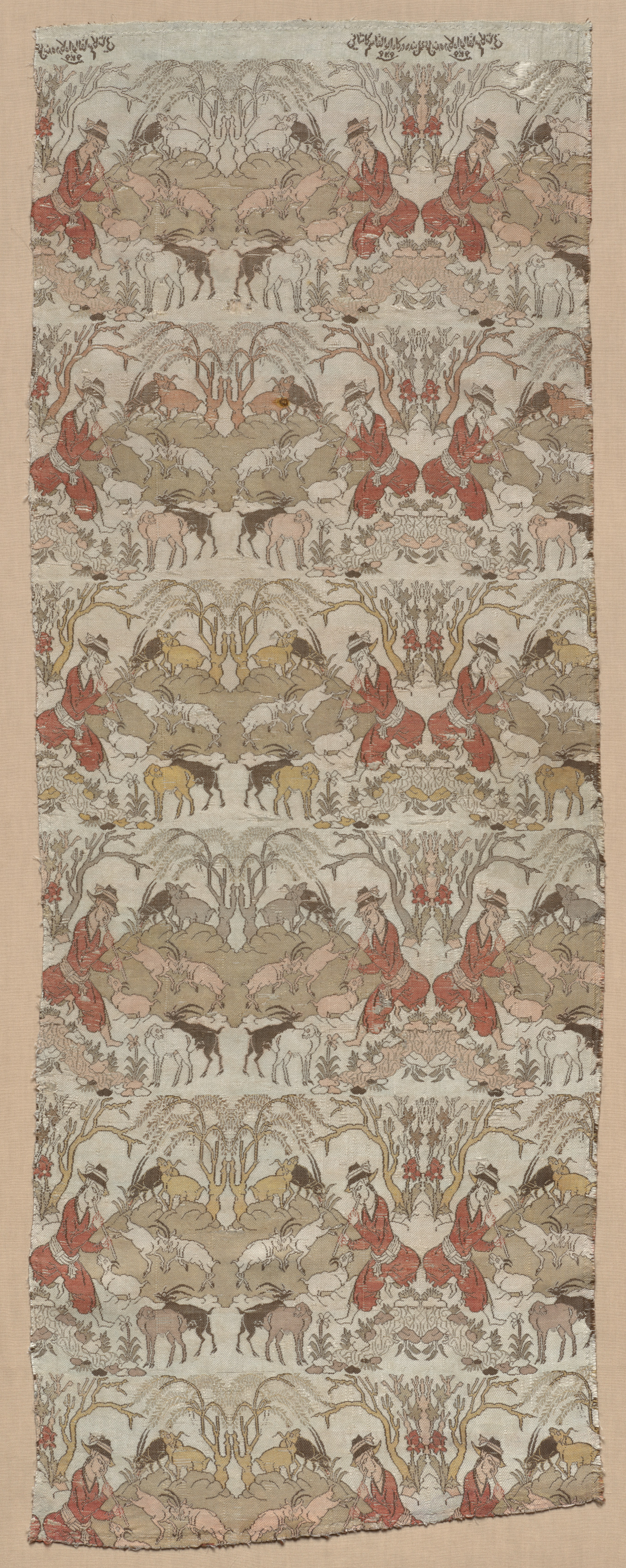
At Zoey Fashion Lab, we operate at the intersection of heritage and hyper-modernity. Our mission is to deconstruct historical textiles not merely as artifacts, but as living DNA strands—genetic codes of visual language, social memory, and material science. The subject of this analysis, a Silk Textile with Goatherds in a Landscape from Isfahan, Iran, executed in a lampas weave, presents a profound paradox. It is a fixed, luxurious object from the Safavid era, yet its narrative structure—its new DNA strand—is inherently nomadic, fluid, and ripe for avant-garde reinterpretation.
This analysis will dissect the textile’s technical architecture, its iconographic syntax, and its latent potential for radical deconstruction. We propose that this piece is not a finished story, but a chromosomal sequence waiting to be spliced, mutated, and re-expressed through the lens of contemporary fashion.
Technical Anatomy: The Lampas Weave as a Structural Blueprint
The lampas weave is a complex, compound structure that demands a high level of precision. Unlike simpler weaves, lampas creates a pattern by using a main warp and weft for the ground, while a secondary, often silk, weft floats across the surface to create the design. This is not a simple embroidery; it is an integrated, multi-layered system. For Zoey Fashion Lab, this technical intricacy is the first element of the new DNA strand.
Consider the implications for avant-garde design: the lampas weave inherently creates a dual-plane surface. The ground fabric (the landscape) and the floating weft (the goatherds) exist in different structural dimensions. This is a physical metaphor for diaspora and displacement. The goatherds, depicted in their pastoral setting, are structurally “floating” above their environment. They are not rooted; they are in transit. An avant-garde garment could literalize this by using deconstructed lampas panels—cutting the floating weft threads to create fringe, or separating the ground from the pattern layer to form a double-skinned silhouette. The weave itself becomes a pattern for movement, not stasis.
Furthermore, the use of silk—a protein fiber—is critical. Silk’s natural luster and tensile strength allow for extreme manipulation. It can be pleated, crushed, laser-cut, or chemically distressed. In the context of this Isfahan piece, the silk’s smooth, reflective quality contrasts with the rugged, earthy life of the goatherds. This tension—between luxury and labor, between the city of Isfahan (a center of refinement) and the nomadic landscape—is the core conflict that drives our deconstruction. The new DNA strand must encode this conflict, not resolve it.
Iconographic Syntax: The Goatherds as a Mobile Motif
The central imagery—goatherds in a landscape—is deceptively simple. In Persian textile art, pastoral scenes often symbolize abundance, harmony with nature, and the idealized life of the court. However, for the avant-garde, we read this as a code of perpetual motion. Goatherds are not stationary farmers; they are transient, following seasonal cycles. The landscape is not a fixed backdrop but a passing terrain.
This motif becomes a powerful symbol for the modern condition: the constant negotiation between belonging and displacement, between tradition and the future. The goatherds are the original nomads, carrying their culture in their movements. For Zoey Fashion Lab, this translates into a design philosophy where the garment is a vessel for narrative. We propose a collection where the goatherd figure is not a static print but a repeating, morphing pattern that appears to shift as the wearer moves. This can be achieved through digital jacquard weaving or kinetic textile techniques—where the image changes based on temperature, humidity, or the wearer’s gesture.
The landscape itself—often depicted with stylized trees, streams, and rocks—is a cartographic abstraction. It is not a realistic map but a symbolic one. This is where the new DNA strand becomes truly radical: we can treat the landscape as a genetic map. The trees become nodes, the streams become pathways, the rocks become data points. By extracting these visual elements and re-coding them into parametric patterns, we can create garments that are literally “woven from the landscape.” The goatherds are no longer figures; they are vectors of movement across a textile terrain.
The Avant-Garde Intervention: Splicing the DNA Strand
To translate this analysis into a tangible avant-garde collection, Zoey Fashion Lab proposes a series of deconstructive interventions:
1. Structural Dissection: The lampas weave is cut along the lines of the goatherds’ paths. The result is a garment that is fragmented and reassembled—a jacket where the sleeves are formed from the landscape ground, and the body is built from the floating weft of the figures. This creates a visual and tactile dialogue between the static and the mobile.
2. Material Mutation: The silk is treated with bio-engineered enzymes to create areas of transparency and opacity, mimicking the fading of a historical textile. The goatherds appear as ghosts—remnants of a memory. This is the new DNA strand expressing itself through decay and regeneration.
3. Digital Recoding: The entire pattern is scanned and converted into a 3D digital model. The goatherds are animated to walk across the garment via embedded LED fibers or thermochromic inks. The landscape becomes a live, breathing environment that responds to the wearer’s heartbeat or ambient sound. This is not a reproduction; it is a reincarnation of the original code.
4. Narrative Draping: The textile is used as a single, continuous piece that wraps around the body, with the goatherds positioned at the points of tension—the shoulders, the hips, the spine. The garment becomes a narrative of transit, where the wearer is both the landscape and the traveler. The goatherds are no longer observed; they are embodied.
Conclusion: The Textile as a Genetic Archive
The Silk Textile with Goatherds in a Landscape from Isfahan is far more than a decorative artifact. It is a genetic archive of a culture in motion—a culture that wove its identity into the very structure of its textiles. For Zoey Fashion Lab, this piece provides the new DNA strand for an avant-garde collection that challenges the boundaries of fashion, history, and technology.
By deconstructing the lampas weave, re-coding the pastoral iconography, and splicing these elements with modern materials and digital processes, we create garments that are living documents. They do not merely reference the past; they mutate it, allowing the goatherds to continue their eternal journey across new landscapes—the human body. This is the future of fashion: not as a static object, but as a continuous, evolving sequence of cultural DNA.