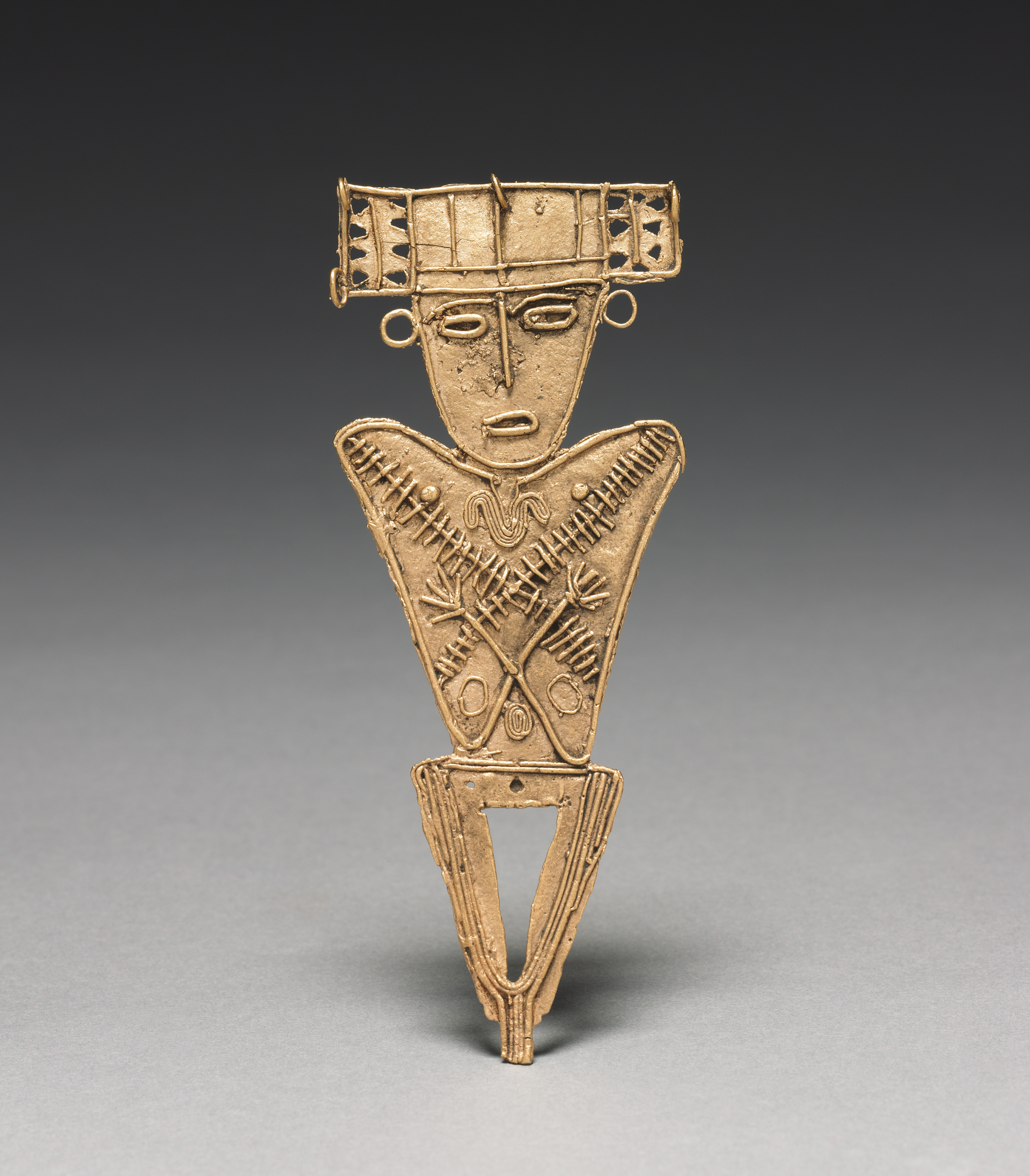
Deconstructing the Tunjos: A Muisca Gold Artifact as Avant-Garde Textile Narrative
At Zoey Fashion Lab, the role of the Chief Fabric Deconstructionist is to interrogate the material, cultural, and symbolic DNA of artifacts, extracting their latent narratives for translation into contemporary textile and garment language. The subject under analysis—a Muisca-style Tunjo (votive offering figurine) from Colombia, cast in gold—presents a profound challenge and opportunity. This small, often flattened anthropomorphic or zoomorphic figure, typically used in ritual offerings to the gods of water, earth, and sky, is not merely a static object of pre-Columbian goldwork. It is a concentrated archive of metaphysical textile: a record of tension between surface and depth, ornament and narrative, the reflective and the funereal. Drawing from the archive resonance of the Mirror with Split-Leaf—a dual-faced object where one side gleams with gold-inlaid palm fronds and the other narrates life through stone relief—we can deconstruct the Tunjo as a wearable, avant-garde text.
Material Memory: Cast Gold as a Fabric of Energy
The technical process of lost-wax casting, used to create these figurines, is itself a textile act. The wax model, built by hand with threads and strips of material, is a temporary, malleable “fabric” that is later sacrificed to fire, leaving behind a permanent gold shell. This process mirrors the avant-garde fashion designer’s relationship with the ephemeral: the prototype, the muslin toile, the sample that is destroyed to birth the final piece. The gold is not a precious metal in the Western sense of wealth display; rather, it is a solar fabric, a material believed to capture the energy of the sun and the transformative power of the earth. In deconstruction, we strip gold of its opulent connotation and re-read it as a conductive thread—a fiber that carries spiritual voltage between the human, the natural, and the divine. The Tunjo’s flattened form, often with exaggerated limbs and abstracted features, becomes a pattern piece for a garment that is not worn but worn out—a ritual shedding of the self.
Surface and Depth: The Split-Leaf Dialectic
Referencing the Mirror with Split-Leaf, the Tunjo operates on a similar dual-axis. On one side, the gold surface is polished to a reflective sheen, akin to the silver mirror inlaid with palm fronds. This is the ornamental epidermis—the visible, public-facing layer of the artifact. The palm fronds, symbols of victory, fertility, and tropical abundance, are not mere decoration; they are structural motifs that map the body’s energy lines, much like a textile’s warp and weft. In an avant-garde context, this surface is the fabric of spectacle: a metallic, shimmering skin that catches light and distorts the viewer’s gaze. Yet, this brilliance is a veil. The other side of the Tunjo—the hidden, concave underside, or the narrative implied by its ritual context—is the stone relief. It is the cold, unadorned narrative of life, death, and transformation. The Tunjo was often deposited in sacred lakes or high-altitude lagoons, submerged in water, where its gold would be lost to the human world but preserved in the aquatic womb of the earth. This submersion is the ultimate deconstruction: the dissolution of the surface into the depth of the archive.
Anthropomorphic Abstraction: The Body as a Garment Pattern
The Muisca Tunjo typically presents a human figure with a disproportionately large head, wide hips, and small limbs. This is not a realistic portrait but a symbolic diagram of the body as a vessel for spiritual exchange. In deconstructing this form for Zoey Fashion Lab, we read the figurine as a draped garment—a poncho, a tunic, a ritual cape. The exaggerated head becomes a hood or headdress, the wide hips suggest a flared skirt or peplum, and the small limbs are the sleeves and hems that barely contain the energy within. The gold is not stiff but fluid; the casting process allows for thin, almost textile-like sheets of metal that can be folded, pleated, and twisted. This is the avant-garde paradox: a rigid material behaving like a soft fabric. The Tunjo’s flat, two-dimensional quality—often with a single plane of gold—becomes a pattern piece for a garment that exists between sculpture and cloth. It is a wearable relic, a piece of armor for the spirit, not the body.
Narrative of Sacrifice: The Garment as Offering
The ritual function of the Tunjo is central to its deconstruction. It was an offering, a materialized prayer cast into the water to petition for rain, fertility, or healing. In fashion terms, this is the garment as sacrifice—a piece of clothing that is not meant for daily wear but for a single, transformative event. The avant-garde designer often works with this concept: the one-of-a-kind piece, the haute couture creation that is too fragile to be worn twice, or the performance garment that is destroyed during its presentation. The Tunjo’s gold, once offered, was never retrieved; it was lost to the archive of the lake. This echoes the Mirror with Split-Leaf’s stone relief side, which tells a life narrative that is fixed, cold, and unchangeable. The Tunjo’s narrative is not in its form but in its absence—the moment of its submersion. For Zoey Fashion Lab, this translates into a garment that disappears or transforms upon activation: a dress that dissolves in water, a coat that unweaves itself, a textile that sheds its gold lamé to reveal a narrative of bare, raw fiber underneath.
Textile Translation: From Gold to Fiber
In the deconstructionist’s studio, the gold of the Tunjo is not melted down but translated into textile equivalents. The reflective surface becomes metallic organza, liquid lamé, or hand-embroidered Lurex that mimics the lost-wax texture. The palm frond motif of the Mirror is reimagined as jacquard weaves or laser-cut leather appliqués that repeat the split-leaf pattern across a garment’s surface. The cold stone relief of the reverse side becomes heavy wool crepe, felted cashmere, or raw silk noil—fabrics that carry weight, texture, and a sense of ancient time. The Tunjo’s anthropomorphic form is deconstructed into pattern blocks: a circular yoke for the head, a trapezoidal skirt for the hips, and tubular sleeves that hang like ritual offerings. The gold is not used as a symbol of wealth but as a signifier of the sacred—a material that, in the Muisca worldview, was the sweat of the sun god. This is the ultimate avant-garde gesture: to treat gold not as a luxury but as a humble, sacrificial thread.
Conclusion: The Archive Resonance of the Votive
The Muisca Tunjo, when deconstructed through the lens of the Mirror with Split-Leaf, reveals itself as a textile artifact of dualities: surface and depth, ornament and narrative, gold and stone, life and death. For Zoey Fashion Lab, this is not a historical curiosity but a working blueprint for collections that challenge the boundary between garment and ritual object, between wearability and offering. The Tunjo teaches us that fashion can be a votive act—a casting of one’s energy into the world, a sacrifice of the self to the unseen. In the avant-garde, the garment is not just a covering; it is a conductive thread between the human and the cosmic, a gold-fiber that glows with the memory of the sun and the cold weight of the earth. The archive resonance is clear: the Tunjo is not an artifact of the past but a future textile, waiting to be unspun, re-cast, and worn into the next ritual cycle.