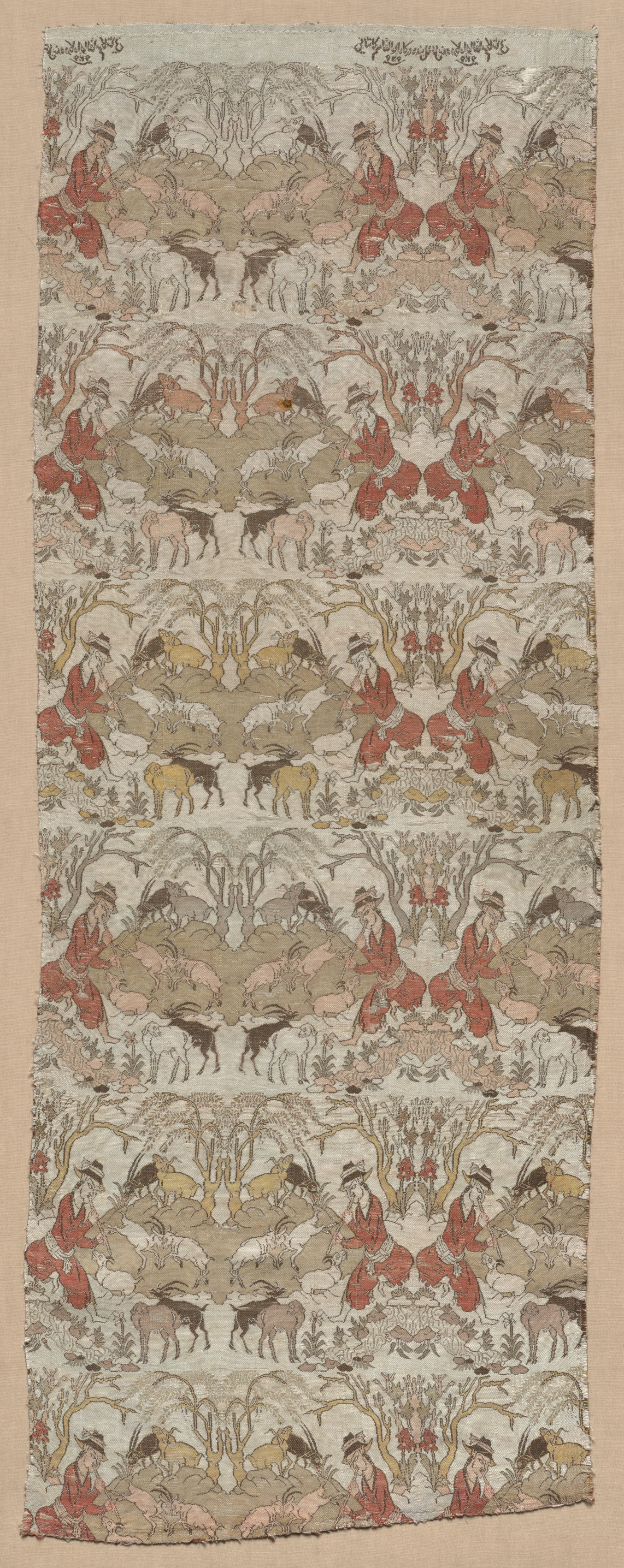
Deconstructing the Avant-Garde: A Technical and Aesthetic Analysis of the Isfahan Silk-Goatherd Textile
Zoey Fashion Lab is pleased to present a comprehensive deconstruction of a singular textile artifact: a silk lampas weave from Isfahan, Iran, depicting goatherds in a pastoral landscape. This piece, distinguished by its technical complexity and conceptual resonance, serves as a pivotal "New DNA Strand" for avant-garde fashion design. The analysis below dissects its material, structural, and iconographic elements, demonstrating how this historical textile can inform a radical, forward-thinking aesthetic.
Technical Foundations: The Lampas Weave and Its Avant-Garde Potential
The primary structure—a silk lampas weave—is a compound weave that employs two warp systems and two weft systems to create a pattern. In this Isfahan example, the ground weave is typically a plain or twill, while the pattern is formed by a supplementary weft that floats on the surface. This technique allows for intricate, multi-colored designs with a distinct, raised texture. For the avant-garde designer, the lampas weave offers a tactile and visual interplay that can be exploited in garment construction. The surface floats can be intentionally abraded, cut, or manipulated to create a distressed, deconstructed effect, challenging the pristine finish often associated with luxury silk. This aligns with the avant-garde ethos of revealing the process of making, where the weave's internal logic becomes an external, expressive feature.
The lining, a twill tapestry with a double-locked structure, introduces a contrasting technical vocabulary. Twill tapestry, unlike the lampas, uses discontinuous wefts that are "locked" at the boundaries of color areas, creating a reversible fabric with a distinct, ribbed texture. The double-locked technique—where wefts are interlocked at each color change—ensures structural integrity while allowing for sharp, painterly transitions. In an avant-garde context, this lining can be recontextualized as an outer layer, its robust, utilitarian character juxtaposed with the silk's delicacy. The double-locked seams can be left exposed, serving as a structural statement that echoes the "deconstruction" of traditional garment assembly. This approach mirrors the work of designers like Rei Kawakubo, who often flips linings outward to expose the unseen architecture of clothing.
Iconography and Narrative: Goatherds in a Landscape as Avant-Garde Motif
The depicted scene—goatherds tending flocks in a stylized landscape—is a classic trope of Persian pastoral art, often symbolizing harmony between humanity and nature. However, from an avant-garde perspective, this narrative is ripe for subversion and recontextualization. The goatherd, traditionally a figure of rustic simplicity, can be reinterpreted as a symbol of transience and displacement. The landscape, with its rolling hills and stylized flora, becomes a backdrop for exploring themes of migration, ecological fragility, or the tension between the pastoral ideal and urban reality. The avant-garde designer might fragment the scene through asymmetric cuts, layered panels, or digital manipulation of the pattern, creating a disjointed narrative that mirrors contemporary anxieties. For instance, a single goatherd figure could be isolated and repeated across a garment, transforming a serene image into a haunting, repetitive motif.
The choice of silk as the primary material adds a layer of material semiotics. Silk, historically associated with luxury, status, and the Silk Road's cultural exchange, becomes a medium for critique. By using this precious fabric to depict a humble pastoral scene, the textile creates a dissonance between material and subject. This dissonance can be amplified in avant-garde design: a silk gown printed with the goatherd motif might be deliberately stained, torn, or patched, challenging the notion of silk as untouchable luxury. The double-locked twill tapestry lining further complicates this, as its robust, workmanlike quality contrasts with the silk's delicacy, suggesting a dichotomous identity—one that is both precious and durable, refined and raw.
The "New DNA Strand": Conceptual and Structural Implications
The reference to a "New DNA Strand" positions this textile as a generative source code for avant-garde fashion. In biological terms, DNA carries hereditary information that can be mutated and recombined to produce new forms. Similarly, this Isfahan textile's technical and iconographic elements can be extracted, mutated, and recombined to create novel design languages. For example:
- Structural Mutation: The lampas weave's surface floats can be cut and frayed to create a fringe that mimics the goatherd's staff or the landscape's grasses, integrating motif into material.
- Pattern Recombination: The twill tapestry's color blocks can be digitally extracted and reassembled into a new, abstract composition, losing the original figuration but retaining its chromatic DNA.
- Reverse Engineering: The double-locked seams can be replicated as decorative elements, their structural logic becoming a visible design feature that references the textile's origin.
This "DNA" approach aligns with the avant-garde's fascination with hybridity and transformation. The textile is not a static artifact but a living source of inspiration that can be deconstructed and reconstructed across multiple garments, collections, or even installations. For instance, a single garment might feature the lampas silk on the front and the twill tapestry on the back, creating a binary identity that shifts with movement. Alternatively, the goatherd motif could be laser-cut into the silk, leaving negative spaces that reveal the lining, thus creating a layered, dimensional narrative.
Avant-Garde Styling and Presentation
To fully realize the avant-garde potential of this textile, Zoey Fashion Lab proposes a deconstructed presentation. The garment—perhaps a long, asymmetrical coat or a sculptural dress—would feature the lampas silk as the primary fabric, but with deliberate cuts, tears, and patches that expose the twill tapestry lining. The goatherd motif could be fragmented and rearranged across the garment, with some sections printed in full color and others in monochrome or negative. The double-locked seams might be exaggerated and left raw, serving as structural ribs that echo the landscape's topography.
Accessories could include a scarf or wrap made from the twill tapestry alone, its robust texture contrasting with the silk's fluidity. Footwear might feature laser-etched patterns inspired by the goatherd's staff or the landscape's contours, extending the textile's DNA into three-dimensional forms. The overall aesthetic would be one of controlled chaos, where the historical textile's elegance is disrupted by avant-garde interventions, creating a garment that is both a tribute to its origins and a radical departure from them.
Conclusion: From Artifact to Catalyst
This Isfahan silk textile, with its lampas weave and double-locked twill tapestry lining, is far more than a historical artifact. It is a catalyst for avant-garde design, offering a rich vocabulary of technical and iconographic elements that can be deconstructed, mutated, and recombined. By treating its structure as a "New DNA Strand," Zoey Fashion Lab can generate garments that challenge conventional notions of luxury, narrative, and materiality. The goatherds in their landscape become symbols of transformation, their pastoral serenity subverted by the avant-garde's disruptive energy. In this analysis, we have seen how the lampas weave's surface floats, the twill tapestry's locked seams, and the pastoral motif's semiotic weight can be harnessed to create fashion that is not merely worn but experienced as a deconstructed, evolving text. This textile is a bridge between Isfahan's artisanal heritage and the future of fashion—a future where tradition is not preserved but reimagined through radical, material storytelling.