Deconstructing the Halberd: An Avant-Garde Analysis for Zoey Fashion Lab
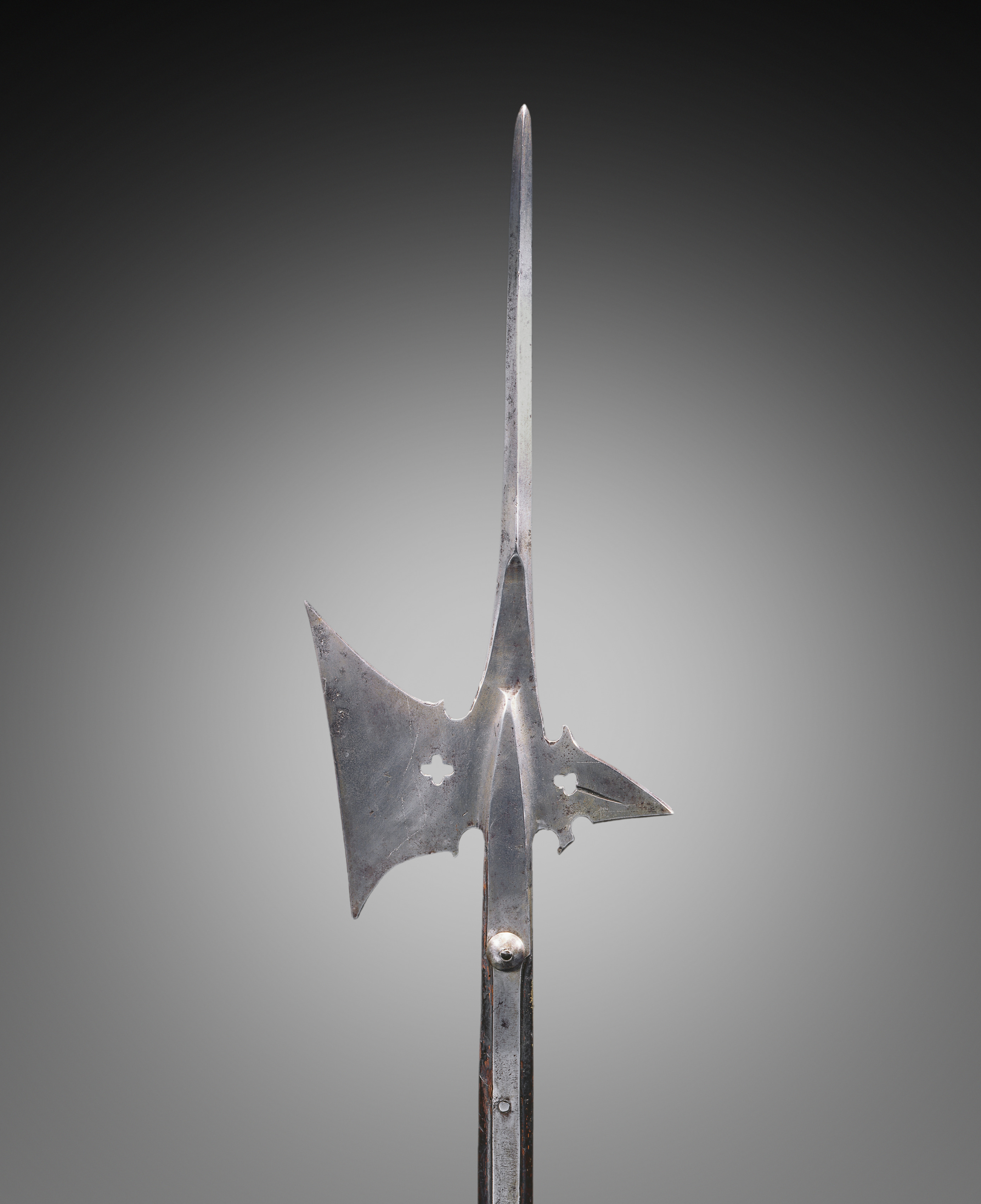
At Zoey Fashion Lab, our mission is to transcend traditional garment construction by reimagining historical artifacts as raw material for avant-garde design. The subject of this analysis—a German halberd, circa 15th century—presents a unique opportunity to explore the intersection of martial utility, medieval craftsmanship, and contemporary fashion ideology. Composed of a steel head featuring a pierced quatrefoil and mounted on a rectangular wood haft with planed corners, this weapon is not merely a relic of warfare but a structural and symbolic blueprint. By applying our signature deconstructionist methodology, we will dissect its technical elements, extract its DNA, and propose a new strand of avant-garde fashion that challenges conventional silhouettes, materiality, and narrative.
Technical Analysis: Steel and Wood as Structural Vocabulary
The halberd’s steel head is the focal point of its aggressive elegance. The pierced quatrefoil—a four-lobed cutout—serves both functional and aesthetic purposes. Historically, this perforation reduced weight while maintaining structural integrity, but for Zoey Fashion Lab, it represents a motif of negative space. In avant-garde design, voids are as critical as solids; they create visual rhythm, breathability, and a sense of incompleteness that invites reinterpretation. The steel’s cold, reflective surface contrasts with the warmth of the wood, offering a dialogue between hardness and organic texture. The rectangular wood haft, with its planed corners, introduces precision geometry. Unlike a rounded shaft, the planed edges create sharp angular lines, akin to tailored seams in a structured jacket. This detail suggests a deliberate human intervention—a hand that shaped the wood to fit a grip, much like a pattern cutter shapes fabric to a body.
From a deconstructionist perspective, the halberd’s components are not fixed. The steel head can be abstracted into a collar or shoulder piece, its quatrefoil transformed into a cutout on a leather bodice. The wood haft, stripped of its martial context, becomes a structural stay for a corset or a rigid spine for a coat. The planed corners, when translated into fabric, suggest sharp pleats or laser-cut edges that mimic the weapon’s precision. This technical analysis reveals that the halberd is not a single object but a system of parts—each capable of being detached, recontextualized, and woven into a garment’s architecture.
Historical and Symbolic DNA: From Battlefield to Runway
The halberd’s origin in Germany, particularly during the late medieval period, imbues it with a DNA of power, ceremony, and utility. It was a weapon of infantry, used to hook cavalry riders and pierce armor—a tool of both defense and offense. However, its pierced quatrefoil hints at a decorative sensibility that transcends pure function. This duality—brutality and ornamentation—is a rich vein for avant-garde fashion. The halberd’s DNA strand, as we define it, includes themes of verticality (the long haft), asymmetry (the blade’s offset shape), and layered aggression (the combination of spike, axe blade, and hook).
For Zoey Fashion Lab, this DNA translates into a new silhouette: elongated, with sharp, asymmetrical draping that mimics the halberd’s blade. The quatrefoil becomes a recurring cutout motif on sleeves or hems, while the planed wood haft inspires a rigid, columnar skirt or a structured trench coat. The weapon’s historical role as a symbol of authority (carried by guards and ceremonial officers) suggests a fashion narrative of empowerment and protection. Garments derived from the halberd would not be passive; they would assert presence, much like the weapon’s wielder. This symbolic DNA challenges the wearer to embody strength, precision, and a touch of medieval drama.
Material Translation: Steel and Wood in Fabric and Form
The halberd’s materials—steel and wood—are traditionally non-textile, but our deconstruction process reimagines them through a textile lens. Steel’s properties—rigidity, reflectivity, and coldness—can be approximated with liquid metallic finishes on leather or coated nylon, or with metal mesh inserts that echo the quatrefoil’s perforation. The wood’s grain and texture inspire jacquard weaves with linear patterns, or corsetry boning made from sustainable bamboo or resin that mimics the haft’s planed edges. The rectangular shape of the haft suggests a modular approach: panels of fabric that are stiffened and joined at sharp angles, creating a garment that stands away from the body, like armor.
In practice, a Zoey Fashion Lab halberd-inspired collection might feature a steel-blue silk taffeta gown with a quatrefoil cutout at the sternum, supported by internal boning that mimics the haft’s geometry. A structured wool coat could have planed lapels that echo the wood’s corners, while the sleeves terminate in pointed cuffs reminiscent of the blade. The pierced quatrefoil could be laser-cut into leather gloves or a belt, creating a motif that unites the collection. The wood haft’s rectangular cross-section inspires a boxy, architectural shoulder line, contrasting with the fluidity of the steel-inspired fabrics. This material translation respects the halberd’s essence while pushing it into the realm of wearable art.
Avant-Garde Interpretation: The New DNA Strand
The reference to a New DNA Strand in our analysis is central to Zoey Fashion Lab’s philosophy. We do not simply copy historical forms; we extract their genetic code—the underlying principles of structure, proportion, and meaning—and recombine them into something unprecedented. The halberd’s DNA strand is composed of three core elements: piercing (the quatrefoil), linearity (the haft), and asymmetrical force (the blade). When woven together, these produce an avant-garde aesthetic that is both aggressive and refined.
For example, a deconstructed halberd dress might feature a single, exaggerated sleeve that extends into a blade-like point, while the opposite side is bare, creating imbalance. The quatrefoil is repeated as a cutout along the spine, revealing the skin in a pattern that suggests vulnerability and strength. The haft’s planed corners are translated into a series of sharp, horizontal seams across the bodice, breaking the vertical line and adding tension. This garment does not reference the halberd literally but embodies its spirit: a confrontation between form and function, history and future.
In conclusion, the German halberd is not a static artifact but a dynamic source code for avant-garde fashion. Its steel and wood, pierced quatrefoil, and planed corners offer a vocabulary of negative space, angular precision, and martial elegance. By deconstructing its technical, historical, and material DNA, Zoey Fashion Lab can create garments that are not merely inspired by the past but are active participants in a new fashion narrative. The halberd becomes a blueprint for power dressing, reimagined through a contemporary, deconstructionist lens—a true new strand in the evolution of style.