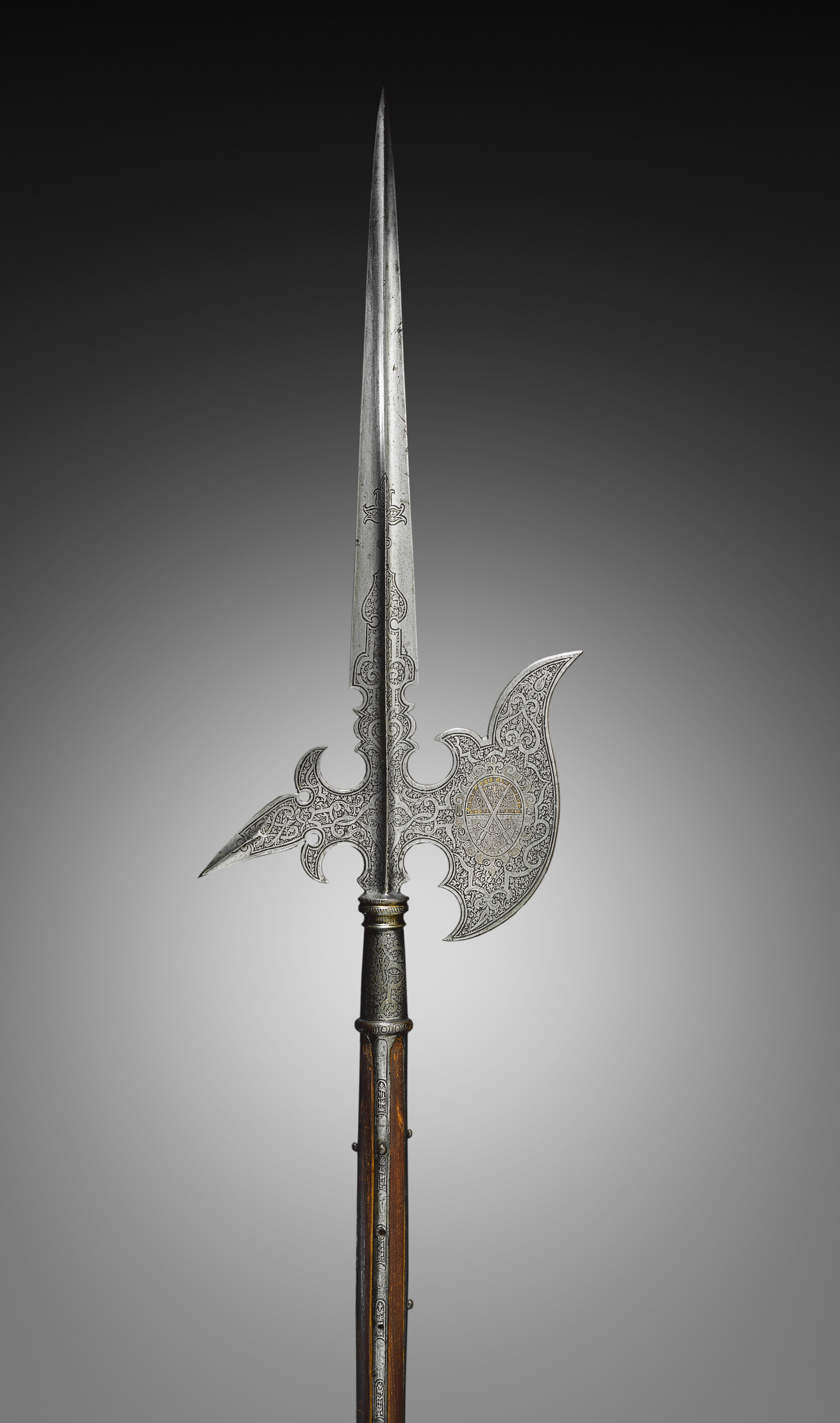
Deconstructing the Parade Halberd: An Avant-Garde Analysis for Zoey Fashion Lab
At Zoey Fashion Lab, the role of the Chief Fabric Deconstructionist extends beyond textiles. We dissect artifacts, not merely as historical objects, but as repositories of structural logic, material tension, and performative identity. The subject of this analysis—the Parade Halberd from the state guard of Elector Christian I of Saxony (late 16th Century, Germany, Saxony)—is a weapon of state, a symbol of authority, and a masterpiece of metallurgical craft. Yet, for the avant-garde eye, it is a proto-deconstructive garment, a blueprint for challenging silhouette, function, and ornament. This analysis will extract its core DNA strands: axial tension, gilded aggression, and ritualized weight, and recontextualize them for a future-facing fashion paradigm.
Strand One: Axial Tension – The Haft as Spine and Silhouette
The halberd’s defining feature is its vertical axis. The round wood haft, approximately 1.8 to 2 meters in length, is not merely a handle; it is the spine of the object. In traditional fashion, the spine is internal, supporting fabric. Here, the spine is externalized, exposed, and functional. For the avant-garde, this suggests a radical rethinking of the human form. The halberd’s haft becomes a wearable exoskeleton, a rigid, linear counterpoint to the soft, flowing curves of the body.
Consider the structural logic: the haft is a single, uninterrupted line that dictates the weapon’s balance and reach. In a garment, this translates to a monolithic central seam or a vertical structural element—perhaps a metal rod or a stiffened fabric tube—that runs from the nape of the neck to the floor. This is not a corset, which constricts; it is a spatial anchor that forces the wearer to move in a deliberate, processional manner. The roundness of the wood, tactile and organic, contrasts with the sharp, geometric steel head. In fabric, this could be echoed through a tubular, ribbed knit or a padded, cylindrical collar that extends downward, creating a silhouette that is both architectural and fluid.
The deconstructionist insight lies in the relationship between the haft and the hand. The halberd is held, not worn. But what if the haft were integrated into the garment? Imagine a coat where the right sleeve is replaced by a long, polished wood rod, ending in a steel tip. The wearer’s arm would be sheathed within, the hand emerging at the base to grip a secondary element. This blurring of tool and clothing is a hallmark of avant-garde design, challenging the passive nature of dress. The halberd’s haft becomes a prosthetic limb, a declaration of power through extension.
Strand Two: Gilded Aggression – The Etched Steel as Embellishment and Armor
The steel head of the halberd is not purely utilitarian. It is gilded and etched, a process that transforms cold metal into a canvas of prestige. The etching, likely depicting scrollwork, foliage, or heraldic motifs, is a form of surface narrative. For the avant-garde, this is a direct analog to digital or hand-embellished textiles. The gilding—a thin layer of gold—introduces a luminous, reflective quality that contrasts with the matte, dark steel. This is a lesson in dichotomy of materials: the aggressive, functional shape is softened by precious decoration.
In fashion, this translates to armored panels that are not merely protective but ornamental. Imagine a jacket where the shoulders and chest are constructed from laser-cut steel plates, each etched with a unique pattern, then highlighted with gold leaf. The weight and rigidity of the steel would create a sculptural silhouette, forcing the fabric beneath to drape in tension. The halberd’s head is a composite of shapes: the axe blade for chopping, the spike for thrusting, the hook for pulling. These disparate functions are unified in a single, elegant form. Similarly, a garment could feature detachable or modular elements—a collar that becomes a hood, a sleeve that converts into a cape—each etched with its own symbolic pattern.
The deconstructionist move is to expose the process. The etching is a removal of material, a negative space. In fabric, this could be achieved through cutwork, laser-cut perforations, or burnout velvet, where the pattern is created by dissolving fibers. The gilding, too, can be deconstructed: instead of a uniform gold layer, apply gold foil in fragmented, irregular patches, suggesting wear, age, or incomplete ritual. This honors the halberd’s history while subverting its perfection.
Strand Three: Ritualized Weight – The Object as Performance
The Parade Halberd was never intended for battle. It was a ceremonial object, carried in processions, displayed in court. Its weight—approximately 2.5 to 3.5 kilograms—was a physical burden that demanded a specific posture and gait. This ritualized weight is the third DNA strand. In an era of lightweight, fast fashion, the avant-garde re-embraces heft as a signifier of significance. A garment that is heavy forces the wearer to perform, to move with intention, to become part of a larger choreography.
For Zoey Fashion Lab, this suggests weighted garments that are not merely draped but suspended from structural frames. Imagine a floor-length skirt made of chainmail or densely beaded fabric, its weight pulling the waistline downward, creating a vertical tension that echoes the halberd’s haft. The sound of such a garment—the clink of metal, the rustle of heavy silk—becomes part of the performance. The halberd’s head, with its sharp edges, also introduces a threat of injury. In fashion, this translates to sharp, projecting elements—spikes, blades, or rigid collars—that create a zone of personal space, a visual and physical boundary.
The deconstructionist perspective asks: what happens when the ritual is broken? What if the halberd is worn, not carried? The haft could be splintered and woven into a bodice, the steel head fragmented into a necklace or a belt. The weight becomes distributed across the body, no longer a single point of focus but a field of tension. This is the ultimate deconstruction: the weapon is no longer a tool of the state; it is a garment of the self, a personal armor against the mundane.
Synthesis: The Avant-Garde Halberd Garment
From these three strands—axial tension, gilded aggression, ritualized weight—we can synthesize a prototype garment for Zoey Fashion Lab. Imagine a floor-length coat constructed from a single, continuous panel of heavy, black wool, lined with gilded steel mesh. The coat is asymmetrically closed by a series of etched steel clasps, each shaped like a miniature halberd head. The left sleeve is replaced by a polished wood rod, extending beyond the hand, tipped with a gold-leafed spike. The right sleeve is voluminous, gathered at the wrist with a chainmail cuff. The collar is a tall, rigid steel ring, etched with a repeating pattern of the Saxon coat of arms. The hem is weighted with lead beads, causing the coat to fall in a straight, vertical line, echoing the halberd’s haft.
This garment is not clothing; it is architecture for the body. It is a deconstructed weapon, a ritual object, and a statement of power. It challenges the wearer to move with deliberation, to accept the burden of history, and to perform the role of the modern elector—a sovereign of the self in a world of fleeting trends. The Parade Halberd, through the lens of avant-garde fashion, becomes a new DNA strand, a blueprint for garments that are not worn but inhabited.