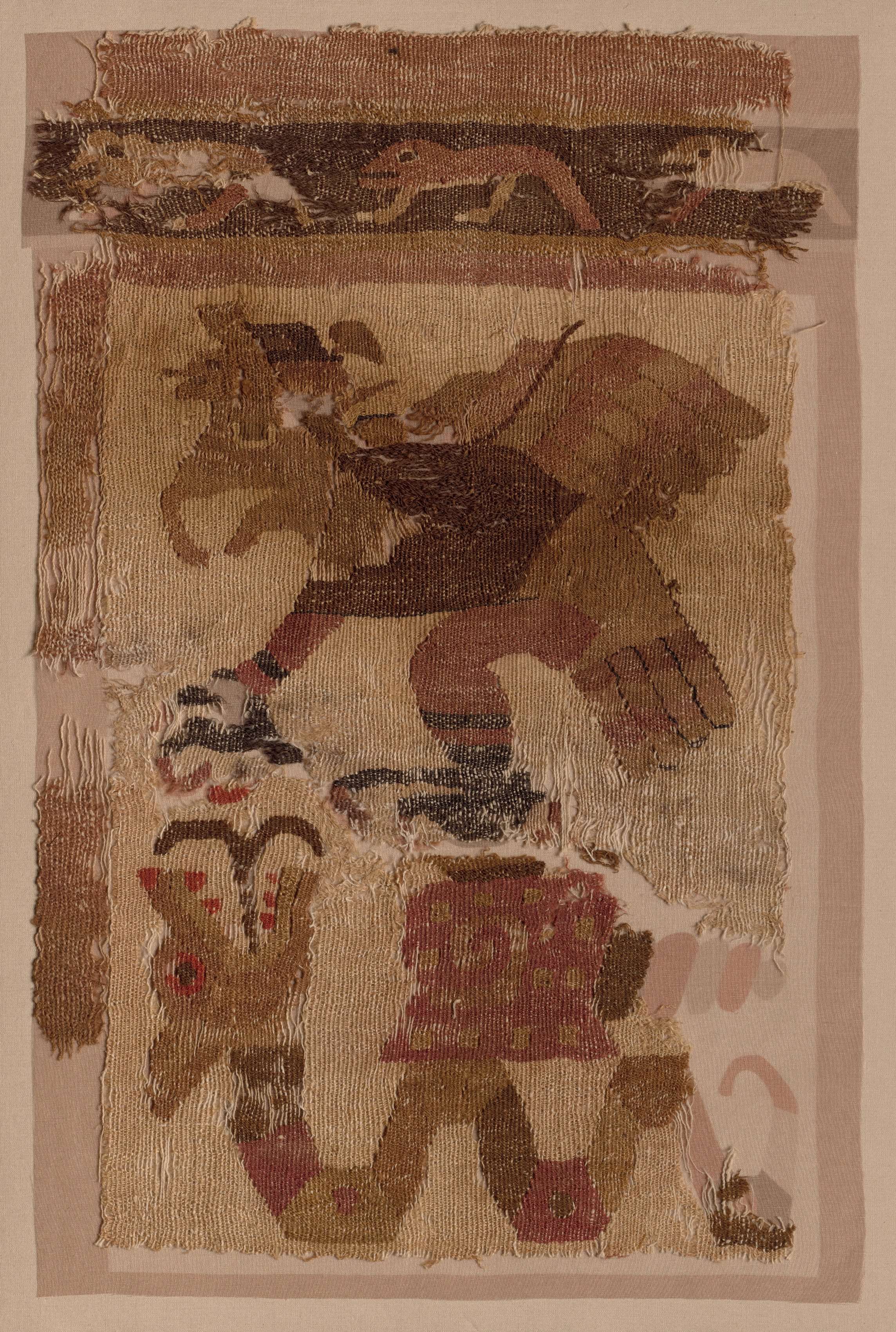
Deconstructing the Moche Fragments: An Avant-Garde Analysis for Zoey Fashion Lab
The textile fragments from the Moche culture of Peru’s north coast, crafted from cotton and camelid fiber, represent far more than archaeological remnants. They are a resonant archive of pre-Columbian ingenuity, a tactile record of a society that mastered fiber technology and symbolic communication. For Zoey Fashion Lab, these fragments are not relics to be preserved under glass, but raw material for deconstruction and reinvention. In the spirit of the avant-garde, we must strip away the historical patina and examine the core structural, textural, and conceptual elements that can be recontextualized into a radical, contemporary aesthetic.
Structural Integrity and the Logic of Fragmentation
The Moche weavers achieved remarkable structural complexity using only backstrap looms. The interplay of cotton—a locally domesticated, absorbent, and breathable fiber—with camelid fiber—from alpaca or llama, prized for its warmth, luster, and natural color range—created a dialectic of tactile opposites. Cotton provided a soft, matte ground; camelid fiber offered a resilient, often glossy, accent. This binary is the first point of avant-garde extraction.
Zoey Fashion Lab can amplify this inherent tension by deliberately fragmenting the textile’s original logic. Instead of respecting the warp and weft as a unified plane, we propose a deconstruction of the weave itself. Imagine garments where cotton panels are left raw-edged and loosely stitched, while camelid fiber elements are extracted and re-embroidered as chaotic, biomorphic lattices that resemble both Moche iconography and digital glitch aesthetics. The fragment is not a sign of decay, but a generative principle—a way to expose the structural bones of the cloth. By isolating single threads or small woven patches, we can create translucent, skeletal garments that reveal the body in motion, echoing the Moche’s own fascination with anatomical representation in their ceramics.
Material Alchemy: Cotton and Camelid as Avant-Grade Substrates
The Moche’s material choices were deeply functional—cotton for everyday wear, camelid for ritual and elite garments. In the avant-garde lexicon, these fibers become subversive agents. Cotton, often associated with comfort and utility, can be re-engineered as a canvas for distress. Think of garments where cotton is chemically treated, burned, or shredded to create organic, scar-like textures, mimicking the coastal desert’s erosion patterns. This is not destruction for its own sake, but a narrative of time and decay—a commentary on the fragility of all material culture.
Camelid fiber, conversely, offers a lush, almost animalistic sensuality. In the lab, we can felt and full this fiber into dense, sculptural forms that contrast with the cotton’s ephemerality. Imagine a cape where camelid fiber is needle-felted into three-dimensional, crustacean-like plates, referencing the Moche’s marine iconography (crabs, sea lions, fish), but rendered in a monochrome palette of undyed blacks, browns, and whites. The result is a wearable artifact that feels both ancient and futuristic—a hybrid of textile and armor, soft yet impenetrable.
Archive Resonance: The 16th-17th Century Interference
Your reference to the 16th-17th century as a period of cultural collision and aesthetic fusion is crucial. This era witnessed the violent encounter between Andean textile traditions and European iconography, resulting in hybrid forms like the tocapu (Inca geometric designs) merged with Christian symbols. For Zoey Fashion Lab, this historical moment is a blueprint for deliberate anachronism. We can simulate this collision by layering Moche fragment motifs with digital-age interventions.
For instance, take a fragment featuring the Moche “Aí Apaec” (the Decapitator) or a geometric wave pattern. Instead of reproducing it faithfully, we can digitally distort the pattern using algorithms that mimic both colonial transcription errors and modern pixelation. This distorted image is then jacquard-woven into a new textile that combines cotton and camelid fiber with metallic or synthetic threads—a direct reference to the European introduction of silk and metal threads in the 16th century. The resulting fabric is a palimpsest of histories: the Moche’s original symbolism, the colonial misinterpretation, and the contemporary digital gaze. The garment becomes a wearable archive, but one that is intentionally corrupted, questioning the authenticity of any historical narrative.
Avant-Garde Silhouettes: From Fragment to Form
The Moche fragments themselves are often irregular, torn, and incomplete. This inherent asymmetry is a gift to avant-garde design. Zoey Fashion Lab can reject the symmetrical, tailored forms of Western fashion and instead embrace asymmetrical draping, deconstructed seams, and non-linear hemlines. Imagine a dress constructed from multiple, unconnected panels of cotton and camelid fiber, held together by visible, oversized stitching in contrasting thread—a technique that references both Moche mending practices and contemporary boro (Japanese patchwork).
Another silhouette could be inspired by the Moche huaco (ceramic vessels), which often have bulbous, organic forms. We can translate this into voluminous, cocoon-like shapes using camelid felt that is heat-shrunk and molded over body forms. These pieces are not meant to be worn in a conventional sense; they are sculptural interventions that transform the wearer into a living artifact. The cotton fragments, meanwhile, can be used as internal linings or visible underlayers, their raw edges creating a sense of exposure and vulnerability—a stark contrast to the protective, felted exterior.
Color and Surface: The Monochrome of the Desert and the Sea
The Moche palette was limited by natural dyes: indigo for blues, cochineal for reds, and various minerals for yellows and browns. The natural colors of camelid fiber—from cream to deep brown—also played a key role. For an avant-garde collection, we can strip this palette to its extremes. Imagine a monochrome collection where every piece is undyed, relying solely on the natural spectrum of cotton and camelid fiber. This creates a textural, rather than chromatic, contrast—a minimalist approach that forces the viewer to focus on weave, density, and surface manipulation.
Alternatively, we can introduce a single, jarring color—a fluorescent magenta or a synthetic cyan—as a deliberate anachronism. This color could be applied through digital printing onto cotton fragments, creating a stark visual rupture that echoes the colonial insertion of European dyes into Andean textiles. The camelid fiber remains untouched, preserving its natural, earthy tones, while the cotton becomes a canvas for contemporary, almost neon, intervention. This is not about harmony, but about dissonance as a creative force.
Conclusion: The Fragment as Future
The Moche textile fragments are not a dead past; they are a living blueprint for a new material language. For Zoey Fashion Lab, the avant-garde is not about rejecting history, but about deconstructing it to release its latent potential. By treating the cotton and camelid fiber as active agents of structural and symbolic disruption, we can create garments that are at once archaeological and futuristic, tactile and conceptual. The fragment becomes a unit of resonance—a small, incomplete piece that contains the seed of an entire, radical aesthetic. Through this process, we honor the Moche not by preserving their work, but by continuing their tradition of material innovation in a language that speaks directly to the 21st century’s fragmented, collaged, and hybridized identity.